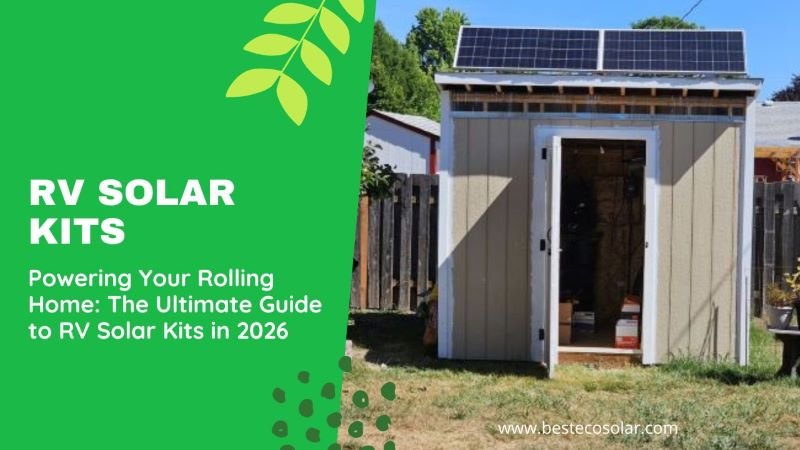
Powering Your Rolling Home: The Ultimate Guide to RV Solar Kits in 2026
Ever sat in a breathtakingly remote campsite, surrounded by nothing but nature’s silence, only to have the anxiety of your RV battery dying slowly crush your peace? Or felt the invisible leash of a crowded, noisy RV park just because you needed to plug in?
RV Solar Kits – What if you could cut that cord for good? That’s the promise of an RV solar kit—your personal, portable power plant. It’s not just about electricity; it’s about liberation. In this guide, we’re going to dive deep into the world of RV solar kits. We’ll unpack the jargon, compare your options, and give you the knowledge to confidently harness the sun. So, buckle up! We’re about to turn you from a power-dependent camper into a self-sufficient, sun-chasing nomad.
Why Go Solar? The Unplugged Revolution
 Let’s start with the “why.” Why are thousands of RVers making the shift to solar? Imagine your RV’s electrical system as a wallet. When you’re hooked up to “shore power,” it’s like having a limitless credit card. But when you’re boondocking or dry camping, you’re running on the cash in your wallet—your batteries.
Every light you switch on, every fan you run, and every phone you charge spends that cash. Traditional charging methods—running a loud generator or driving to the nearest hookup—are like finding an ATM: inconvenient, often costly, and they break your immersion in nature.
An RV solar panel kit flips the script. It’s a steady, silent side hustle that constantly puts cash back in your wallet. It’s clean, quiet, and after the initial setup, remarkably cheap to run. The sun, last I checked, doesn’t send a monthly bill. This isn’t just a tech upgrade; it’s a lifestyle upgrade, granting you the freedom to camp where you want, for as long as you want.
The Heart of the System: What’s Inside an RV Solar Kit?
An RV solar power setup might seem like a mysterious black box, but it’s really just a team of components working in harmony. Think of it like a rainwater harvesting system for your roof: you need panels (gutters) to collect, a charge controller (a filter and flow regulator) to manage, batteries (a storage tank) to hold, and an inverter (a faucet/pump) to use the water on demand.
1. Solar Panels: Your Sun Catchers
These are the workhorses, the face of your operation. You’ll typically find three types in complete solar kits for RVs:
- Monocrystalline: The premium, high-efficiency option. They’re darker in color, perform better in lower light, and are more space-efficient. Perfect if your roof real estate is limited.
- Polycrystalline: The value champion. They have a bluish hue and slightly lower efficiency, but are more affordable. Great for larger roofs where you can spread out more panels.
- Flexible Panels: The sleek, low-profile option. They glue directly to your roof, adding almost no height or wind resistance. Efficiency and longevity can be a trade-off, but they’re ideal for aesthetics and low-clearance vehicles.


2. The Charge Controller: The Brain of the Operation
This is your system’s guardian angel. It takes the raw, variable power from the panels and safely converts it into a charge that your batteries can digest. There are two main types:
- PWM (Pulse Width Modulation): The simpler, budget-friendly option. It’s like connecting the panels directly to the battery through a smart on/off switch. It works, but it’s less efficient, especially on cloudy days.
- MPPT (Maximum Power Point Tracking): The undisputed champion for RV solar setups. Think of it as a sophisticated translator and negotiator. It constantly finds the optimal voltage to draw the absolute maximum power from your panels, often providing 20-30% more harvest than PWM, particularly in cold or sub-optimal light.
3. The Battery Bank: Your Power Pantry
This is where your harvested sunshine lives. The technology here is evolving fast.
- Lead-Acid (AGM): The old reliable. They’re affordable and familiar but have a limited “usable” capacity (you can only drain them to about 50% without damage) and a shorter lifespan.
- Lithium (LiFePO4): The game-changer for modern off-grid RV solar systems. They’re lighter, can be discharged nearly 100%, last 5-10 times longer, and charge much faster. While the upfront cost is higher, their performance and longevity make them the go-to choice for serious boondockers.


4. The Inverter: Making Power Usable
Your batteries store DC (Direct Current) power, like what your car’s 12V outlets provide. But your laptop, coffee maker, and TV need AC (Alternating Current)—the kind from a wall socket. The inverter is the magician that performs this conversion. You’ll choose one based on the wattage of the appliances you want to run simultaneously.
Sizing Your Solar Arsenal: How Much Power Do You Really Need?
This is the million-dollar question. An undersized system leaves you frustrated; an oversized one hits your wallet unnecessarily. Sizing your DIY RV solar power system is a three-step dance: Audit, Analyze, Assemble.
Step 1: The Energy Audit (Know Your Habits)
Grab a notebook. For a few days of typical use, list everything you power: lights (LEDs vs. halogens matter!), fans, water pump, fridge (on LP or electric?), electronics, and any occasional “luxuries” like a blender or instant pot. Note their wattage and how many hours you use them per day. This isn’t about deprivation; it’s about awareness.
Step 2: Crunch the Numbers
Here’s a simplified example:
- LED Lights (20W) x 5 hours = 100 Watt-hours (Wh)
- Roof Fan (50W) x 8 hours = 400 Wh
- Laptop (60W) x 3 hours = 180 Wh
- Water Pump (40W) x 1 hour = 40 Wh
- Total Daily Usage: 720 Wh
This means you need your solar kit for motorhome to replenish at least 720 Watt-hours into your batteries every day.
Step 3: Factor in Reality: The Sun Isn’t Always Perfect
You have to account for inefficiencies, cloudy days, and less-than-ideal sun angles (often called “Sun Hours”). A good rule of thumb for a four-season system is to divide your daily Wh need by 3 (a conservative average of peak sun hours). Then, add a 20-30% buffer for future expansion or less-sunny locales.
Using our example: 720 Wh / 3 Sun Hours = 240 Watts of solar panels minimum. With a buffer, a 300W-400W RV solar panel kit would be a robust starting point for this usage.


Installation: DIY Adventure or Professional Job?
Can you install an RV solar kit yourself? Absolutely. Many kits are designed for savvy DIYers. The process involves mounting panels, running wires through conduit, connecting to the charge controller and batteries, and grounding the system. It requires basic tools, patience, and careful attention to electrical safety (fuses and breakers are non-negotiable!).
When to call a pro? If the thought of drilling into your roof gives you hives, if your electrical system is complex, or if you want a warranty on the labor, professional installation is a wise investment. It ensures everything is weatherproof, secure, and up to code.

Maintenance: Keeping Your Sun Factory Humming
One of the beautiful aspects of RV solar setups is their simplicity. Maintenance is minimal:
- Panel Cleaning: A quick wipe with a soft cloth and water every few months to remove dust, pollen, and bird droppings. Clean panels are happy panels.
- Connection Checks: Periodically inspect wire connections for corrosion or looseness, especially after rough travel.
- Battery Care: For lead-acid, check water levels. For lithium, ensure your charge controller is set to the correct battery profile.
RV Solar Kits Cost Analysis: Investment vs. Endless Payoff
Let’s talk numbers. A robust, complete DIY solar kit for RV—including 400W of panels, an MPPT controller, wiring, and mounting hardware (but not batteries)—can range from $800 to $1,500. Adding a quality 100Ah lithium battery might be another $800-$1,000.
Compare this to the alternatives: Generator fuel costs ($3-$5/hour of runtime), nightly RV park fees (anywhere from $30 to $80), or the priceless value of being able to camp for free on public lands for weeks. The payoff isn’t just financial; it’s the payoff in serenity and freedom. For many, the system pays for itself in one or two seasons of serious travel.
Panel Technology Comparison at a Glance
| Feature | Monocrystalline Panels | Polycrystalline Panels | Flexible Panels |
|---|---|---|---|
| Efficiency | High (18-22%) | Moderate (15-17%) | Moderate to High (16-20%) |
| Space Efficiency | Excellent | Good | Excellent (conforms to the roof) |
| Cost | Higher | Lower | Highest |
| Durability | Very High (rigid frame) | Very High (rigid frame) | Good (can be prone to degradation) |
| Best For | Limited roof space, max output | Larger roofs, budget-conscious builds | Low-clearance RVs, curved roofs, stealth looks |
| Weight | Heavy | Heavy | Very Light |

Looking Ahead: The Future of RV Solar is Bright
The trends for 2024 and beyond are exciting. We’re seeing more efficient panels (pushing past 23% efficiency), smarter all-in-one solar kits for RVs that integrate the controller and inverter, and a continued drop in lithium battery prices. The integration of solar with other systems, like DC-powered air conditioners and app-based monitoring, is making off-grid living more comfortable and manageable than ever.
Conclusion
Embracing an RV solar kits is more than a purchase; it’s a declaration of independence. It’s choosing sunsets over sewer hookups, bird songs over generator hums, and the open road over the crowded park. It demystifies your power needs and puts you in control.
Whether you start with a simple 100W portable suitcase to top up your batteries or go all-in with a roof-mounted, lithium-backed powerhouse, you’re taking a step toward a more sustainable, liberated, and deeply fulfilling way to roam. The sun is up there, offering its energy freely. All you need is the right kit to catch it. So, what are you waiting for? Your next great adventure, fully powered, is just a sunrise away.
FAQs
This is the holy grail, but it's a major power challenge. A standard rooftop AC requires 1500-3500 watts to start and 500-1500 watts to run. To do this off-grid with solar, you'd need a very large system (1000W+ of panels, a substantial lithium bank, and a large inverter), and even then, you'd likely need bright, sustained sun. Most use solar to reduce generator runtime for AC, not eliminate it entirely. Yes, but at a significantly reduced rate. Think of it like a sunburn on a cloudy day—UV still gets through. High-quality panels, especially with an MPPT controller, can still harvest 10-25% of their rated power in diffuse light. It's why proper battery sizing for multiple "no sun" days is crucial. Most rigid solar panels are rated to withstand hail up to 1 inch in diameter at 50+ mph. For peace of mind, check the panel's IEC/UL ratings. Theft is a concern for portable panels left outside; always secure them with a cable lock. Roof-mounted panels are generally safe, as they're permanently fastened and hard to access. Flat mounts (lying flush on your roof) are the "set it and forget it" approach and work fine. You lose about 20-30% efficiency compared to panels tilted at the optimal angle. Many RVers use portable panels that they can tilt or use simple, manually adjustable roof mounts for longer stays to boost harvest. Cold weather actually improves panel output (semiconductors love the cold!). The real challenge is the sun's lower angle and shorter days, reducing total harvest. Snow cover is a bigger issue—a covered panel produces nothing. The weak link is often the battery: lead-acid batteries lose a huge amount of capacity in freezing temperatures and can be damaged if charged when cold. Lithium batteries perform better in cold weather but usually have an internal heater and require a special "cold weather" charging profile to operate safely below freezing.Can I run my RV air conditioner solely on a solar kit?
Will my solar panels charge on cloudy or rainy days?
How do I protect my solar investment from hail or theft?
Do I need to adjust my panels to face the sun, or are flat mounts okay?
How does winter/cold weather affect my RV solar system?


You Might Also Like