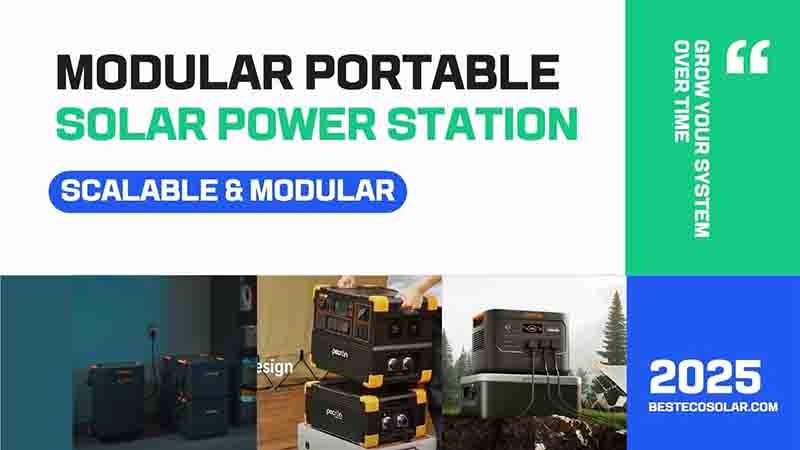
Scalable & Modular Portable Solar Power Stations: Grow Your System Over Time
Modular Portable Solar Power Station – Imagine you’re on day three of a camping trip, and your cooler, phones, and camp lights have drained your traditional power station. With a conventional unit, you’d be in the dark—literally. But with a modular portable solar power station, you’d simply connect an extra battery module and harness the sun to keep everything running. This isn’t just convenience; it’s energy independence.
In 2025, our relationship with power is transforming. We’re no longer satisfied with bulky, one-size-fits-all power solutions. Instead, a revolution in modular portable solar power stations is empowering outdoor enthusiasts, homeowners, and remote workers to build a custom power ecosystem that grows with their needs.
This comprehensive guide will unpack everything you need to know about this game-changing technology, helping you make an informed decision about how you harness and use energy.
What Exactly is a Modular Portable Solar Power Station?
Let’s break down the jargon. A modular portable solar power station is a system where the core components—typically the power station (inverter/controller), battery packs, and solar panels—are separate units that connect together. Think of it like building blocks for electricity. You start with a central unit that houses the outlets, controls, and brains of the operation.
Then, you can stack, link, or plug in additional battery packs to increase your energy storage (measured in watt-hours, or Wh).
This is a stark contrast to all-in-one power stations, which have a fixed capacity. If you need more power, you have to buy a completely new, larger (and often more expensive) unit. Modularity gives you the freedom to start with an affordable base system and expand your capacity over time, making it an incredibly smart and adaptable approach to off-grid power.

Why 2025 is the Breakout Year for Modular Portable Solar Power Station?
The demand for these systems is exploding, and it’s no wonder. The market for portable power is projected to hit a staggering $4.41 billion in 2025, and a significant driver of this growth is the desire for flexible, clean power. But why now?
We’re living in a world of increasing climate uncertainty, with aging power grids and a collective push towards eco-friendly choices. People are ditching loud, fume-spewing gas generators for silent, zero-emission solar power. Furthermore, our lives are more mobile than ever.
The rise of remote work and digital nomadism means we need reliable power that can adapt to life on the road, at a campsite, or in a home office during an outage. Modular systems are perfectly poised to meet this moment, offering a blend of customisation, scalability, and clean energy that fixed systems simply can’t match.


Unpacking the Key Benefits: Why You’ll Love a Modular System
The “modular” concept isn’t just a buzzword; it translates into real, tangible advantages that change how you interact with your power source.
1. Scalability: Power That Grows With You
This is the superstar feature. Are you a weekend camper who mostly needs to charge phones and a speaker? Start with a single base unit. Later, if you buy a portable fridge or need to power a project site, you can invest in expansion batteries to double, triple, or even quintuple your capacity without replacing your initial equipment. Brands like OUPES offer systems that can scale from a base 1024Wh to an impressive 5kWh, enough to power essential home appliances during an outage.
2. Unmatched Customisation and Flexibility
Your power needs aren’t static, so why should your power station be? Modular portable power stations let you tailor your setup for every scenario.
- For Camping, keep it light with just the base unit and a small solar panel.
- For RV Life: Add high-capacity batteries and a large solar array for off-grid comfort.
- For Emergencies: Have a robust setup with multiple batteries on standby at home.
This “mix-and-match” philosophy ensures you’re never lugging around more or less power than you actually need.
3. Enhanced Reliability and Redundancy
In a traditional, all-in-one unit, if the battery fails, the entire system is a brick. With a modular design, if one battery module has an issue, you can simply remove it and continue operating with the remaining units. This built-in redundancy is crucial for emergency preparedness and remote applications where failure is not an option.
4. Future-Proofing Your Investment
Technology evolves rapidly. By investing in a modular ecosystem from a reputable brand, you’re not just buying a product for today; you’re buying into a platform for the next decade. As battery technology improves, you may be able to add newer, more efficient modules to your existing system, protecting your investment from premature obsolescence.
5. Long-Term Cost-Effectiveness
While the initial price of a modular base unit might be higher than a comparable all-in-one, the long-term value is superior. Instead of buying multiple fixed-capacity stations for different uses, you build one scalable system. This “pay-as-you-grow” model is kinder to your wallet and reduces electronic waste.

6. Must-Have Features in a 2025 Modular Power Station
When you’re shopping, don’t just look at the price tag. Keep an eye out for these critical features that define a high-quality system.
7. Advanced LiFePO4 Battery Chemistry
In 2025, Lithium Iron Phosphate (LiFePO4) batteries are the undisputed champion for portable power. They offer 3,000 to 6,000 charge cycles—far outperforming older lithium-ion batteries. This means you could use them daily for over a decade before noticing significant capacity loss. They are also more stable and safer, making them ideal for family use.


8. Smart Monitoring and App Control
Over 40% of power stations now feature smart capabilities. A companion app that lets you monitor battery level, input/output watts, and estimated runtime from your phone is no longer a luxury—it’s a necessity. Some advanced systems even offer weather-aware charge optimisation and remote control of outlets.
9. Rapid Solar Charging with MPPT
A solar power station is only as good as its ability to recharge quickly. Look for a high solar input rating (e.g., 1000W or more) and ensure the system has a built-in Maximum Power Point Tracking (MPPT) controller. This technology optimises the solar harvest, squeezing every possible watt from your panels, even in low-light conditions.
10. Multiple Charging Methods
The sun isn’t always available. The best systems offer versatile charging: from a wall outlet (often with super-fast AC charging), from your car’s 12V port, and, of course, from solar panels. This flexibility ensures you can always top up your power bank, no matter your situation.
11. A Diverse Array of Output Ports
Check the ports before you buy. A good station should be a universal power hub. Look for:
- AC outlets for standard appliances.
- USB-C with Power Delivery for fast-charging modern laptops and phones.
- Standard USB-A for older devices.
- 12V DC carports for coolers and other car accessories.
Some models even include innovative 15W wireless charging pads on top for ultimate convenience.

Where Will You Take Your Power? Top Applications
The beauty of a modular system is its incredible versatility. It’s the ultimate multi-tool for energy.
- Outdoor Adventures & Camping: Power your campsite without a whisper. Run LED lights, charge camera gear, and keep your portable fridge cold for days by scaling your battery bank with extra modules.
- Emergency Preparedness & Home Backup: When the grid goes down, your modular system becomes a lifeline. Keep phones, medical devices (like CPAP machines), routers, and critical lights running for extended periods.
- Remote Work & Digital Nomad Life: Turn any location into your office. Power your laptop, monitor, and Wi-Fi hotspot reliably. The scalability means you can support a full workstation setup without anxiety.
- RV and Marine Use: Replace noisy generators with silent, fume-free solar power. Modular systems can efficiently power appliances in your RV or on your boat, supporting a comfortable and sustainable mobile life.
Standout Models: A Quick Comparison
The market is rich with excellent options. Here’s a look at some of the top contenders that exemplify the modular philosophy.
| Model | Key Feature | Base Capacity / Expandable To | Ideal For |
|---|---|---|---|
| EcoFlow DELTA Pro Ultra X | End-to-End System Protection | 12kWh / 180kWh | Whole-Home Backup Power |
| EcoFlow DELTA Pro Ultra | Best Expandable Capacity | 6kWh / 90kWh | Whole-Home Backup Power |
| EcoFlow DELTA Pro 3 | Exclusive X-Boost technology allows the unit to exceed its rated output | 4kWh / 48kWh | Power high-demand appliances—from 3-ton*central AC to 1 HP water pump |
| BLUETTI Apex 300 | Smartest 120V/240V Portable Power | 2.7kWh / 58kWh | Off-grid energy for home backup or outdoor use. |
| BLUETTI Pioneer 150 (AC240) | It’s reliable enough to keep your adventures smooth | 2,4kWh / 20kWh | Outdoor activities |
| Jackery Explorer 5000 Plus | 120V/240V Dual Voltage Enhances Compatibility | 5kWh / 60kWh | Home Backup Power |
| Jackery HomePower 3600 Plus | Powering a Family of 3 for over 2 Weeks | 3kWh / 21kWh | Home Backup Power |
| Pecron E3600LFP Power Station | boasting efficient energy conversion | 3kWh / 15kWh | regular outdoor and home emergency use |


Your Buyer’s Checklist: Choosing the Right System
Feeling overwhelmed? Walk through this simple checklist to find your perfect match.
- Audit Your Power Needs: List the devices you need to power and for how long. Add up their watt-hours to estimate your minimum capacity requirement.
- Prioritise Portability vs. Capacity: If you’ll be carrying it on hikes, weight is key. If it’s for a van or home backup, you can prioritise a larger, heavier capacity.
- Check the “Must-Have” Features: Confirm LiFePO4 battery chemistry, a good selection of ports, and a high-wattage solar input for future expansion.
- Research the Brand’s Ecosystem: Do they offer a wide range of compatible solar panels and expansion batteries? A strong ecosystem is a sign of a good long-term partner.
- Balance Budget with Future Plans: It’s often wiser to invest in a scalable base unit from a reputable brand, even if you can’t afford extra batteries immediately, than to buy a cheaper, non-expandable unit you’ll soon outgrow.
The Future is Bright and Scalable
Looking ahead, the trend towards modularity is only accelerating. We can expect even deeper integration with smart home systems, allowing your portable power station to automatically become a home backup source during an outage.
Battery energy densities will continue to improve, giving us more power in smaller, lighter packages. Furthermore, the rise of solar-ready power stations with seamless panel integration will make true energy independence more accessible than ever.
Conclusion: Power Your World, Your Way
Modular portable solar power station – The era of being tethered to the grid or limited by a fixed power supply is over. A modular portable solar power station is more than just a gadget; it’s a declaration of energy independence. It offers the freedom to explore further, work from anywhere, and protect your home with a clean, reliable, and customizable power source.
In 2025, there’s no need to adapt your life to the limitations of your equipment. Now, you can build a power system that adapts perfectly to you.
FAQs
- Can a modular solar power station really power my entire home during an outage?
While a single base unit might only power a few essentials, a fully expanded modular system can absolutely act as a whole-home backup. Systems like the Jackery Explorer 5000 Plus, when expanded to 60kWh, have the capacity to run critical circuits—like refrigeration, lights, and communication devices—for an extended period, making them a viable alternative to traditional gas generators. - How long does it take to recharge a large modular system using only solar?
Recharge time varies based on the battery capacity and the wattage of your solar panels. For example, a 2kWh station paired with 600W of solar panels might recharge in 3-4 hours of ideal sunlight. High-capacity systems can take a full day or more. Look for models with high solar input limits (e.g., 1500W or more) to enable faster recharging with a large solar array. - Are these systems reliable in cloudy or rainy weather?
Solar charging efficiency does drop on cloudy days, but it doesn’t stop completely. Modern panels can still generate 10-25% of their rated power in overcast conditions. This is where the modular capacity shines—having extra battery modules means you have a larger energy reserve to draw from when solar input is reduced, ensuring you have power through multiple days of bad weather. - What is the typical lifespan of a LiFePO4 battery in these stations?
LiFePO4 (Lithium Iron Phosphate) batteries are renowned for their longevity. Most quality manufacturers rate them for 3,000 to 6,000 charge cycles before the capacity degrades to 80% of its original state. In practical terms, this means you could use it daily for nearly a decade before noticing a significant reduction in runtime. - Is the higher initial cost of a modular system worth it compared to a traditional gas generator?
Absolutely. While the upfront cost is higher, a modular solar power station has zero fuel costs, requires almost no maintenance, operates silently, and produces no emissions. The “pay-as-you-grow” model also makes it more financially flexible over time. When you factor in the savings on fuel and maintenance, along with the environmental and quality-of-life benefits, the long-term value is overwhelmingly positive.

You Might Also Like