





Bluetti Apex 200 Review (2026): Specs, Price, Solar Speed, and Who Should Buy It
Big batteries are heavy, and that’s the whole problem. You want enough juice to keep the fridge alive through a two-day outage, but you don’t want a unit you need a friend and a hand truck to move. The Bluetti Apex 200 is Bluetti’s attempt at splitting that difference.
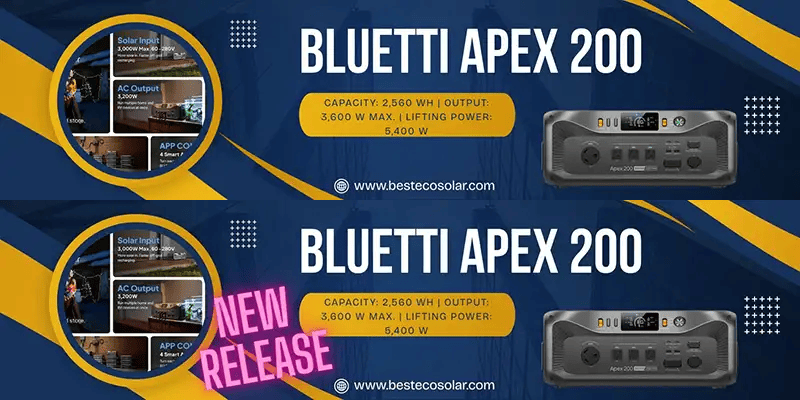
Bluetti Apex 200 Review: The Bluetti Apex 200 packs 2,560 Wh of LFP battery into a 59-pound box, pushes out 3.2kW to 3.6kW of AC power, and accepts up to 3kW of solar. It also scales to roughly 100kWh if you stack three units. It launched in the US in early November 2026 at $1,099 for the standalone unit during the opening window, and the regular price is $1,399.

What Is the Bluetti Apex 200?
Think of the Bluetti Apex 200 as the “little sibling who turned out surprisingly capable.” Bluetti announced it in late October 2026 and opened early access before the official launch. The company’s marketing director said the number one piece of feedback on the Apex 300 was that people loved the modular design but wanted something easier to manage day to day. The Apex 200 is the answer to that request.
It’s an expandable power station, meaning the base unit works alone but can grow. You can bolt on extra battery modules later, or even link several Apex 200 units together. That “start small, scale up” idea is the heart of the product. You’re buying an entry ticket, not a dead end.
Where It Sits in the Apex Family
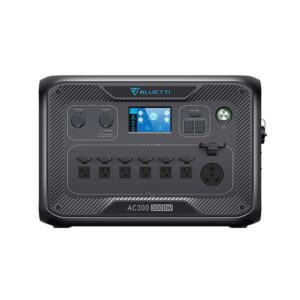
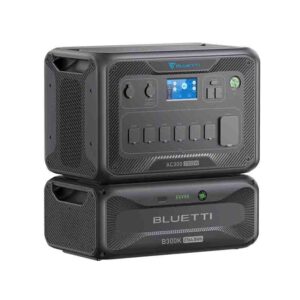
Bluetti’s lineup has been getting crowded, so a quick map helps. The Apex 300 is the heavier, 120V/240V flagship built for serious home backup. The Elite series sits below it as more traditional all-in-one stations. The Apex 200 slots in as the lighter, more movable Apex. It borrows the modular DNA of the Apex 300 but trades some muscle for portability.
How We Tested (and What We Couldn’t)
Let’s be straight with you, because trust matters more than hype. The Apex 200 only reached US buyers within the last few days, and our hands-on bench time with a retail unit is limited. So this review doesn’t pretend to include weeks of drain tests it didn’t run.
Here’s what we actually did:
- Spec verification. We cross-checked Bluetti’s official launch release, its product page, and independent launch coverage so no single number rests on one source.
- Runtime math. We built load estimates using a conservative 85% real-world efficiency assumption, the same rule of thumb we use for every power station.
- Apex 300 benchmarking. We compared figures against published Apex 300 data to see what changed and what didn’t.
- Use-case modeling. We mapped the specs onto three scenarios: a two-day outage, a weekend camping trip, and a van build.
Where a number is an estimate, we say so. Where it’s Bluetti’s claim, we say that too. Once we’ve logged our own charge and discharge tests, we’ll update this page with measured results.
Bluetti Apex 200 Specs at a Glance
Specs can be dull, but they’re where the truth lives. Here’s the Bluetti Apex 200 in one place.
| Spec | Bluetti Apex 200 |
|---|---|
| Battery capacity | 2,560Wh (LFP) |
| AC output | 3.2kW (up to 3.6kW with expansion or active charging) |
| Weight | 26.9 kg (about 59.3 lb) |
| Volume | 36.2 L |
| Solar input | Up to 3kW (2kW high-voltage MC4 + 1kW XT60) |
| MPPT voltage range (HV input) | 60V–280V |
| Solar charge time (with 3kW array) | 0–80% in ~50 min; 100% in ~1.7 hr |
| Output ports | 10, including TT-30R and 12V/30 A Anderson |
| Smart AC outlets | 4, individually controllable |
| UPS switchover | 15ms |
| Idle draw (AC on, display off) | 10.5W |
| Single-unit max capacity | 33.28 kWh (with up to six B500K batteries) |
| Parallel max | 3 units, 6kW and about 100 kWh |
| Launch price | $1,099 (regular $1,399) |
Notice the 70.7 Wh/L energy density Bluetti advertises. That’s a fancy way of saying the battery is packed tightly, and it’s a big reason the Apex 200 fits where bulkier stations can’t.
Design, Size, and Portability
Weight and Footprint
At roughly 59 pounds, the Bluetti Apex 200 is not a toss-it-in-the-trunk-with-one-hand gadget. It’s a two-hand carry, and you’ll feel it. But compare that to the Apex 300 at about 84 pounds, and the difference is real. Shaving more than 24 pounds off a power station changes who can move it and how often they’ll bother.
Picture lifting a full suitcase versus a suitcase plus a carry-on. Same trip, very different back.
The 36.2-liter body is compact enough to slide under RV dinette seating or into a pass-through storage bay. For apartment dwellers, it also means the unit can live in a closet instead of taking over a garage corner.
Ports and Outlets
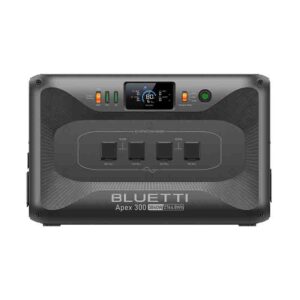
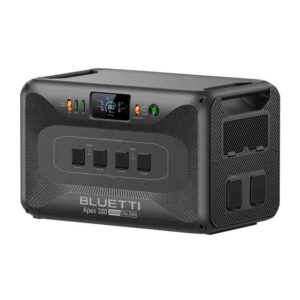
Ten output ports is a generous count. The headline additions are a native TT-30R, the 30A RV outlet, and a heavy-duty 12V/30A Anderson port. If you’ve ever wrestled with adapters in a cramped camper, you know why that matters. Plug the trailer cable straight in, and you’re done.
Bluetti Apex 200 Battery Capacity and Real-World Runtime
Capacity is the number everyone asks about first. Does 2,560Wh actually get you through a blackout?
What 2,560 Wh Actually Runs
No battery delivers 100% of its rated watt-hours to your devices. Inverter losses, standby draw, and heat all take a bite. Using an 85% efficiency assumption gives roughly 2,170 Wh of usable energy. Here’s what that looks like in rough, estimated terms:
| Device | Typical draw | Estimated runtime |
|---|---|---|
| Modern refrigerator (cycling) | ~100–150 W avg. | ~1.5–2 days |
| Wi-Fi router + modem | ~20W | ~100 hours |
| Laptop | ~60W | ~35 hours |
| LED lighting (several rooms) | ~50W | ~40 hours |
| 1,000W microwave | 1,000W | ~2 hours |
| Window AC unit | ~600W | ~3.5 hours |
| 1,500W space heater | 1,500W | ~1.4 hours |
The takeaway? The Bluetti Apex 200 handles “essentials mode” well. A fridge, a router, phones, lights, and a laptop—that’s a day or two of comfort. A space heater or air conditioner will drain it fast, which is true of every unit in this size class.
That’s also where the expansion batteries earn their keep. Bluetti says adding one or two B300K batteries can stretch essential home backup to two or three days. We’d treat that as a best-case figure that depends on your actual loads.
Solar Charging: The Bluetti Apex 200 Solar Input
If there’s one place the Apex 200 truly flexes, it’s solar. Up to 3kW of input across two independent channels is serious for a station this size. One channel takes up to 2kW through a high-voltage MC4 input with a 60V–280V MPPT range, and the other takes 1kW through an XT60 connector.
Why should you care about that 280V ceiling? Higher voltage lets you wire panels in series with thinner cables and less energy loss. It’s like moving water through a wide pipe instead of a garden hose. And in a long outage, solar is what turns a battery into a power plant.
Bluetti’s own figures, using an array of SORA 500 panels at full 3kW input, claim a 0–80% charge in about 50 minutes and a full charge in roughly 1.7 hours. Those are best-case, clear-sky, ideal-angle numbers. Real rooftops and cloudy November afternoons will be slower. Still, even half that speed would be impressive.
The unit also charges from wall AC with three modes (Silent, Standard, and Turbo), from gas generators, and from a vehicle through Bluetti’s Charger 2.
Smart AC Outlets and the Bluetti App
Here’s a feature that sounds like a gimmick until you picture a long blackout. The Apex 200 has four independently controllable smart AC outlets. Through the Bluetti app, you can switch each one on or off remotely, set schedules, and apply state-of-charge limits.
Why does that matter? Because the biggest threat to a battery during an outage isn’t the fridge. It’s the forgotten TV, the phone charger brick, and the game console on standby, all quietly sipping power. With smart outlets, you can cut the non-essentials and keep the juice flowing to the fridge and router.
A few more details worth knowing:
- 15ms UPS switching keeps sensitive electronics like desktops and networking gear running through a grid drop. The UPS mode is off by default, so enable it in the app.
- Smart home support covers Alexa, Google Home, and Home Assistant.
- 10.5W idle draw with AC enabled, and the screen off means the unit sips power while waiting.
Bluetti Apex 200 for Home Backup
Let’s talk about the scenario most buyers care about: the lights go out. Now what?
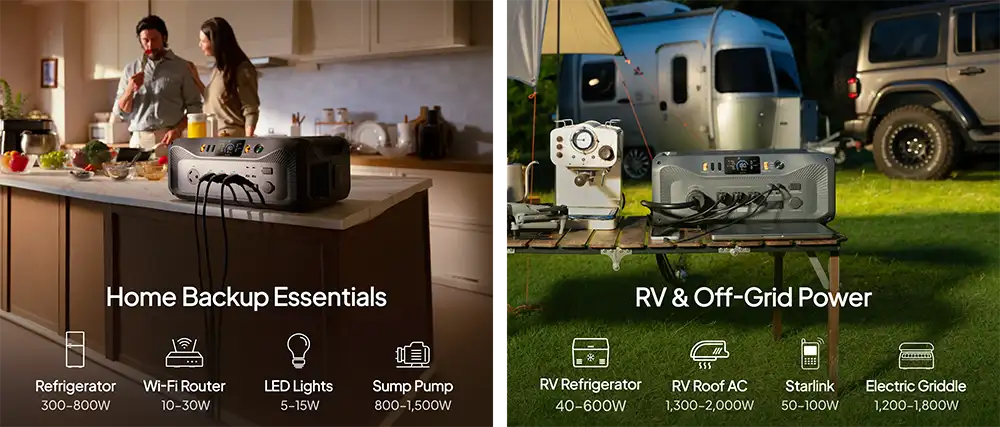
The Bluetti Apex 200 for home backup works best as an “essentials” system. It’s perfect for keeping a fridge, internet, lighting, and device charging alive. With 3.2kW of AC output, it can also start many power tools and some well-pump motors, though you’ll want to check the surge rating for anything with a big compressor.
Apartment and condo owners will like it most. No installation, no electrician, no panel work. You plug your critical appliances into it, and you’re covered.
Expanding the System
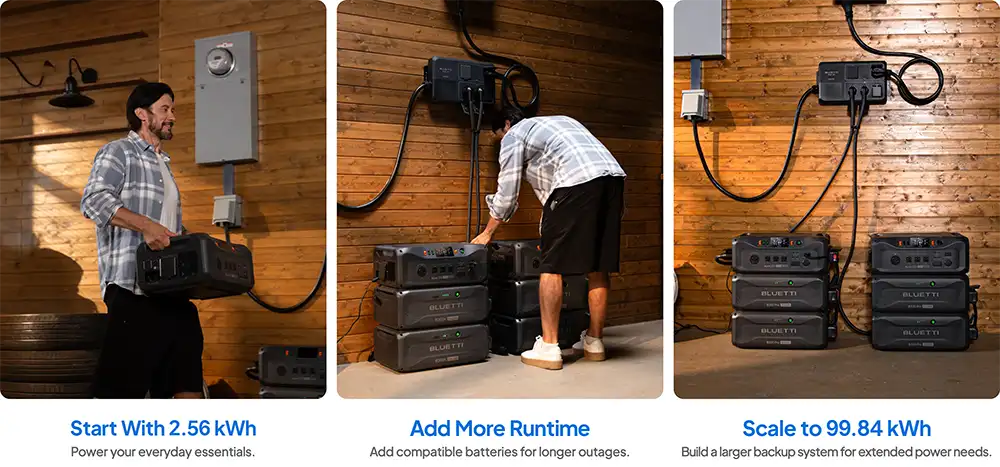
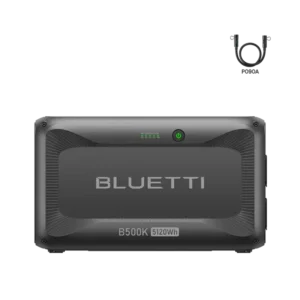
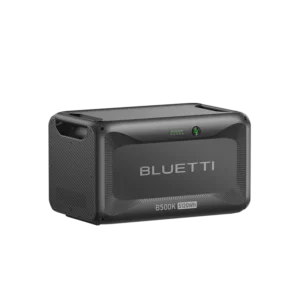
Bluetti Apex 200 Review: This is where the Apex 200 gets interesting. A single unit connects with up to six B500K expansion batteries, reaching 33.28kWh on its own. Want more? Link up to three Apex 200 units through the HUB A1, and you get 6kW of continuous AC output and about 99.84 kWh of capacity.
That’s a big runway. Here’s one way to see it: you can begin with a $1,099 station today and grow it into something that backs up a whole house later, without throwing away your first purchase.
The catch is that expansion costs real money. Bluetti’s bundle with a B300K lists at $2,199 during launch, and the B500K bundle with a TT-30 cable lists at $2,799. Plan your budget around the final system, not just the entry price.
Bluetti Apex 200 for RV and Van Life
Now flip the script. You’re not worried about outages. You’re parked at a campsite with a 30A hookup and a cooler full of food.
The Bluetti Apex 200 RV setup is where that native TT-30R shines. Plug your travel trailer’s shore-power connection directly into the station, and your 120V loads run without adapters. The 12V/30A Anderson port handles portable fridges and communications gear without an inverter in between, which wastes less energy.
Pair it with Charger 2, and you can recharge from the alternator while you drive. So your drive to the next campsite becomes charging time. For van builders working with tight spaces, that 36.2-liter body is the real star.
One honest caveat: if you plan to run a rooftop RV air conditioner for hours, you’ll chew through 2,560 Wh quickly. You’d want expansion batteries and a serious solar array for that.
Bluetti Apex 200 vs Apex 300
The question we keep hearing is simple: which one should I buy? The two machines are siblings, not twins. Here’s how they compare.
| Feature | Bluetti Apex 200 | Bluetti Apex 300 |
|---|---|---|
| Capacity | 2,560Wh | 2,764.8Wh |
| AC output | 3.2kW–3.6kW | 3,840W |
| Voltage | 120V | 120V / 240V |
| Weight | ~59.3 lb | ~83.8 lb |
| Max solar input | 3kW | Higher (check current specs) |
| Native RV port | TT-30R | TT-30R and NEMA 14-50R |
| Best for | Portable essentials backup, RV, apartments | Whole-home backup, 240V loads |
The pattern is clear. The Apex 300 wins on raw output and 240V compatibility, and the Apex 200 wins on weight, size, and starting price. If anything in your home runs on 240V, such as an electric dryer, an oven, or a well pump, or you plan to wire a backup into your breaker panel, go with the Apex 300. If you want a movable system that handles the essentials, the Apex 200 is the smarter pick.
Bluetti Apex 200 Price and Launch Deals
Money talk. The Bluetti Apex 200 price starts at $1,099 for the standalone unit during the first 14 days of launch pricing, which runs until November 18 at 11:59 PM PDT. The regular price is $1,399, and Bluetti says standalone pricing steps up gradually through December 5 before settling there.
Here are the launch bundles, as published by Bluetti:
| Bundle | Launch price | Regular price | |
|---|---|---|---|
| Apex 200 standalone | $1,099 | $1,399 | View Details |
| Apex 200 + 200W solar panel | $1,499 | $1,699 | View Details |
| Apex 200 + SORA 500 solar panel | $1,849 | $2,199 | View Details |
| Apex 200 + Charger 2 | $1,598 | $1,799 | View Details |
| Apex 200 + B300K | $2,199 | $2,599 | View Details |
| Apex 200 + B500K + TT-30 cable | $2,799 | $3,299 | View Details |
Do the math on value. At $1,099, you’re paying about 43 cents per watt-hour. At the regular $1,399, that rises to about 55 cents. Compared with larger stations, that’s competitive, and the expansion path adds long-term value. Bluetti also lists a BLUETTI5OFF code for an extra 5% off bundles, though promotions change, so confirm at checkout. Prices and codes can shift fast.
Pros and Cons
What we like
- Genuinely portable for its capacity class at about 59 pounds
- 3kW solar input with a wide 60V–280V high-voltage range
- Four individually controlled smart AC outlets, an unusual feature
- Native TT-30R and 12V/30A Anderson ports for RV use
- Real expandability up to about 100kWh
- LFP chemistry, which is known for long cycle life and thermal stability
- Low 10.5W idle draw
What gives us pause
- 120V only, so no native 240V for heavy home appliances
- 2,560Wh won’t run big heating or cooling loads for long
- Expansion batteries add high cost
- Launch pricing is time-limited, and the price climbs afterward
- Many performance figures are still manufacturer claims awaiting independent testing
Who Should Buy the Bluetti Apex 200?
Buy it if you’re a renter, condo owner, or homeowner who wants dependable essentials backup without an electrician. Buy it if you’re an RVer or van builder who needs 30A compatibility in a small package. Buy it if you like the idea of starting modestly and growing later.
Skip it if your must-have loads are 240V, or if you want a single unit that can swallow an entire home’s demand on day one. In that case, the Apex 300 or a permanently installed home battery makes more sense.
Bluetti Stores
| USA | Australia | Europe | United Kingdom |
|---|---|---|---|
 |  |  |  |
| Visit Store | Visit Store | Visit Store | Visit Store |
| Italy | Germany | France | Canada |
 |  |  |  |
| Visit Store | Visit Store | Visit Store | Visit Store |
Conclusion
So, is this Bluetti Apex 200 review ending with a thumbs up? Mostly, yes, with an asterisk. The Apex 200 does something that sounds simple but is hard in practice: it delivers a flexible, expandable, solar-friendly power station that a normal person can actually move.
The 3kW solar input, smart outlets, and RV-friendly ports make it far more than a smaller battery in a smaller box. The asterisk is that it’s brand new, and the headline performance numbers still need independent, long-term validation. We’ll update this review with our measured results as soon as we have them.
If the launch price fits your budget and 120V covers your needs, the Bluetti Apex 200 is one of the most sensible expandable stations to land this year.
Our Score Box
Provisional scores based on verified specifications, launch information, and modeled use cases. We’ll update these after full hands-on testing.
| Category | Score (out of 10) |
|---|---|
| Portability and design | 9.0 |
| Capacity and runtime | 8.0 |
| AC output and ports | 8.5 |
| Solar charging | 9.5 |
| Smart features and app | 9.0 |
| Expandability | 9.5 |
| Value for money | 8.5 |
| Overall score | 8.8 / 10 |
Verdict: A strong, flexible starter system for backup and RV life. Pass on it only if you need 240V output.
FAQs About EcoFlow Smart Home Panel
The standalone Bluetti Apex 200 starts at $1,099 during Bluetti’s first 14-day launch window, which ends November 18, 2026. The regular price is $1,399, and bundles with solar panels, batteries, or Charger 2 range from roughly $1,500 to $2,800.
With about 2,170Wh of usable energy (assuming 85% efficiency) and a typical modern fridge averaging 100–150W, you can expect roughly one and a half to two days. Your results depend on the fridge’s age, room temperature, and how often the door opens.
On its own, no. It’s designed as an essentials backup. But it can scale: up to 33.28kWh with expansion batteries on a single unit, and about 6kW and 100kWh with three units linked through the HUB A1. Even then, it’s a 120V system, so check whether your home needs 240V loads.
Yes. It includes a native TT-30R 30A RV outlet and a 12V/30A Anderson port, and it can recharge from a vehicle alternator through the Charger 2. Its compact 36.2-liter body also fits tight spaces. Just remember that rooftop air conditioners will drain the base battery quickly.
The Apex 300 is heavier (about 84 lb vs. 59 lb), offers 120V/240V output, and suits whole-home setups. The Apex 200 is lighter, 120V, and cheaper to start with, making it better for portability, apartments, and RV use.
You Might Also Like