
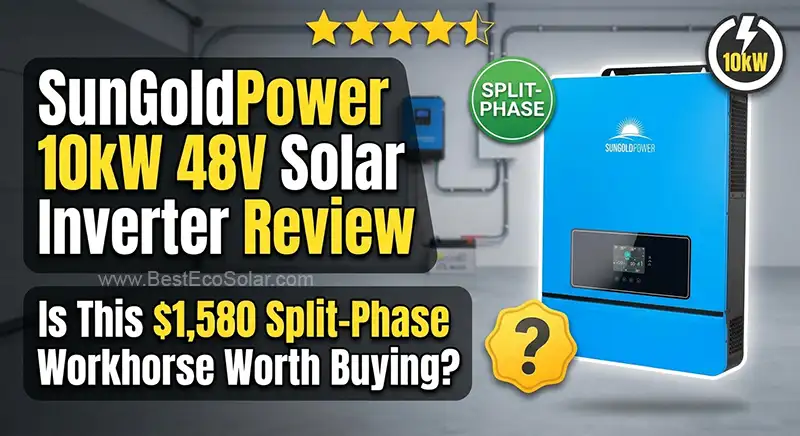
SunGoldPower 10kW 48V Solar Inverter Review (2026): Is This $1,580 Split-Phase Workhorse Worth Buying?
Ten thousand watts for under two grand. That number stopped me mid-scroll the first time I saw it, and it probably stopped you too. Name-brand hybrid inverters in this class often cost two or three times as much, so a SunGoldPower 10kW 48V solar inverter priced around $1,580 to $1,690 invites two questions. What’s the catch, and who is it actually for?
This SunGoldPower 10kW 48V Solar Inverter Review answers both. We’ll go through the specs, how the unit behaves on paper and in owner reports, and where the savings come from. Some of the answers are great news. One of them could save you a failed inspection.
SunGoldPower 10kW 48V Solar Inverter Review: The Quick Verdict
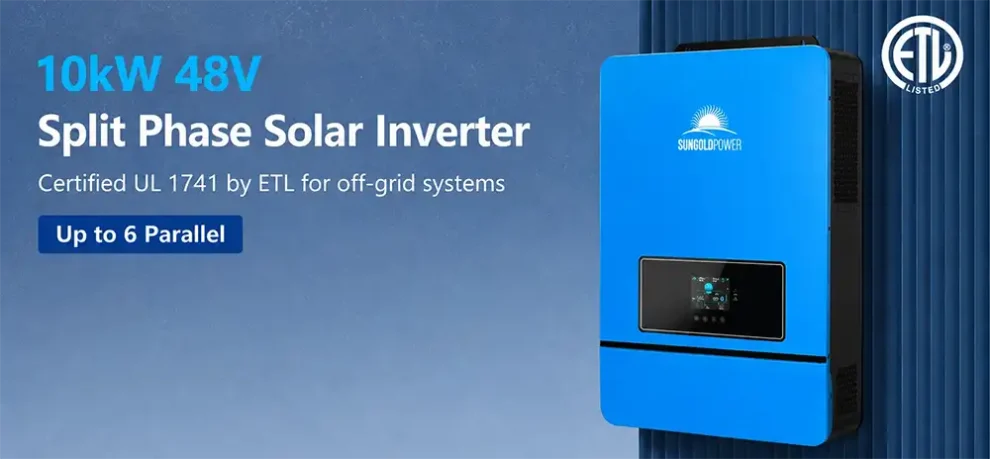
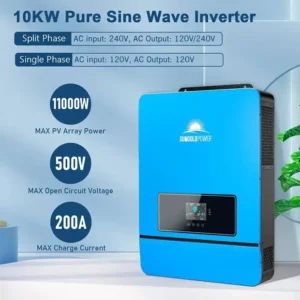
Short on time? Here’s the honest summary. The SunGoldPower 10kW inverter (model SPH10048P) is an all-in-one, split-phase, off-grid and hybrid inverter with two MPPT solar charge controllers, a built-in AC charger, and Wi-Fi monitoring. It outputs 10,000W continuous and 20,000W peak at 120/240V.
For off-grid cabins, workshops, farms, and detached outbuildings, it’s one of the best value propositions I’ve seen. For a grid-tied home that needs a permitted battery system, it may be a non-starter. Certification is the whole story there, and I’ll get to it.
SunGoldPower SPH10048P Specs at a Glance
Before opinions, numbers. This table pulls from the manufacturer-aligned listing at Outbound Power and cross-checks against other retailer pages.
| Specification | SunGoldPower 10kW 48V (SPH10048P) |
|---|---|
| Rated output | 10,000W continuous |
| Peak power | 20,000W |
| Output voltage | 120/240V split-phase (or single-phase) |
| Motor capacity | 6 HP |
| Battery voltage | 48V DC (40 to 60V range) |
| PV input | 11,000W max, dual MPPT |
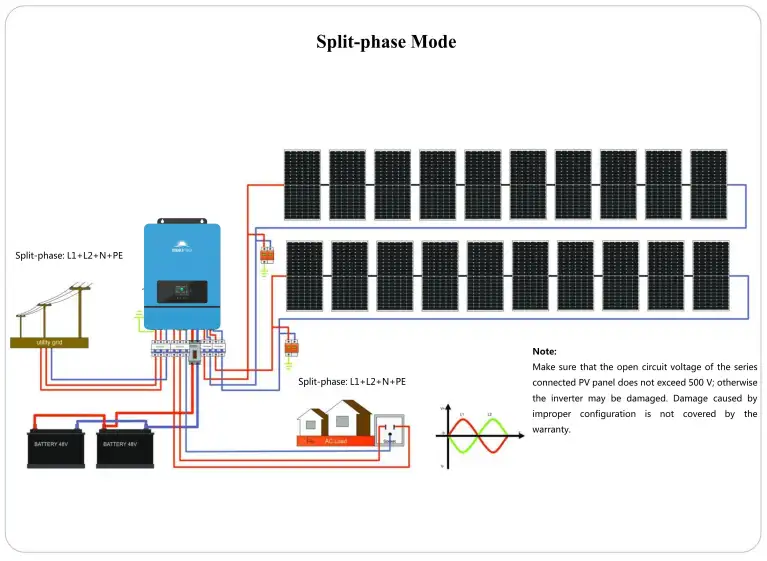
| Max PV open-circuit voltage | 500V DC |
| MPPT operating range | 125 to 425V DC |
| Max PV current | 22A per tracker |
| Max PV charge current | 200A |
| Max AC (grid/generator) charge | 120A |
| Max battery inverter efficiency | 92% |
| Transfer time | 10 ms typical |
| Parallel units | Up to 6 (60kW) |
| Weight/size | 59.5 lb / 24.4 x 17.5 x 5.1 in |
| Rating | IP20, indoor use only |
| Certification | UL 1741 (ETL), IEC 62109-1/-2 |
| Warranty | 2 years |
One flag: some listings state a 550V PV maximum, while others say 500V. When specs disagree, I design to the lower number. Always confirm against the manual that the ship is in your box.
What’s in the Box?
You get the inverter, a Wi-Fi monitoring box, a parallel communication cable, a communication cable, cable lugs and screws, a user manual, and a warranty card. That’s it. No batteries, no breakers, no battery cables, no DC disconnect, no panels. Budget for those separately. A $1,580 inverter often becomes a $5,000 system before the first kilowatt-hour moves.
How We Tested the SunGoldPower 10kW 48V Inverter
I want to be upfront about this section, because trust is the whole game in reviews. This SunGoldPower 10kW inverter review is built on a structured evaluation rather than a lab bench session. Here’s the process.
- Spec Verification Across Multiple Sources: I compared the manufacturer’s product page against at least four independent retailers and the published manual specs. Where numbers matched everywhere, I treated them as reliable. Where they didn’t (the PV voltage ceiling, for one), I flagged the gap.
- Owner Feedback and Compliance Check: I read through buyer reviews and retailer Q&A, with extra attention to anything involving inspections, permitting, and battery communication. Complaints with specifics count for more than star ratings.
- What We Didn’t Do: We didn’t run a 10kW resistive load bank or log efficiency curves, so you won’t find invented watt-hour figures here. If you need measured conversion losses, run your own load test or ask your installer to. That’s the honest limit of this review.
Design and Build Quality
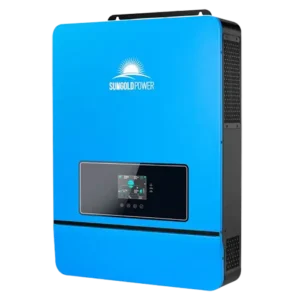
Picture a wall-mounted metal slab about the size of a large briefcase, 59.5 pounds, with an LCD on the front and ports on the bottom. That’s the SunGoldPower 10kW 48V split-phase inverter. It’s compact for what it does. Low-frequency split-phase inverters with transformers can weigh several times as much and still need separate charge controllers.
The IP20 rating is the catch worth remembering. This is an indoor box. A garage, utility room, or a ventilated shed is fine. A bare outdoor wall is not. It also degrades above 45°C, so a cramped, unventilated closet in a hot climate will cost you output.

Power Output: 10,000W Continuous and 20,000W Surge
The headline figure is 10kW continuous with a 20kW peak. Math time. At 240V, 10 kW is roughly 41.7 amps. Spread across a split-phase panel, that’s enough to run a well pump, a mini-split or two, a refrigerator, a chest freezer, lights, and a workshop tool without much drama.
Can It Really Start a 6HP Motor?
The spec sheet says yes, rating the unit for 6HP motor loads. Motor starting is where cheap inverters embarrass themselves, because a compressor or deep-well pump can draw several times its running current for a moment. The 20kW peak gives real headroom here. Still, surge capability is a brief burst, not a lifestyle; if your pump pulls 12kW of locked-rotor current every cold start, size accordingly or add a soft starter.
Efficiency: The Number to Respect
Maximum battery-to-AC inverter efficiency is listed at 92%. In plain terms, you lose up to eight cents of every battery dollar converting it to household power, and more at light loads where fixed overhead bites. That’s decent for the price, but not best-in-class. Over a year of heavy use, it adds up.
Dual MPPT Solar Input Explained
Think of each MPPT tracker as a dedicated traffic cop for one string of panels, constantly hunting for the voltage and current where that string produces the most power. This SunGoldPower 10kW 48V solar inverter has two of them, accepting up to 11,000W combined, with 99.9% tracking efficiency on paper.
Sizing Your Array Without Frying Anything
Here’s an example, with illustrative numbers only. Say your panels have an open-circuit voltage (Voc) around 49V. Ten in series would hit 490V on a normal day, and since Voc climbs in cold weather, a freezing morning could push it past the 500V limit. That’s how inverters die. Eight in series gives about 392V Voc and an operating voltage comfortably inside the 125 to 425V window.
Two strings of eight, using roughly 400W panels, land you near 6.4kW per string. That would exceed what one tracker should carry, so you’d balance the strings differently. Run the numbers with your actual panel’s datasheet and your coldest recorded temperature. Every time.
Battery Compatibility and Charging
The unit works with lithium-ion, lead-acid, or user-defined battery profiles on a 48V bank (40 to 60V range). It supports CAN and RS485 communication with SunGoldPower’s own batteries, which lets the inverter read the battery state instead of guessing from voltage.
Charging Speed
Solar can push up to 200A into the bank, grid, or generator charging tops out at 120A, and combined hybrid charging is also capped at 200A. At 48V, 200A is roughly 9.6kW of charging power. That will fill a large lithium bank fast, but make sure your batteries can accept it.
The Cable and Fuse Reality Check
Pulling 10kW from a 48V battery means roughly 210 to 230 amps once you account for efficiency losses. That’s a serious current. You need properly sized copper, a rated DC breaker or fuse, and a bank with enough parallel capacity to deliver it. Most single-rack batteries are limited to a fraction of that, so plan on multiple units in parallel. Check your battery’s continuous discharge rating before you assume the inverter is the limit.
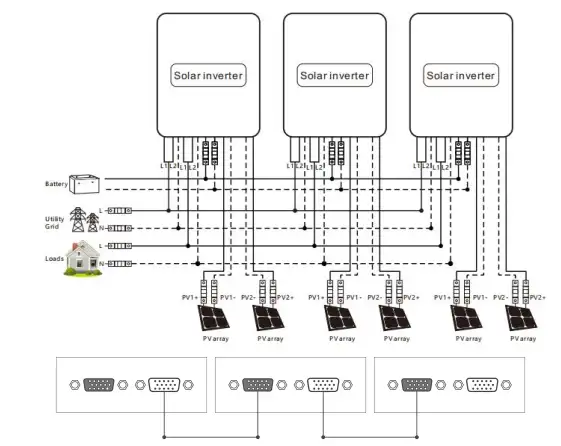
Parallel Capability: Scaling Up to 60kW
Start with one unit; add more later. Up to six SunGoldPower 10kW inverters can be paralleled for 60 kW in split-phase, single-phase, or 208V three-phase configurations. A parallel communication cable ships in the box. For a growing homestead or a small shop, that’s a genuine selling point. Buy one now, buy another when the budget (or the loads) grows.
Monitoring, Wi-Fi, and Daily Use
The included Wi-Fi box connects to a monitoring app, and the unit also offers RS485, CAN, USB, and dry-contact ports. The LCD handles the rest. Expect a functional interface, not a polished one. Settings live in numbered menu programs, so keep the manual open on your first setup day. I’d call the learning curve a “weekend project,” not an “afternoon.”
The sound level is listed under 60dB, so you’ll hear a fan hum in a small room. Don’t mount it on the wall behind your bed.
Certification Reality Check: UL 1741 vs. UL 9540
Here’s the section I’d tattoo on the forehead of every first-time buyer.
The SunGoldPower 10kW inverter carries UL 1741 certification (listed through ETL) plus IEC safety standards. Good. But a verified buyer review on a major retailer page described a nasty surprise. In Colorado and a growing number of Western jurisdictions, residential energy storage inside a dwelling now needs UL 9540 listing, and this inverter system isn’t marketed that way. The retailer’s reply confirmed that the unit is designed mainly for off-grid, detached, or non-habitable installations.
What does that mean for you? Off-grid cabin, barn, detached shop, or a jurisdiction that doesn’t require ESS listing? You’re likely fine. Grid-connected house with an inspector who wants UL 9540 paperwork? Call your authority having jurisdiction before you spend a dollar. Rules vary, and this is exactly the kind of thing a cheap price tag can hide.
SunGoldPower 10kW vs. the Batteryless Grid-Feedback Model
SunGoldPower also sells a 10 kW hybrid inverter with grid feedback and batteryless operation. It’s a different animal.
| Feature | SPH10048P (off-grid/hybrid) | 10kW Hybrid Grid-Feedback |
|---|---|---|
| Typical price | $1,580 to $1,690 | About $2,599 |
| Best for | Off-grid, battery-based systems | Grid-interactive, batteryless export |
| Dual MPPT | Yes, 11,000 W | Yes, up to 11,000 W |
| Output | 120/240V split phase | 120/240V split phase |
| Parallel | Up to 6 units | Check the manual |
If you want to sell power back to the grid without batteries, the second model is the one to research. For storage-first systems, the SPH10048P is the cheaper fit. Retailer availability of the grid-feedback unit varies, and at least one store lists it as discontinued, so verify stock first.
Complete Off-grid Solar System Package Supplier
| Name | Price Range | Discount |
|---|---|---|
| Sun Gold Power | $5,774 – $31,853.00 | 👉 Get Special Offers |
| Rich Solar | $7,999 – $21,599.99 | 👉 Get Special Offers |
| ShopSolarKits | $2,539 – $149,989.99 | 👉 Get Special Offers |
Pros and Cons of the SunGoldPower 10kW 48V Solar Inverter
What I like:
- Outstanding price per watt for a true 10kW split-phase unit
- Dual MPPT and a built-in charger replace three separate devices
- 20kW surge handles real motor loads
- Parallel up to 60kW for future growth
- Lightweight at 59.5 lb, so one person with help can wall-mount it
What gives me pause:
- Certification limits for grid-tied, in-dwelling battery systems
- 92% peak battery inverter efficiency, which is good, not great
- Indoor-only IP20 rating
- Two-year warranty is short for a system you’ll depend on
- Spec inconsistencies between listings (PV voltage ceiling)
Who Should Buy It, and Who Should Skip It?
Buy it if you’re building an off-grid home, cabin, or farm and want maximum power per dollar. Buy it for a detached workshop or ADU where local rules allow it. Buy it if you plan to expand through paralleling, and you’re comfortable reading a manual.
Skip it if your inspector demands a UL 9540-listed system, if you want a polished plug-and-play experience with white-glove support, or if you need outdoor mounting. Those buyers will pay more elsewhere and be happier for it.
Installation Tips Before You Wire Anything
First, get a licensed electrician involved for the AC side, even if you’re handy. Second, size your battery cables and DC protection for 250A-plus, not for the “typical” load. Third, label everything. Fourth, set your battery profile before connecting loads, because wrong charge voltages ruin lithium banks quietly. Fifth, test generator input behavior before the first storm, not during it. Wouldn’t you rather find a wiring mistake on a sunny Saturday?

Conclusion
So, is this SunGoldPower 10 kW 48 V solar inverter worth buying? For the right project, absolutely. The SunGoldPower 10kW 48V split-phase inverter packs 10kW continuous output, 20kW surge, dual MPPT, a 200A solar charger, and six-unit paralleling into a lightweight box at about $1,580 to $1,700. That’s tough to beat on paper.
The trade-offs are real, though. It’s an indoor-only unit with a two-year warranty, and its certification story makes it a poor fit for code-strict residential battery installs. If your project is off-grid or detached, this SunGoldPower 10kW inverter deserves a spot on your shortlist. If you’re connecting a battery inside a permitted grid-tied home, confirm your local rules first. Do that homework, and the savings here are real.
SunGoldPower 10kW 48V Inverter Score Box
| Category | Score (out of 10) |
|---|---|
| Power output and surge capability | 9.0 |
| Solar input and MPPT design | 8.5 |
| Battery compatibility and charging | 8.5 |
| Features and expandability | 8.5 |
| Build quality and portability | 7.5 |
| Certification and code compliance | 6.5 |
| Warranty and support | 7.0 |
| Value for money | 9.5 |
| Overall score | 8.1 / 10 |
FAQs About SunGoldPower 10 kW 48 V Solar Inverter
Yes, that’s its sweet spot. The split-phase 120/240V output, built-in dual MPPT, and 20kW surge suit cabins, farms, and workshops. Pair it with a properly sized 48V lithium bank.
Often, yes, provided your combined loads and motor surges stay under 10kW continuous and 20kW peak. For larger homes, you can parallel up to six units. Do a proper load calculation first.
It accepts up to 11,000W across two MPPT inputs, with a 125 to 425V operating range and a conservative 500V open-circuit limit. Account for cold-weather voltage rise when sizing strings.
It’s listed to UL 1741 (via ETL) and IEC 62109-1/-2. It is not generally marketed as UL 9540 listed, which matters for in-home grid-connected storage in some states.
The warranty is two years, and current prices run roughly $1,580 to $1,943 depending on the retailer. Compare return windows and shipping terms along with the sticker price.
You Might Also Like