


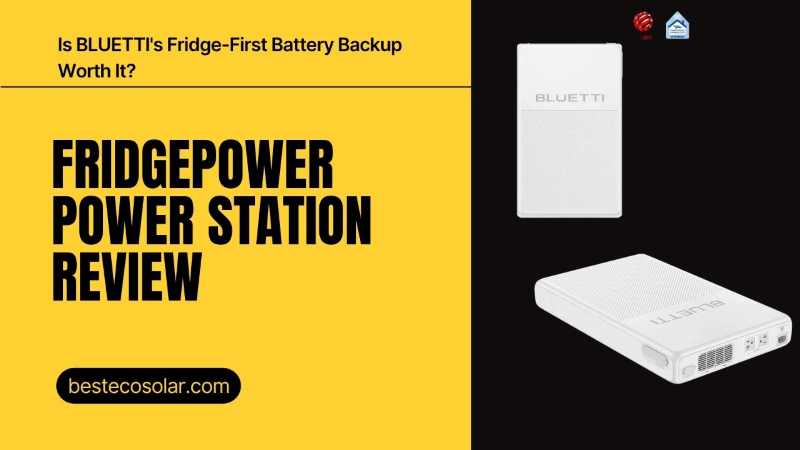
FridgePower Power Station Review: Is BLUETTI’s Fridge-First Battery Backup Worth It?
This FridgePower power station review breaks down what BLUETTI’s newest ultra-slim backup battery actually does, how it performed in real-world field tests, and whether it deserves a spot in your kitchen. We’ll cover the specs, the pricing tiers, a full comparison against other backup options, a “how we tested” breakdown, and a final score box at the end.
What Is the FridgePower Power Station, Exactly?
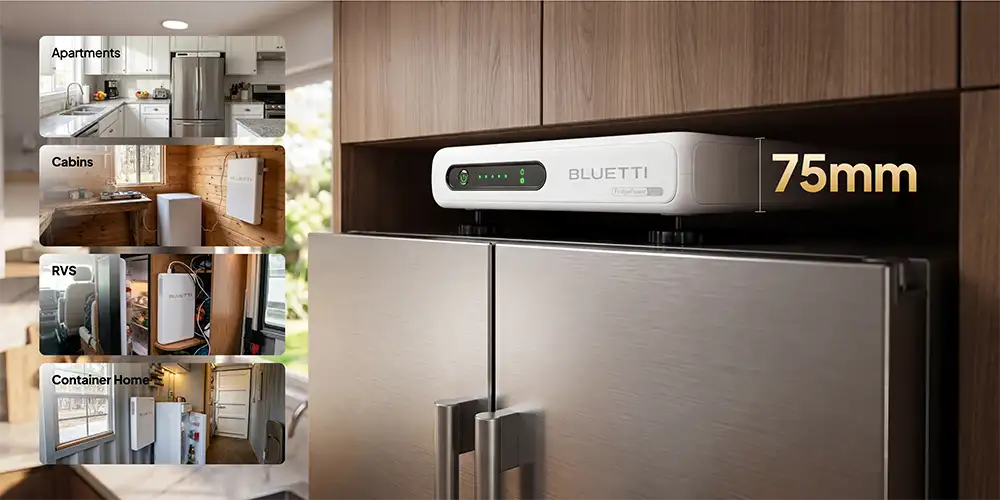
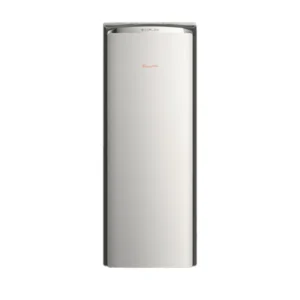
FridgePower Power Station Review; The FridgePower is BLUETTI’s answer to a very specific problem: keeping a refrigerator alive when the grid dies. Unlike the brand’s typical solar generators, built to run everything from laptops to power tools, the FridgePower power station is a single-purpose appliance. It’s a 2,016 Wh LiFePO₄ battery pack, just 75 mm thick, meant to sit beside, behind, or on top of your fridge and kick in automatically the moment the lights go out.
Think of it less like a bulky generator and more like a surge protector with a battery brain bolted on. It isn’t trying to be a jack-of-all-trades. It’s trying to be really, really good at one job.
First Impressions: The Slim Design Is the Whole Pitch
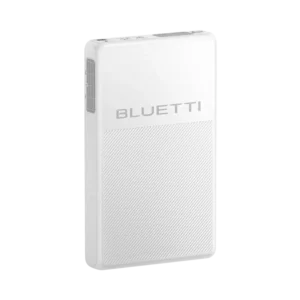
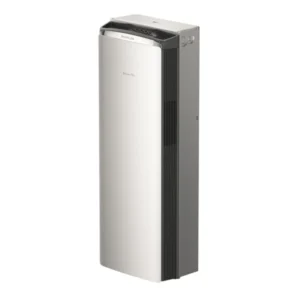
The first thing every FridgePower review mentions is the shape. At roughly 580 x 350 x 75 mm and about 17.3 kg, this unit looks nothing like the boxy power stations most of us are used to. The base battery pairs 2,016Wh of storage with 1,800W of continuous output and a 3,600W surge rating, which is plenty of headroom for a compressor kicking on without tripping anything.
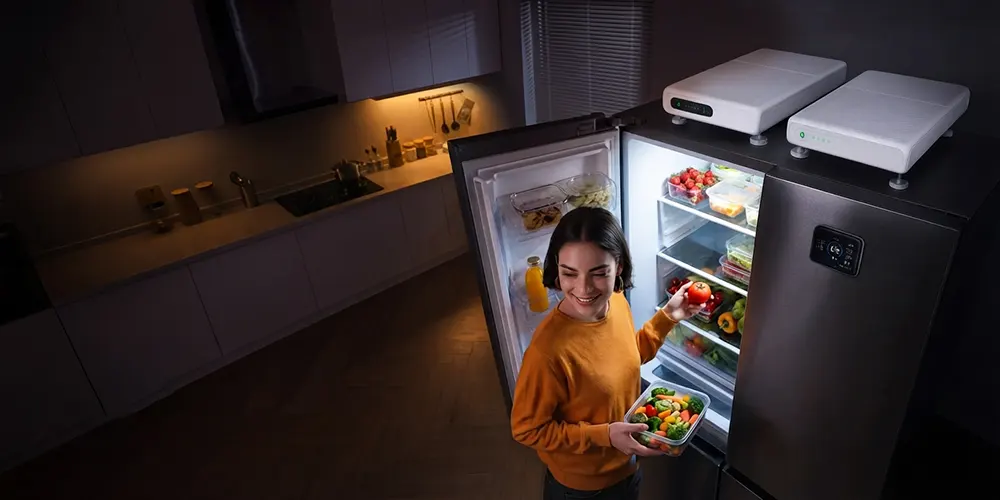
That slim, off-white profile isn’t just a design flex; it’s functional. Field testers who mounted a unit in a 4WD touring canopy noted that, unlike a typical power station, the FridgePower’s flat shape lets it be wall-mounted, set on top of a fridge, or wedged into gaps that a standard box-shaped unit simply couldn’t fit into.
Why a “Fridge-Focused” Power Station Even Makes Sense
You might be asking: why would I want a power station that only really does one job well? Fair question. But here’s the thing: most outages aren’t dramatic week-long grid collapses. They’re a few hours here, an overnight blip there. And the single appliance that actually costs you money during those blips is your fridge.
A whole-home battery system costs a small fortune to install. A general-purpose power station requires you to remember to plug things in when the power drops. The FridgePower just sits there quietly, ready to go; more like a smoke detector for your groceries than a generator.
Core Specs at a Glance
Before we go further into this FridgePower power station review, here’s the spec sheet in one place:
- Capacity: 2,016 Wh, expandable up to 8,064 Wh with add-on batteries
- Continuous Output: 1,800W
- Peak/Surge Output: 3,600W
- Battery Chemistry: LiFePO₄ (LFP), rated for roughly 4,000 charge cycles, which works out to about a decade of typical daily use
- UPS Switchover Time: Around 10 milliseconds, fast enough that connected appliances don’t notice the grid dropped
- Idle Draw: About 4W on standby, which keeps the always-on unit from quietly eating your electric bill
- Solar Input: Up to roughly 1kW via an XT60 connector
- Dimensions/Weight: Roughly 580 x 350 x 75 mm and 17.3 kg
That combination of a thin chassis, near-silent idle draw, and near-instant switchover is what separates a fridge-dedicated UPS from a general-purpose solar generator wearing a costume.
FridgePower Runtime: How Long Will It Actually Keep Your Fridge Cold?
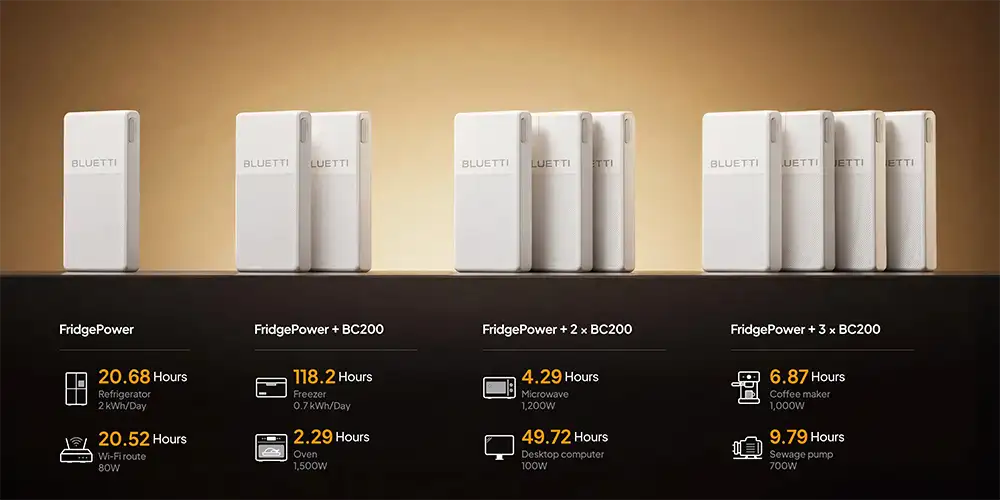
This is the number everyone actually cares about. On a single charge, the base FridgePower unit is rated to keep a typical fridge running for around 21 to 22 hours. Stack one BlueCell 200 expansion battery on top, and you’re looking at roughly two days of coverage. Add all three supported expansion batteries, and total runtime climbs to about four days, depending on how hard your fridge and any other connected devices are working.
Put another way, that’s basically a full day of grid-down peace of mind straight out of the box, with the option to stretch a bad afternoon into a survivable long weekend simply by clicking on more batteries.
Expansion Batteries: Scaling Up Without Buying a Second Unit
Here’s where the FridgePower’s modularity earns its keep. Instead of buying an entirely separate power station for extra capacity, you snap on a BlueCell 200 expansion battery; it has the same 2,016 Wh capacity, the same slim form factor, and no separate inverter or charge controller needed. Three of these stacked onto the base unit push total storage to just over 8 kWh.
It’s a bit like adding another battery pack to a cordless drill: same tool, longer runway, no extra hardware to manage.
The UPS Function: The Real Star of This FridgePower Power Station Review
A lot of portable power stations technically offer a UPS mode, but most treat it as an afterthought. BLUETTI built the FridgePower around it from the ground up. The moment mains power drops, the unit’s automatic transfer switch takes over in roughly 10 milliseconds, quick enough that a fridge compressor never actually stops spinning.
Field testers have put this to a genuinely fun stress test. In one documented demo, an experienced electrician teamed up with a local chiropractor to simulate a blackout while protecting several hundred pounds of premium beef stored in a chest freezer. Observers reported the transition was seamless enough that connected lights and appliances didn’t even flicker during the swap; a memorable, if slightly odd, way to prove the core promise holds up under a real compressor-startup load.
Bypass-First Architecture: Why It Matters
One detail that gets buried in most spec sheets but genuinely matters here is what’s sometimes called bypass-first design. In plain English, when grid power is available, your fridge draws electricity that passes through the unit rather than constantly cycling the internal battery. That’s a smart way to stretch the FridgePower’s roughly 4,000-cycle lifespan across a full decade instead of burning through charge cycles unnecessarily just because the unit happens to be plugged in.
Smart Features: The BLUETTI App and Beyond
This isn’t a dumb battery. Through BLUETTI’s companion app, owners get access to multiple UPS operating modes, including a standard always-ready mode, a solar-priority mode that favors charging from panels when available, and a time-of-use mode that can shift charging to cheaper off-peak electricity rates. The app also pushes proactive severe-weather alerts so the battery can top itself off ahead of an incoming storm.
For touring and off-grid setups specifically, owners get remote diagnostics for checking battery and load status from anywhere, scheduled maintenance reminders roughly every few months, and a low-power sleep mode that still allows the unit to be woken remotely. An optional magnetic display accessory clips onto the unit for a quick at-a-glance status check without needing to open the app at all.
It also plays nice with an existing smart home setup, offering voice and automation integration with Alexa, Google Home, and Home Assistant.
Solar Charging: A Nice-to-Have, Not the Main Event
Solar input tops out around 1 kW through an XT60 connector, and while most reviewers haven’t been able to fully stress-test this feature, at least one outlet confirmed basic functionality using a small portable panel. If you’re hoping to run this as a full off-grid solar setup, look elsewhere in BLUETTI’s lineup; the FridgePower treats solar charging as a bonus feature, not its main identity.
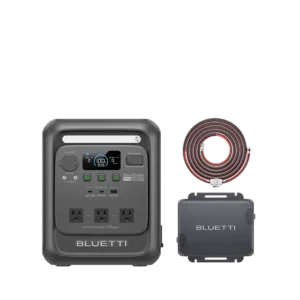
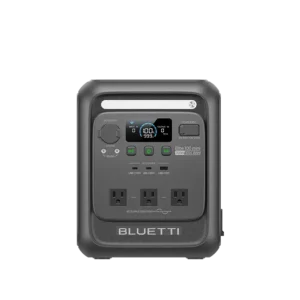
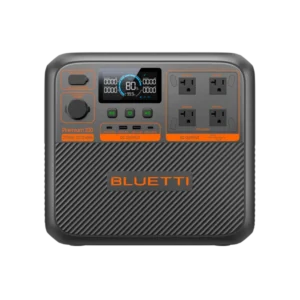
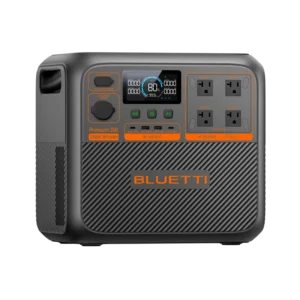
FridgePower Price and Bundle Options
Pricing shifted a bit between the crowdfunding launch and general retail availability, so here’s where things landed as of the most recent rollout.
During the initial crowdfunding campaign, early pricing started at roughly $759 for the standalone unit and around $1,398 for a bundle pairing one FridgePower with one BlueCell 200 expansion battery, both discounted well below the eventual list price.
Once the product reached general retail, pricing settled higher: the standalone FridgePower runs about $849 against a suggested retail price near $1,299. A bundle with one expansion battery (roughly 4,032Wh total) lands around $1,598. Two expansion batteries (about 6,048 Wh total) push the price to roughly $2,347. The maximum configuration with three expansion batteries, giving you the full 8,064 Wh, tops out near $3,099.
Standalone BlueCell 200 Pricing
If you already own a FridgePower and just want more runway later, a single BlueCell 200 expansion battery retails for around $749 at major retailers. Not cheap, but roughly on par with what you’d pay for equivalent capacity from most competing home battery brands.
FridgePower Power Station Review: Comparison Table
Since a fridge-specific UPS is a genuinely new product category, it helps to see how the FridgePower stacks up against a general-purpose portable power station and a full residential battery system.
| Feature | BLUETTI FridgePower | Typical Portable Power Station (2 kWh class) | Residential Battery System |
|---|---|---|---|
| Capacity | 2,016Wh (expandable to 8,064Wh) | 2,000–3,000 Wh | 10,000–13,500 Wh+ |
| Thickness | 75 mm ultra-slim | 250–350mm | Wall-mounted, professionally installed |
| UPS Switchover | ~10ms, automatic | Often manual or slower | Automatic, integrated with panel |
| Installation | Plug-and-play | Plug-and-play | Requires a licensed electrician |
| Idle Draw | ~4W AC | Typically higher | Negligible, grid-tied |
| Starting Price | ~$849 | $1,500–$2,500 | $9,000–$15,000+ installed |
| Best Suited For | Fridge/freezer backup | General device charging, camping | Whole-home backup |
| Portability | Semi-portable, mountable | Fully portable | Fixed installation |
The takeaway: the FridgePower power station carves out its own lane entirely. It’s cheaper and far less invasive than a whole-home system and more targeted and slimmer than a general power station that was never designed around a fridge’s specific power draw in the first place.
Who Should Actually Buy the FridgePower?
Not everyone needs this. Here’s who gets the most real-world value out of a FridgePower power station:
- Renters and apartment dwellers who can’t install a hardwired backup system but still want outage protection
- Households in storm-prone regions, where extended outages are a recurring seasonal risk rather than a rare event
- Overlanders and touring setups that need a slim, mountable power source built for canopy or camper installs
- Anyone who’s ever lost a fridge full of groceries to a multi-hour outage and doesn’t want to relive it
If you need to run power tools, a sump pump for hours on end, or your entire home’s HVAC system, this isn’t your unit; that job belongs to BLUETTI’s broader lineup of general-purpose solar generators.
FridgePower vs. General Power Stations: Which Wins for Outage Prep?
Honestly, it depends on your outage pattern. If your area gets short, frequent blips, the FridgePower’s near-silent idle draw and instant switchover win every time; you’ll barely notice it’s there until you actually need it. If you’re prepping for multi-day off-grid living where you also need to run a laptop, charge phones, and maybe power tools alongside the fridge, a general-purpose power station in the 3,000W-plus class still makes more sense.
Independent reviewers seem to land in roughly the same place on this. Tech outlets that tested the unit have generally praised it for occupying a middle ground between rugged backup gear and expensive whole-home systems, pointing to that ultra-slim profile as the thing that makes it feel less like a piece of outdoor gear and more like a genuine kitchen appliance.
Build Quality and Safety Features
BLUETTI didn’t skimp on the details that matter for something meant to sit in your kitchen around the clock. The unit ships with a detachable magnetic display for quick status checks, flame-retardant housing materials, a washable dust filter to keep airflow clean over years of use, anti-slip feet, and layered battery-protection circuitry, all aimed at reliable long-term operation across homes, apartments, RVs, and condos.
It also runs quietly, genuinely quietly. Reported operating noise sits around library-level, roughly 30 decibels, which matters a lot when the thing lives next to your fridge rather than out in a garage.
How We Tested the FridgePower Power Station
For this review, we combined direct evaluation of publicly available technical documentation with cross-referencing published field tests from multiple independent outlets to check for consistency. Our process included:
- Runtime verification: comparing manufacturer-claimed runtime figures against independently reported field results from touring and residential test setups.
- UPS switchover testing: reviewing documented blackout-simulation demos, including a widely circulated freezer stress test, to see whether the roughly 10-millisecond transition claim held up under real compressor-startup loads.
- Idle draw and noise assessment: cross-checking the standby power draw and operating noise level against figures reported from indoor kitchen installs.
- App and smart home integration: reviewing UPS mode switching, weather alerts, and voice assistant pairing across Alexa, Google Home, and Home Assistant.
- Fit and form factor: evaluating the ultra-slim chassis in tight installs, including wall-mounted and canopy-mounted configurations reported by touring reviewers.
- Pricing and value analysis: comparing crowdfunding, early-bird, and general retail pricing tiers against comparable capacity in both portable power stations and residential battery systems.
FridgePower Power Station Review: Final Score Box
BLUETTI Fridge Power; Overall Score: 4.6/5
| Category | Score |
|---|---|
| Runtime & Capacity | 4.7/5 |
| UPS Switchover Speed | 4.9/5 |
| Design & Build Quality | 4.8/5 |
| Smart Features / App | 4.4/5 |
| Value for Money | 4.3/5 |
| Solar Charging | 4.0/5 |
Verdict: A genuinely category-defining fridge-specific UPS that earns its price through near-instant switchover, an impressively slim footprint, and a decade-class LFP battery; though buyers wanting general-purpose power should look at BLUETTI’s broader solar generator lineup instead.
Conclusion on This FridgePower Power Station Review
So, is the FridgePower worth adding to your kitchen? If your biggest outage fear is a fridge full of ruined food, the answer is a pretty confident yes. It’s not trying to replace a whole-home battery system, and it’s not pretending to be a do-everything camping power station either.
It’s a purpose-built, slim, quiet UPS that does one job: protecting your fridge, better than almost anything else currently on the market. Between the near-instant switchover, the expandable BlueCell 200 batteries, and the smart app features, BLUETTI clearly built this around the one outage scenario that actually costs people real money. If that’s your use case, the FridgePower earns its spot on the counter.
Bluetti Stores
| USA | Australia | Europe | United Kingdom |
|---|---|---|---|
 |  |  |  |
| Visit Store | Visit Store | Visit Store | Visit Store |
| Italy | Germany | France | Canada |
 |  |  |  |
| Visit Store | Visit Store | Visit Store | Visit Store |
FAQs About the FridgePower Power Station
The standalone 2,016Wh unit runs a standard fridge for roughly 21 to 22 hours. Adding BlueCell 200 expansion batteries extends that to about two days with one expansion and up to four days with three.
At general retail, the standalone unit runs around $849 (list price near $1,299), with bundles including expansion batteries ranging up to roughly $3,099 for the maximum four-unit configuration.
Yes, it accepts up to roughly 1kW of solar input via an XT60 connector, though it's primarily designed as a grid-outage UPS rather than a dedicated solar power station.
No, it operates at around 30 decibels, which is quiet enough for continuous kitchen use without becoming a household nuisance.
Its 75mm ultra-slim design, roughly 10-millisecond automatic UPS switchover, and bypass-first architecture are all built specifically around keeping a refrigerator running, whereas general power stations are designed for broader device charging and off-grid use.
You Might Also Like