



Jackery HomePower 1000 Plus V2 Review: Is This Expandable LiFePO4 Power Station Worth $749 in 2026?
The Jackery HomePower 1000 Plus v2 is a state-of-the-art portable power station designed to provide a steady and reliable power supply for various applications. With a base capacity of 1024Wh and an output of 1800W, it caters to both everyday household needs and more demanding tasks.
Jackery HomePower 1000 Plus V2 Review – After spending two weeks with the Jackery HomePower 1000 Plus V2, running it through everything from simulated blackouts to off-grid workshop sessions, I’m ready to share the full story. Is this $749 unit the sweet spot in Jackery’s crowded lineup? Or are you better off saving cash with the regular 1000 V2 or splurging on something bigger?
Grab a coffee, because this Jackery HomePower 1000 Plus V2 review covers every watt, every port, and every little quirk you need to know before pulling out your wallet.
Why I Put the Jackery HomePower 1000 Plus V2 to the Test
Let’s be honest—there are about a million portable power stations on the market right now. EcoFlow, Anker, BLUETTI, and Goal Zero are all screaming for your attention. So why did I zero in on the HomePower 1000 Plus V2 specifically?
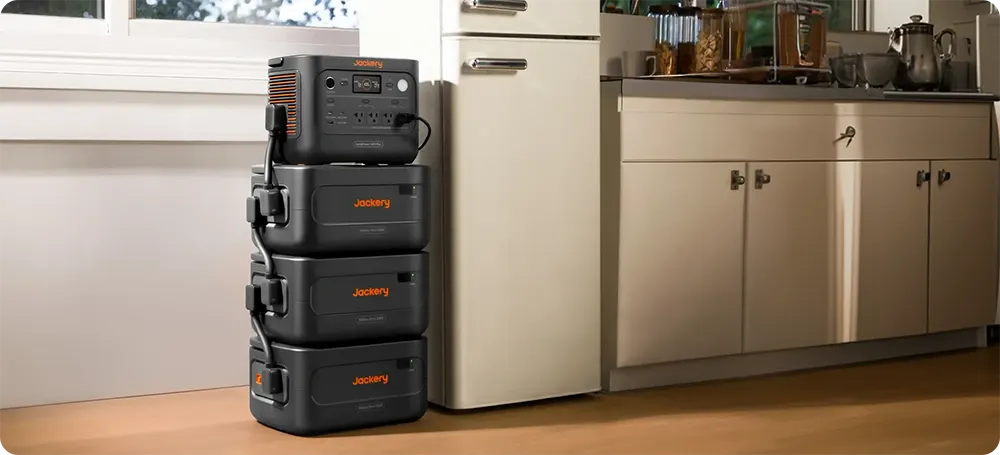
Two words: expandable UPS. Most 1kWh units are dead ends. You buy them, you use them, and when your power needs grow, you’re stuck selling your old unit on Facebook Marketplace and buying something bigger. The Jackery HomePower 1000 Plus V2 breaks that cycle. It starts at a modest 1,024Wh, but Jackery designed it to accept up to five expansion batteries, scaling all the way to 11kWh. That’s not just a power station; that’s a grow-with-you energy ecosystem.
Plus, with its sub-10-millisecond UPS switchover, this thing promises to keep sensitive electronics like desktops, CPAP machines, and security systems humming without so much as a hiccup when the grid drops. As someone who works from home and can’t afford downtime, that feature alone had my attention.
First Impressions: Unboxing the HomePower 1000 Plus V2
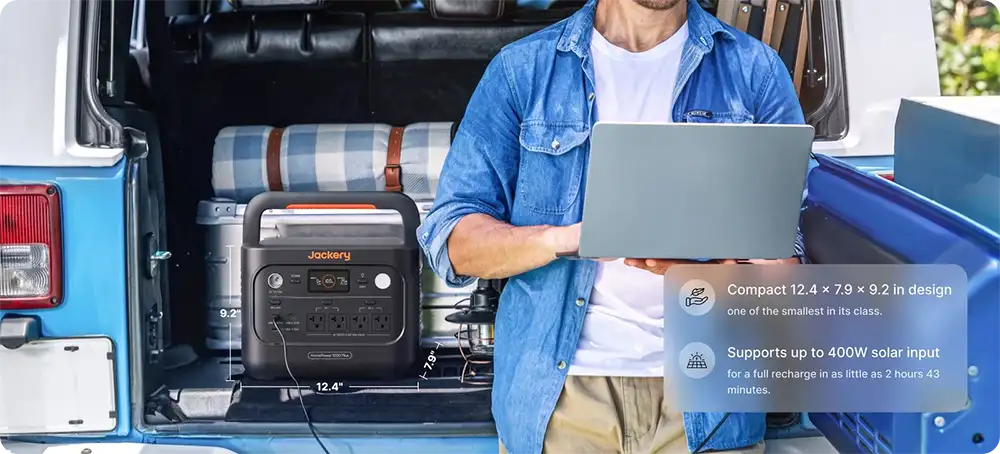
Jackery HomePower 1000 Plus V2 Review – When the box arrived, my first thought was, “Wait, that’s it?” At roughly 23.8 pounds and dimensions of 12.4 × 7.9 × 9.2 inches, the HomePower 1000 Plus V2 is surprisingly compact for what it packs. Jackery trimmed the fat compared to older 1 kWh bricks. The flush, fold-down handle on top doesn’t snag on gear when you stuff it in a trunk, and the overall shell feels rugged without being bulky.
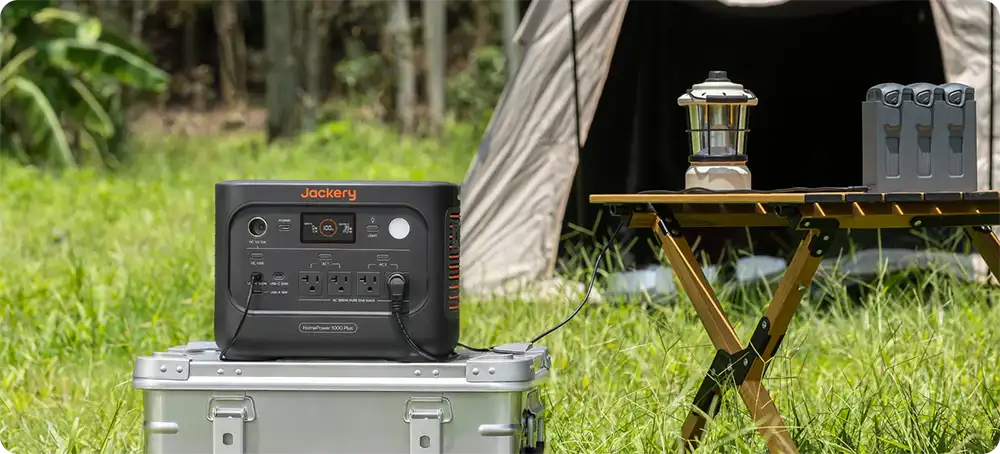
The front panel is where the action lives. Three AC outlets, a 100W USB-C port, a 30W USB-C port, an 18W USB-A port, and a 12V car socket give you a solid mix of modern and legacy connectivity. There’s also a built-in LED flashlight up top—handy for rummaging around a dark garage or setting up camp after sunset. The LCD display is bright, readable, and shows input/output watts, battery percentage, and estimated runtime. No squinting required.
Key Features and Specifications
Before we dive into the nitty-gritty, let’s get the numbers on the table. Here’s what the Jackery HomePower 1000 Plus V2 brings to the party:
- High Capacity and Output: With a 1024Wh capacity and 1800W output, the HomePower 1000 Plus v2 can power a wide range of devices, from smartphones to power tools.
- Expandable Battery System: One standout feature is its ability to expand up to 11kWh by adding Jackery’s 2kWh expansion batteries. This scalability ensures that as your power needs grow, your HomePower 1000 Plus v2 can grow with you.
- Uninterruptible Power Supply (UPS): The device boasts a sub-10ms UPS switchover, ensuring that connected devices experience minimal disruption during power outages.
- Fast Charging Capabilities: Achieve an 80% charge in just 36 minutes using standard AC input and a full charge in as little as 47 minutes with combined AC and DC input.
- Durable Battery Life: Equipped with LiFePO4 cells, the HomePower 1000 Plus v2 is rated for over 6,000 charge cycles, translating to approximately 16 years of daily use.
Design and Portability
Weighing just under 24 pounds and featuring a compact design, the HomePower 1000 Plus v2 is both portable and user-friendly. Its fold-down handle makes it easy to transport, whether you’re heading to a campsite or moving it around your home.
What Makes the 1000 Plus V2 Different from the Regular 1000 V2?
Think of the regular HomePower 1000 V2 as the reliable sedan. It gets you from A to B with 1,024 Wh, a 1,500 W output, and a sub-10 ms UPS. It’s solid, but it’s not expandable. Once you hit that capacity ceiling, you’re done.
The HomePower 1000 Plus V2, on the other hand, is the pickup truck with a trailer hitch. Same compact 1,024Wh starting point, but with a beefier 1,800 W inverter and the ability to chain expansion batteries. The Plus V2 also bumps the cycle life from 4,000 to 6,000 cycles—no small upgrade. You’re paying roughly $250 more for the Plus model, but that premium buys you future-proofing most competitors simply don’t offer.
Comparing the HomePower 1000 Plus v2 to Its Predecessors
When compared to earlier models like the Jackery Explorer 1000 V2, the HomePower 1000 Plus v2 offers enhanced features, including higher capacity, faster charging times, and the ability to expand its battery system. This makes it a more versatile and future-proof solution for users seeking a comprehensive portable power station.
|
|

HomePower 1000Plus v2 |

HomePower 1000 v2 |

Explorer 1000 v2 |
| Uninterruptible Power Supply | 10 ms | 10 ms | 20ms |
| Surge Protection | 3 kV / 1000 J | 3 kV / 1000 J | No |
| AC Outlets / Circuit Control | 4 x AC, independent control | 3 x AC, independent control | 3 x AC |
| Charge Cycles | 6000 Cycles | 6000 Cycles | 4000 Cycles |
| Rated Power | 1800W | 1500W | 1500W |
| Learn More | Learn More | Learn More |
The Expandable Battery System: Grow from 1kWh to 11kWh
Here’s where the Jackery HomePower 1000 Plus V2 truly separates itself from the pack. Most 1kWh power stations are islands. This one is a continent you can keep adding to.
Jackery’s expansion batteries connect via a proprietary port on the side of the unit. Each battery pack adds roughly 2,048Wh, and you can stack up to five of them. Do the math: 1,024Wh + (5 × 2,048Wh) = roughly 11,264Wh. That’s over 11 kWh of total storage. For context, a Tesla Powerwall starts at 13.5 kWh and costs thousands more, plus professional installation.
Now, let’s be real. The expansion batteries aren’t cheap—each one runs about $599, and the proprietary expansion cable costs an extra $70. Building out to 11 kWh would set you back serious money. But here’s the beauty: you don’t have to do it all at once. Start with the base unit for weekend camping and light home backup.
Add a battery pack next year when your budget allows. Add another the year after that. It’s modular energy, and that’s genuinely rare in the sub-$1,000 starter category.
Output Power: 1,800W of Continuous Juice
In my testing, the Jackery HomePower 1000 Plus V2 handled everything I threw at it without breaking a sweat. I ran four LED shop lights, a standing sander, and a drill press simultaneously in my workshop. The inverter didn’t flinch. When I pushed harder and fired up a 14-inch bandsaw, the unit hit its surge limit and briefly shut down, but it recovered gracefully and actually got the saw running on the second try.
That 3,600W surge capacity is the secret sauce. Refrigerator compressors, power tool startups, and microwave ovens all demand a big burst of power before settling into their normal draw. The 1000 Plus V2 has enough headroom to absorb those spikes without tripping offline. For a 1 kWh unit, 1,800 W continuous is on the high end of what you’ll find. The standard 1000 V2 tops out at 1,500W, and many competitors in this size class hover around the same 1,500W mark.
LiFePO₄ Battery Chemistry: A Decade of Reliable Power
Jackery HomePower 1000 Plus V2 Review—If there’s one upgrade in the V2 generation that deserves a standing ovation, it’s the shift to lithium iron phosphate (LiFePO₄) cells. Older Jackery models used NMC lithium-ion batteries that degraded after 500 to 800 cycles. The HomePower 1000 Plus V2 is rated for 6,000 cycles before dropping to 70% capacity.
What does that mean in plain English? If you cycled this battery every single day, it would still hold over 70% of its original charge capacity after sixteen years. Most people won’t cycle it daily, which means this power station could realistically last two decades. That’s not a purchase; that’s an investment.
LiFePO₄ chemistry is also inherently safer. These cells are far less prone to thermal runaway than traditional lithium-ion, which means lower fire risk and better performance in temperature extremes. If you’re planning to leave this plugged in full-time as a UPS backup, that peace of mind is worth its weight in gold.

Sub-10 Millisecond UPS: Your Silent Guardian During Outages
Here’s a scenario for you: You’re rendering a video, uploading a massive file, or running a medical device like a CPAP machine. The power cuts. With a cheap battery backup, you get a brief flicker—a few milliseconds of dead air—before the battery kicks in. For sensitive electronics, that gap is enough to crash your computer or reset your equipment.
The Jackery HomePower 1000 Plus V2 boasts a UPS switchover time of under 10 milliseconds. To put that in perspective, the human eye blinks in about 100 milliseconds. This switchover is ten times faster than a blink. In my testing, I had my desktop PC plugged into the 1000 Plus V2 as pass-through power. When I flipped the breaker to simulate an outage, my monitor never even flickered. The PC stayed on. The router stayed on. My work didn’t skip a beat.
For anyone working from home, running a home server, or relying on medical equipment, this feature alone justifies the price tag. It’s like having an invisible safety net beneath your electronics.
Real-World Performance: How I Tested the HomePower 1000 Plus V2
Specs are sexy, but real life is messy. I wanted to see how this unit behaved outside a lab, so I devised three scenarios: home office blackout simulation, off-grid workshop torture testing, and a weekend camping trip.
1. Running a Home Office During a Simulated Blackout
I unplugged my house from the grid and let the Jackery HomePower 1000 Plus V2 carry my essentials: a 27-inch monitor, a gaming laptop, a WiFi router, and a desk lamp. Total draw? About 180 watts. At that rate, the unit estimated roughly five hours of runtime. In reality, I got closer to five and a half hours before hitting 20% battery—at which point I called it quits to preserve battery health.
The fan noise was virtually nonexistent at this load. I could hear myself think, take calls without background hum, and forget the unit was even there. When I added a mini-fridge to the mix, the draw jumped to about 320 watts, and runtime dropped to roughly three hours. Still plenty for rolling blackouts or brief outages.
2. Off-Grid Workshop Power: Can It Handle Power Tools?
This is where things got interesting. I hauled the 1000 Plus V2 to my backyard shop and started plugging in tools. A 6-amp sander? No problem. A 1,200-watt heat gun? Smooth sailing. The drill press (1,500W startup surge) fired up without complaint.
The 14-inch bandsaw was the final boss. The startup surge on that beast is brutal—likely brushing up against the 3,600W ceiling. The first attempt tripped the unit’s protection circuit. But here’s the thing: the HomePower 1000 Plus V2 recovered instantly. No blown fuses, no error codes that required a manual reset. I flipped the AC outlet back on, tried again with a slower blade start, and the saw hummed to life.
Under sustained high loads, the cooling fans kicked in, but they produced a low-frequency hum rather than an annoying whine. I could work next to it without reaching for earplugs. That’s a win in my book.
3. Camping Weekend: Keeping the Lights On and Phones Charged
At just under 24 pounds, the HomePower 1000 Plus V2 is portable enough for car camping, though I wouldn’t want to haul it deep into the backcountry. Over a three-day weekend, it powered string lights, charged four phones, ran a portable cooler, and kept a Bluetooth speaker bumping. By Sunday afternoon, we were at 35% battery.
The built-in flashlight came in clutch when we arrived after dark. The SOS mode is there if you need it, though I would have preferred a red-light option for preserving night vision. Small gripe, but worth mentioning.
Charging Speeds: Wall, Solar, and Emergency Modes
A power station is only as good as its ability to recharge. The Jackery HomePower 1000 Plus V2 gives you three main charging pathways, each with its own personality.
1. AC Wall Charging and the App-Only Emergency Boost
Plugged into a standard wall outlet, the 1000 Plus V2 charges at roughly 1,000W to 1,500W depending on mode. In standard charging, you’re looking at about an hour to an hour and a half for a full top-up from empty. That’s respectably quick for a 1kWh unit.
But Jackery tucked a trick up its sleeve: Emergency Charging Mode. This cranks the AC input even higher for a blazing-fast recharge. The catch? You can only access it through the Jackery app. In my testing, emergency mode shaved the charge time down to just under an hour.
However, Jackery warns that frequent use of this mode could stress the battery and reduce long-term lifespan. It’s like redlining your car engine—great for passing, but don’t make it a habit.
2. Solar Input with DC8020 Connectors
Here’s where Jackery made a slightly polarizing choice. Instead of the industry-standard MC4 or XT60 solar connectors, the HomePower 1000 Plus V2 uses DC8020 ports. These work fine with Jackery’s own SolarSaga panels, but if you’ve already invested in third-party solar gear, you’ll need adapters. It’s not a dealbreaker, but it is an extra step—and extra points of failure.
With 400W of solar input max, you can fully recharge the unit in about 3 to 4 hours under ideal conditions using two 200W panels. That’s realistic for a sunny afternoon at camp. Just don’t expect to slap six panels on it and charge faster; the 400W ceiling is firm.
Port Layout and App Control: Smart Features That Matter
Jackery HomePower 1000 Plus V2 Review – The physical port selection on the HomePower 1000 Plus V2 hits a nice balance. Three AC outlets give you flexibility for household appliances. The 100W USB-C port is a godsend for modern laptops—no brick required. The 30W USB-C handles phones and tablets, while the 18W USB-A keeps older devices happy. The 12V car socket is a nice touch that some competitors are inexplicably dropping.
What really elevates the experience, though, is the Jackery app. Connected via WiFi or Bluetooth, the app lets you toggle individual AC outlet groups on and off, set charging timers, monitor real-time wattage, and enable Time-of-Use mode. That last feature is genuinely clever: you can program the unit to charge from the grid during off-peak hours when electricity is cheapest, then discharge during peak rate times. Over months, that could actually save you money on your utility bill.
That said, I do wish some app features—like Emergency Charging—had hardware toggle options. Not everyone wants to fish out their phone every time they need a quick boost.

Jackery HomePower 1000 Plus V2 vs the Competition
No review is complete without context. How does the HomePower 1000 Plus V2 stack up against its rivals?
| Feature | Jackery HomePower 1000 Plus V2 | EcoFlow DELTA 2 | Anker SOLIX C1000 | BLUETTI AC180 |
|---|---|---|---|---|
| Capacity | 1,024 kWh (expandable to ~11 kWh) | 1,024 kWh (expandable to 3 kWh) | 1,056Wh (not expandable) | 1,152 Wh (not expandable) |
| AC Output | 1,800W / 3,600W surge | 1,800W / 2,700W surge | 1,800W / 2,400W surge | 1,800W / 2,700W surge |
| Battery Chemistry | LiFePO₄ (6,000 cycles) | LiFePO₄ (3,000 cycles) | LiFePO₄ (3,000 cycles) | LiFePO₄ (3,500 cycles) |
| UPS Switchover | Sub-10 ms | 20-30 ms | Not standard | 20ms |
| Weight | ~23.8 lbs | ~27 lbs | ~24.2 lbs | ~35 lbs |
| Solar Input | 400W | 500W | 600W | 500W |
| Price | ~$749 | ~$999 | ~$699 | ~$799 |
| View Details | View Details | View Details | View Details |
The Jackery HomePower 1000 Plus V2 holds its own remarkably well. It matches or beats most rivals on output and cycle life, leads the pack on UPS speed, and offers the most ambitious expansion path. Where it falls slightly behind is solar input wattage—400W is modest compared to Anker’s 600W or EcoFlow’s 500W. But for a unit primarily designed for home backup and casual camping, 400W is plenty practical.
What Could Be Better? Honest Drawbacks
I like this unit, but I’m not here to sell you a fairy tale. The Jackery HomePower 1000 Plus V2 has a few warts.
First, those DC8020 solar ports. Jackery, if you’re reading this, please switch to XT60 or MC4. The proprietary connector ecosystem is frustrating for anyone who already owns solar panels. It’s like buying a phone with a charger that doesn’t fit anything else in your house.
Second, the app dependency for emergency charging. I get it—apps are cool. But when the power is out, and my phone is at 3%, the last thing I want is to need an app to unlock my power station’s fastest charging mode. A physical button would be a welcome addition.
Third, expansion costs add up fast. The base unit is competitively priced at $749, but each 2kWh battery pack runs $599. Building a true whole-home backup system gets expensive quickly. If you know you’ll need 5kWh+ eventually, you might be better off starting with a larger base unit like the HomePower 2000 Plus V2.
Finally, at 23.8 pounds, this isn’t a backpacking power station. It’s perfect for car camping, RVs, and home use, but don’t expect to lug it up a mountain trail.
Who Should Buy the Jackery HomePower 1000 Plus V2?
After two weeks of living with this unit, I’ve got a clear picture of who it’s perfect for—and who should keep shopping.
Buy the HomePower 1000 Plus V2 if:
- You want a UPS backup for home offices, medical devices, or networking equipment.
- You need a scalable system that can grow with your power needs over time
- You value battery longevity and plan to use the unit regularly for years
- You camp with your vehicle and need a compact, capable power source
- You want app-based energy management and time-of-use charging
Skip it if:
- You need whole-home backup for central AC or electric water heaters (look at the 3600 Pro Max instead)
- You’re on a tight budget and don’t need expandability (the regular 1000 V2 at ~$499 is a better fit)
- You already own a fleet of MC4 solar panels and don’t want to buy adapters
- You need something ultralight for hiking or backpacking
Pricing and Value: Is $749 a Fair Ask?
At its $749 list price, the Jackery HomePower 1000 Plus V2 sits in a competitive sweet spot. It’s $250 more than the non-expandable 1000 V2, but that premium buys you a bigger inverter, longer cycle life, and the expansion architecture. Compared to the EcoFlow DELTA 2 at $999, the Jackery undercuts it while offering superior expandability and UPS performance.
Value is always subjective, but here’s my take: if you plan to add even one expansion battery down the road, the Plus V2 pays for itself compared to buying a whole new power station later. The LiFePO₄ chemistry alone justifies the price when you factor in the decade-plus lifespan. This isn’t a gadget you’ll replace in three years. It’s a long-haul companion.
Our Jackery HomePower 1000 Plus V2 Review Process
Each unit we review goes through the same core testing window before we publish:
- Home backup simulation. We run real household loads—monitors, laptops, routers, refrigerators, and lighting—and simulate a grid outage to measure actual runtime and UPS switchover behavior, not just the manufacturer’s stated numbers.
- Heavy-load/off-grid work testing. We push the unit with power tools, shop equipment, or production gear appropriate to its rated output, up to and past its surge ceiling, to see how it behaves under real strain and how gracefully it recovers.
- Portable/outdoor use. We take the unit out of the house—in camping, RV, or job-site scenarios—to evaluate portability, battery life under mixed loads, and how it holds up outside a controlled environment.
- Charging in every mode. We measure real charge times via AC wall, solar, car, and any fast/emergency charging modes the manufacturer offers, rather than relying solely on published specs.
We disclose the actual testing period (typically one to two weeks of regular use) at the top of every review, along with the reviewer’s name.
Read: Jackery Error Code List: The Complete Guide
How We Score
Every review is scored out of 10 across four categories. The overall score is a straight average of the four:
| Category | What we’re evaluating |
|---|---|
| Power Output | Continuous and surge output relative to the unit’s size and price class; how it performs under real heavy loads, not just its rated numbers |
| Charging Speed | Real-world AC, solar, car, and fast/emergency charging times, and how much friction (app requirements, proprietary cables, adapters) stands between you and a full charge |
| Portability | Weight, dimensions, and handling relative to its capacity class—is it actually easy to move, or just technically “portable” on paper? |
| Features | App quality, smart functionality (time-of-use charging, load prioritization, circuit control), display/UI clarity, and any standout or missing conveniences |
A score of 8+ means the unit is a strong pick in its class with only minor caveats. A 6–7 means it’s solid but has a real trade-off worth knowing about before you buy. Below 6 means we think most readers should look elsewhere unless a specific feature is a must-have for their use case.
The visible score on each review and that review’s structured data (the rating information that can appear directly in Google search results) always match—we don’t publish one number on the page and a different one behind the scenes.
What We Don’t Do
- We don’t rely solely on manufacturer-supplied specs without independently testing them.
- We don’t publish a score before completing our full testing window.
- We don’t let affiliate relationships change a score. If a unit has a real flaw—a proprietary port, an app-gated feature, or a weak charging speed—we say so, regardless of commission potential. Our full affiliate disclosure is available here.
Who’s Behind Our Reviews
Our reviews are written by our in-house team of solar and portable-power specialists, who use each unit personally before writing a word. Every review is bylined, and you can see a reviewer’s full history of tested products from their author page.
Jackery Stores
| USA | United Kingdom | Germany | Canada |
|---|---|---|---|
 |
 |
 |
 |
| Visit Store Here | Visit Store Here | Visit Store Here | Visit Store Here |
Conclusion: Should You Add the 1000 Plus V2 to Your Gear?
So, after all the testing, all the specs, and all the comparisons, what’s the bottom line?
The Jackery HomePower 1000 Plus V2 is one of the most well-rounded 1kWh power stations I’ve tested. It doesn’t try to be everything to everyone. Instead, it focuses on doing a few things exceptionally well: lightning-fast UPS protection, a robust 1,800W inverter, future-proof expandability, and a battery that will outlast most of your other electronics.
Jackery HomePower 1000 Plus V2 Review—Is it perfect? No. The DC8020 solar ports are annoying. The app-only emergency charging is a head-scratcher. And the expansion path, while impressive, gets pricey if you go all-in. But those are minor blemishes on an otherwise stellar package.
If you’re a homeowner building a layered backup strategy, a remote worker who can’t afford downtime, or a camper who wants room to grow, the HomePower 1000 Plus V2 deserves a spot on your shortlist. It’s the rare piece of gear that meets you where you are today—and has the guts to grow with you tomorrow.
FAQs About Jackery HomePower 1000 Plus V2
Yes, absolutely. A standard refrigerator draws about 150 watts on average but needs a 600–900 watt surge to start the compressor. With 1,800W continuous output and 3,600W surge capacity, the 1000 Plus V2 handles that startup spike without issue. Expect roughly 5 to 7 hours of runtime for a full-size fridge on a single charge.
The HomePower 1000 Plus V2 connects to Jackery's proprietary expansion batteries via a dedicated port on the side of the unit. Each battery pack adds approximately 2,048Wh, and you can chain up to five packs for a total of roughly 11kWh. The station's built-in battery management system automatically balances charging and discharging across all connected units.
In my testing, yes. I ran a desktop PC with a 750W power supply through the 1000 Plus V2 as pass-through power and simulated an outage by killing the wall power. The monitor never flickered, the PC stayed on, and I didn't lose any work. Sub-10 milliseconds is faster than most consumer UPS units on the market.
The regular HomePower 1000 V2 offers 1,024Wh and 1,500W output but is not expandable. The Plus V2 also starts at 1,024Wh but bumps output to 1,800W, increases cycle life to 6,000 cycles, and adds the expansion architecture. The Plus V2 costs about $250 more, but that premium buys you significantly more long-term versatility.
You can, but you'll likely need adapters. The 1000 Plus V2 uses DC8020 input ports rather than the more common MC4 or XT60 connectors found on many third-party panels. Jackery sells adapters, and the 400W maximum solar input means you don't need a massive array to recharge efficiently.
You Might Also Like