





Jackery 3600 Plus vs. 5000 Plus: Which Home Backup Power Station Should You Buy in 2026?
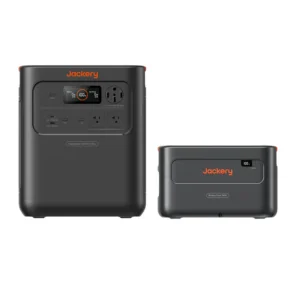
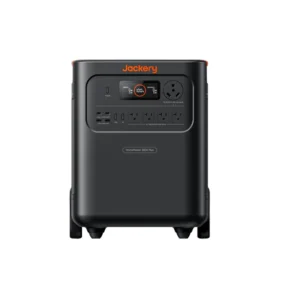
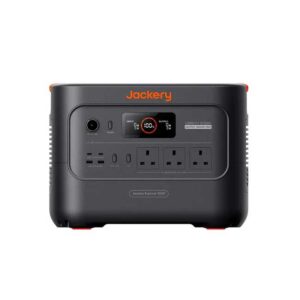
That’s basically the Jackery 3600 Plus vs. 5000 Plus debate. The two sit close together on Jackery’s shelf, and the price gap is big enough to make you hesitate.
Quick Verdict: Jackery 3600 Plus vs. 5000 Plus at a Glance
Jackery 3600 Plus vs. 5000 Plus: If you’re in a hurry, here’s the short version.
Pick the Jackery HomePower 3600 Plus if you want multi-day backup for the essentials (fridge, Wi-Fi, lights, a few outlets), you value a lighter unit with a longer-lasting battery, and you’d like to save a good chunk of cash.
Pick the Jackery Explorer 5000 Plus if you need 240V, want to run heavy appliances like a well pump or an electric dryer, or you’re building toward a serious whole-home setup.
Still here? Good, because the details matter.
Jackery HomePower 3600 Plus vs. Explorer 5000 Plus: Specs Side by Side
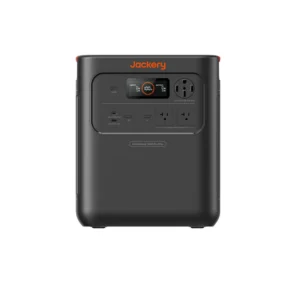
Numbers first, opinions later. The figures below come from Jackery’s own published specifications.
| Feature | Jackery HomePower 3600 Plus | Jackery Explorer 5000 Plus |
|---|---|---|
| Battery capacity | 3,584 Wh | 5,040 Wh |
| Rated / surge output | 3,600W / 7,200W | 7,200W / 14,400W |
| Voltage | 120V | 120V / 240V |
| Expandability | Up to 21 kWh per unit, 43 kWh with two units | Up to 30 kWh per unit, 60 kWh with two units |
| Battery chemistry | LiFePO₄ | LiFePO₄ |
| Cycle life | 6,000 cycles to 70%+ | 4,000 cycles to 70%+ |
| Wall charging | About 2.5 hours | About 3.5 hours |
| Solar charging | About 4 hours (2× SolarSaga 500 X) | About 6.5 hours (2× SolarSaga 500 X) |
| Fastest charging | 2 hours (AC + DC hybrid) | 1.7 hours (smart transfer switch or hybrid) |
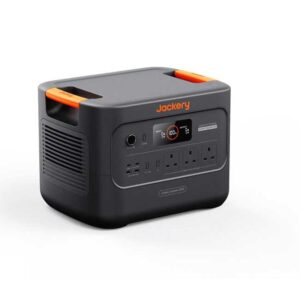
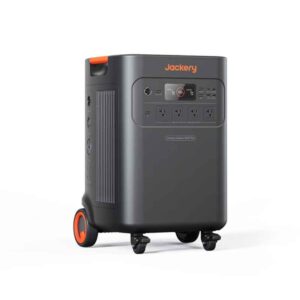
| Weight | 77.16 lbs (35 kg) | 134.5 lbs (61 kg) |
| Size (L×W×H) | 15.2 × 12.2 × 19.3 in | 16.5 × 15.5 × 25 in |
| Noise | Under 30 dB | Under 30 dB |
| UPS switchover | Under 10 ms | 0 ms |
| Warranty | 3+2 years | 3+2 years |
Notice how the 3600 Plus vs. 5000 Plus specs overlap in places and split sharply in others. Chemistry, noise level, warranty, and the app experience are basically twins. Output, voltage, weight, and cycle life are where they part ways.
How We Tested (and Evaluated) the 3600 Plus and 5000 Plus
Let’s be upfront about our method, since trust matters more than hype. We built this comparison by working through each unit’s manufacturer-published specifications line by line. Then we cross-checked Jackery’s listed appliance runtimes, since a 200W fridge or a 1,000W portable AC is a more honest yardstick than a headline watt-hour figure.
We compared recent retail and sale pricing from Jackery, major retailers, and deal trackers. And we scored each unit against a simple rubric of capacity, output, charging speed, portability, longevity, expandability, and value.
Battery Capacity and Expandability: 3,584 Wh vs. 5,040 Wh
Capacity is your fuel tank. It decides how long you can run before you need a recharge.
Starting capacity
The 3600 Plus holds 3,584 Wh. The 5000 Plus holds 5,040 Wh, about 40 percent more. In plain terms, that’s roughly an extra four hours of fridge power or a bit over an hour more of portable air conditioning.
Expansion potential
Both units grow with add-on batteries. The 3600 Plus tops out at 21kWh per unit, or 43kWh with two units in parallel. The 5000 Plus reaches 30kWh per unit, or 60kWh with two.
Honestly, most households will never need 60kWh. Think of it like a garage built for six cars when you own two. It’s nice to have the space, but you pay for it in advance. If your outages last a day or two, the 3600 Plus expansion path is already generous. If you live where week-long grid failures happen, the 5000 Plus gives you more runway.
Power Output: 3,600W vs. 7,200W
Capacity tells you how long. Output tells you how much at once. Mix them up, and you’ll end up with a power station that dies in a hurry or one that refuses to start your appliance at all.
The 120V vs. 240V question
Here’s the single biggest difference in the Jackery 3600 Plus vs. 5000 Plus decision. The 3600 Plus delivers standard 120V power. The 5000 Plus supports both 120V and 240V through its L14-30R/14-50 outlet, rated up to 7,200W.
Why should you care? Because certain household heavy hitters run on 240V: electric dryers, ranges, some well pumps, central air conditioners, and many workshop tools. If any of those are on your must-keep-running list, the 3600 Plus simply can’t do it directly. No amount of capacity changes that.
Surge power and real appliances
Surge matters because motors are drama queens. A fridge compressor or sump pump pulls a big spike when it kicks on. The 3600 Plus handles surges up to 7,200W, which covers the usual suspects. The 5000 Plus doubles that to 14,400W, which gives you comfortable headroom for larger pumps and tools.
If your plan is “fridge, freezer, internet, lights, phones, and a TV,” the 3600 Plus has you covered. If your plan includes a 240V well pump or a big air conditioner, don’t try to squeeze it onto the smaller unit.
Charging Speed: Wall, Solar, and Hybrid
Nobody wants a power station that takes all day to refill. Fortunately, neither of these does.
On a standard wall outlet, the 3600 Plus fills up in about 2.5 hours, while the 5000 Plus takes roughly 3.5. With solar, the 3600 Plus is quicker on paper, around 4 hours with two SolarSaga 500 X panels versus 6.5 hours for the 5000 Plus. That makes sense, since the smaller battery has less to fill.
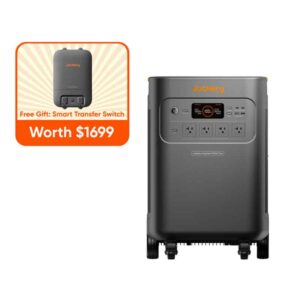
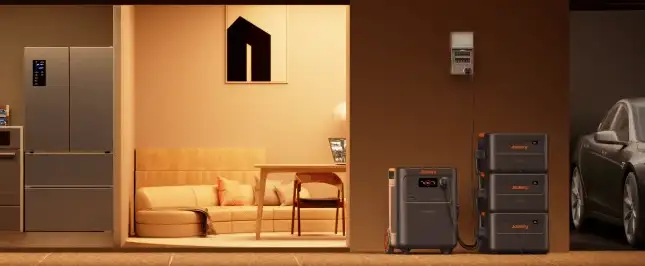
The 5000 Plus fights back with fast hybrid options. Through Jackery’s Smart Transfer Switch, it can charge in about 1.7 hours at up to 4,000W. The 3600 Plus hybrid (AC plus DC) gets you there in about 2 hours. Both are quick enough that a short break in an outage can top you back up.
One more perk worth knowing: the 3600 Plus also supports gas generator and car charging, which is handy when the sun isn’t cooperating.
Portability and Size: Luggage vs. Refrigerator
This is where the 3600 Plus vs. 5000 Plus gap hits you physically.
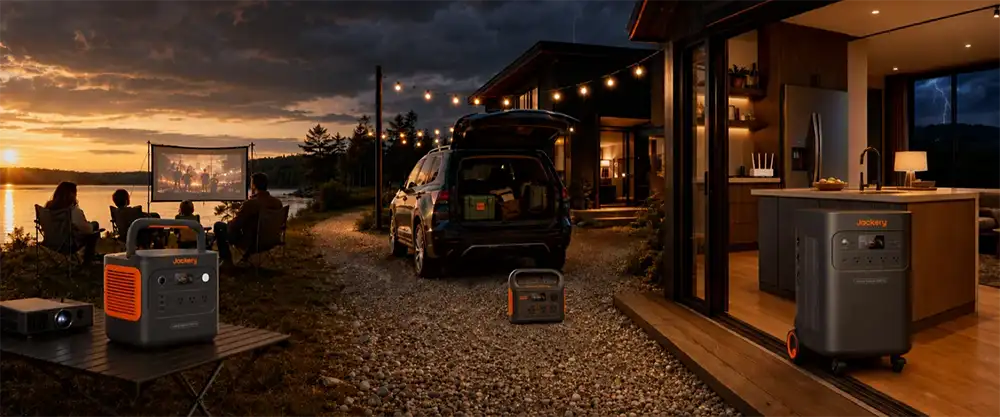
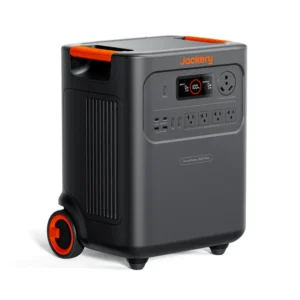
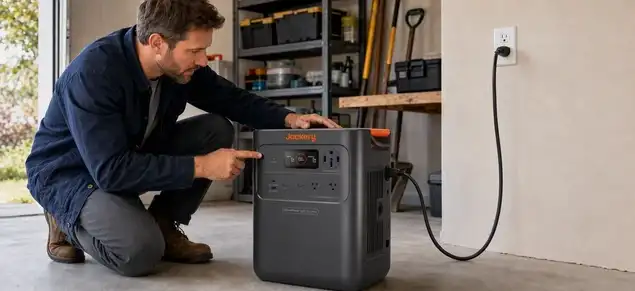
The 3600 Plus weighs about 77 pounds. That’s heavy, yes, but it’s wrangleable with its telescoping handle and wheels. You can pull it like an oversized suitcase and get it into an SUV with a helper.
The 5000 Plus weighs about 134.5 pounds and stands 25 inches tall. It has wheels and a handle too, but think of it as an appliance you roll into place and park, not something you load for a weekend trip. Getting it up porch steps alone is a bad idea.
Your use case decides this one. For RV trips, camping base camps, or moving between rooms, the 3600 Plus wins easily. For a garage or utility-room install that rarely moves, the 5000 Plus weight is a non-issue.
Battery Lifespan and Cold-Weather Performance
Here’s a twist that surprises people: the smaller unit has the longer-lasting battery.
The 3600 Plus is rated for 6,000 cycles to 70 percent capacity. The 5000 Plus is rated for 4,000 cycles to the same threshold. That’s a 50 percent edge for the smaller model. Cycled once a day, 4,000 cycles still stretch past a decade, so for backup duty (where you might cycle it a few dozen times a year), either battery should outlive your patience.
Temperature tolerance also tilts toward the 3600 Plus on paper. It lists charging and discharging from -4°F to 113°F. The 5000 Plus charges from 32°F to 113°F and discharges from 5°F to 113°F. If your unit lives in an unheated garage in a cold climate, that difference deserves a second look.
Real-World Runtime: What Will Each One Actually Power?
Spec sheets are abstract. Appliances are not. Using Jackery’s published runtime estimates:
| Appliance | Jackery 3600 Plus | Jackery 5000 Plus |
|---|---|---|
| Refrigerator (200W) | ~13.7 hours | ~17.1 hours |
| TV (100W) | ~25 hours | ~28.6 hours |
| Computer (200W) | ~13.7 hours | ~17.1 hours |
| Space heater (500W) | ~5.8 hours | ~7.8 hours |
| Portable AC (1,000W) | ~3.0 hours | ~4.1 hours |
| Wi-Fi router (50W) | ~42.3 hours | ~42.8 hours |
A few things jump out. First, the 5000 Plus doesn’t deliver a pure 40 percent runtime boost in every case, because heavier loads and inverter efficiency chip away at the advantage. Second, for tiny loads like Wi-Fi, the two are nearly identical. Third, Jackery says the 3600 Plus can keep a fridge alive for up to 14 days when expanded, which tells you the smaller unit scales nicely with add-on batteries.
If you do the math for your own home, add up the wattage of what you’d really run and divide your battery’s watt-hours by that number. Then knock off about 15 percent for reality.
Price: Which One Gives You More Value?
Prices on both swing wildly during sales, so check current listings before you buy. That said, recent promotions put the HomePower 3600 Plus at roughly $1,699 to $1,799 against a list price of $2,799. The Explorer 5000 Plus has recently appeared around $2,799 to $2,999 against a $4,299 list price. Jackery’s Black Friday sale is live right now, so you may see different numbers today.
Run the cost per kilowatt-hour, and the picture gets interesting. At sale prices, the 3600 Plus works out to about $0.47 to $0.50 per Wh… No, per thousand Wh, call it roughly $470 to $500 per kWh. The 5000 Plus lands near $555 to $595 per kWh. So the smaller unit is actually the cheaper way to buy storage.
But the 5000 Plus offers something you can’t buy on the 3600 Plus at any price: 240V output and double the wattage. Value depends on whether you need those. If you do, the premium is fair. If you don’t, you’re paying for horsepower you’ll never use.
Also look into refurbished 5000 Plus units. Jackery lists them at steep discounts, which can shrink the price gap considerably.
Who Should Buy the Jackery 3600 Plus?
Choose the 3600 Plus if you check most of these boxes:
You want reliable multi-day backup for the essentials. Your appliances all run on 120V. You like the idea of moving the unit between your home, an RV, and the occasional campsite. You’d rather start smaller and add batteries later. And you want the longest battery lifespan for your money.
It’s the sensible, grown-up choice for most households, and honestly, the one we’d steer most readers toward.
Who Should Buy the Jackery 5000 Plus?
Go for the 5000 Plus if this sounds like you:
You need 240V for a well pump, dryer, range, or central AC. You want to run several big appliances at the same time without playing load-shedding games. You’re planning a real whole-home backup with a transfer switch. Or you live somewhere with long, frequent outages and want the highest ceiling for expansion.
If that’s you, the extra cost buys real capability, not just bragging rights.
Pros and Cons Breakdown
Jackery 3600 Plus pros and cons
The upside: lighter at about 77 lbs, longer cycle life at 6,000, lower price, faster wall and solar charging, wider temperature range, and car charging support. The downside: 120V only, lower total output, and a smaller expansion ceiling.
Jackery 5000 Plus pros and cons
The upside: 240V support, 7,200W rated output, 14,400W surge, larger capacity, deeper expansion to 60kWh, and true 0 ms UPS switchover. The downside: heavy at 134.5 lbs, higher price, slower wall and solar charging, and a shorter rated cycle life.
Jackery Stores
| USA | United Kingdom | Germany | Canada |
|---|---|---|---|
 |  |  |  |
| View Special Offers | View Special Offers | View Special Offers | View Special Offers |
Final Verdict: Jackery 3600 Plus vs. 5000 Plus
So, which one wins? It depends on the shape of your life, not on which spec sheet looks flashier.
For most homeowners who want to keep the fridge cold, the internet on, and the lights glowing through a multi-day outage, the Jackery HomePower 3600 Plus is the smarter buy. It’s lighter, cheaper per kilowatt-hour, longer-lived, and easy to expand. For households with 240V loads or serious appliance demands, the Jackery Explorer 5000 Plus is the one that can actually do the job.
Score Box: Our Evaluation Results
| Category | Jackery 3600 Plus | Jackery 5000 Plus |
|---|---|---|
| Capacity & expandability | 8.5/10 | 9.5/10 |
| Power output | 8.0/10 | 9.8/10 |
| Charging speed | 9.0/10 | 8.5/10 |
| Portability | 8.5/10 | 5.5/10 |
| Battery lifespan | 9.5/10 | 8.5/10 |
| Value for money | 9.2/10 | 8.0/10 |
| Overall score | 8.9/10 | 8.3/10 |
FAQs
Yes. Based on Jackery’s figures, a typical 200W fridge runs about 13.7 hours on a single 3600 Plus. With expansion batteries, Jackery says it can keep a fridge going for up to 14 days. Real-world results vary with how often the compressor cycles.
Only if you need what it adds. The 5000 Plus gives you 240V output, 7,200W of continuous power and a bigger battery. If your needs fit within 120V and 3,600W, the 3600 Plus saves you real money and weighs about 57 pounds less.
Yes. The 3600 Plus expands to 21kWh per unit (43kWh with two units), and the 5000 Plus to 30kWh per unit (60kWh with two units). Each uses its own compatible battery pack, so don’t mix them up. The Battery Pack 3600 is for the 3600 Plus, and the Battery Pack 5000 Plus is for the 5000 Plus.
On paper, the 3600 Plus. With two SolarSaga 500 X panels, Jackery lists about 4 hours for the 3600 Plus versus 6.5 hours for the 5000 Plus. The 3600 Plus has a smaller battery to fill, so it finishes first. Real results depend on sunlight, panel angle and weather.
No. Jackery lists both under 30 dB, which is quieter than a whisper. That’s a huge advantage over a gas generator, which makes both models friendly for indoor or garage use, as long as you follow the manufacturer’s ventilation and placement guidance.
You Might Also Like