
Anker SOLIX E10 Price, Specs & Full Review: Is This Whole-Home Backup System Worth Every Penny in 2026?
Understanding the Anker SOLIX E10 price isn’t as simple as looking at one number on a product page. This system is modular, meaning your final cost depends heavily on how you configure it. Think of it like building a custom PC — you start with a base and stack on the components you need.
Anker SOLIX E10 Price – If you’ve been scrolling through reviews and press releases, you’ve probably seen the headline number: $4,299. That’s the Anker SOLIX E10 price for the base model, the “starter pack” of whole-home resilience. But as anyone who has ever bought a house, a car, or even just a decent gaming chair knows, the sticker price is rarely the final cost.
With the SOLIX E10, you’re not just buying a battery; you’re buying an ecosystem. It’s like buying a LEGO set—the fun starts with the core kit, but the real masterpiece (and the real expense) comes when you start adding the expansion packs, the minifigures, and that one rare piece you absolutely must have.
What Exactly Is the Anker SOLIX E10?
The E10 is dubbed a “smart hybrid” product because it can handle charging from solar, the grid, or from a generator. That triple-source flexibility is something most competing systems simply can’t match. And here’s where Anker gets creative — they’ve also built a dedicated smart gas generator that pairs seamlessly with the E10, creating what they call “infinite backup power.” That’s not just marketing fluff. In practice, this means you could theoretically weather any outage, no matter how long it lasts.
Anker SOLIX was celebrated at CES 2026 for wowing attendees with the SOLIX E10 whole-home backup system, thanks to its triple-power approach. Anker SOLIX also earned the 2026 iF Design Award, recognizing excellence in design that makes advanced home energy technology intuitive and accessible.
Why the Anker SOLIX E10 is More Than Just a “Big Battery”
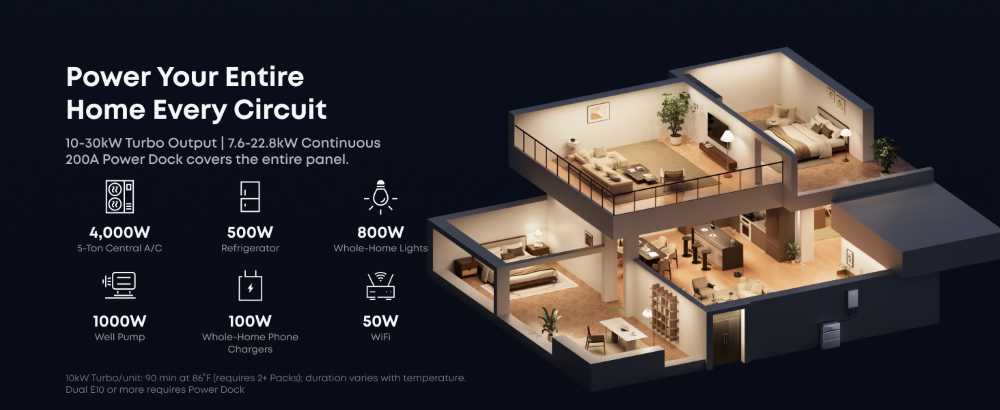
Before we get lost in the spreadsheet of numbers, it’s crucial to understand why the pricing conversation around the E10 is so layered. This isn’t the average portable power station that you charge up for a camping trip. This is a smart hybrid system designed to sit in your garage or basement and act as a silent guardian for your entire electrical panel.
Think of the Anker SOLIX E10 as the Swiss Army knife of home energy. It can store solar power, charge from the grid during cheap off-peak hours, and even fire up a gas generator when the sun has been hiding for a week, and the batteries are running dry. It switches between these sources in under 20 milliseconds—that’s faster than you can blink, meaning your internet router won’t even have time to reset.
This versatility is the secret sauce behind the cost. You’re paying for integration, intelligence, and modularity. Anker has positioned this system to go head-to-head with the Tesla Powerwall and EcoFlow’s high-end systems, but with a unique twist: it combines batteries, solar, and a smart generator into one coordinated dance. This isn’t just outage insurance; it’s a step toward true grid independence, and that premium functionality is baked into the Anker SOLIX E10 price.
Anker SOLIX E10 Price Breakdown: The Base Cost Analysis
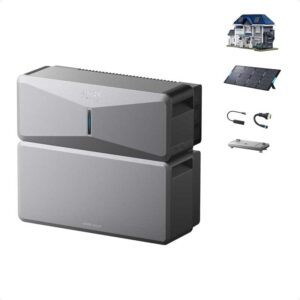
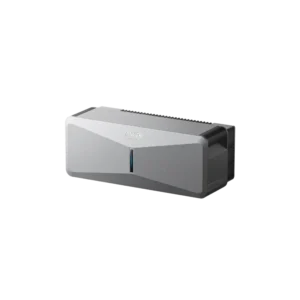
Alright, let’s get down to brass tacks. The entry-level Anker SOLIX E10 price you’ll see advertised is $4,299. For that sum, you’re getting the core components: one Power Module (the brains of the operation) and one B6000 Battery Module with 6kWh of capacity.
But what does that actually buy you?
- Capacity: 6kWh. To put that in perspective, the average American home uses about 30kWh per day. So, this single battery isn’t going to run your air conditioner and electric oven for a week. However, it’s more than enough to keep your essential circuits—refrigerator, lights, internet modem, and maybe the TV for Netflix—humming along for several hours or even a full day if you’re conservative.
- Output: 7.6kW continuous, with a “Turbo” boost up to 10kW for 90 minutes. That turbo mode is a clever trick. It’s like having a nitrous button for your home. Need to start a well pump or a power tool briefly? The E10 can surge to handle that peak demand without needing a much larger (and more expensive) inverter.
Here’s the kicker: the base $4,299 system is a manual backup solution. If the grid goes down, you’ll need to plug your extension cord or transfer switch into the unit yourself. It’s powerful, but it’s not “set it and forget it.” For that, you need to climb the pricing ladder.
Comparing the Entry Price: Is It Competitive?
When you stack the Anker SOLIX E10 price against a Tesla Powerwall (which typically starts around $9,000-$10,000 before installation), the E10 seems like a bargain. However, it’s important to compare apples to apples. The Powerwall is a fully integrated, permanent fixture with a built-in automatic transfer switch.
The base E10 is more of a semi-portable, high-capacity power station with a home integration path. It’s a different philosophy, and that lower entry barrier is a strategic win for Anker, allowing homeowners to dip their toes into home backup without a full system overhaul.
| System | Base Price | Capacity (Base) | Cost per kWh | Installer Required? | Max Expandable Capacity |
|---|---|---|---|---|---|
| Anker SOLIX E10 | $4,299 | 3.84 kWh | ~$651/kWh | Optional | 53.76 kWh |
| Tesla Powerwall 3 | ~$11,500 (installed) | 13.5 kWh | ~$852/kWh | Yes (Tesla-authorized) | 13.5 kWh (per unit) |
| EcoFlow DELTA Pro Ultra | ~$5,799 | 6 kWh | ~$966/kWh | No | ~42 kWh |
| Anker SOLIX E10 + Power Dock | $5,799 | 3.84 kWh | Varies | Optional | 53.76 kWh |
| Anker SOLIX E10 + Smart Generator | $5,899 | 3.84 kWh + Infinite | N/A | Optional | Unlimited (with fuel) |
Detailed Bundle Pricing: What You Get for Your Money
If the base model is the appetizer, the bundles are the main course. Anker offers several tiers to suit different levels of paranoia and budget. Here’s a clear table to visualize how the Anker SOLIX E10 price scales with capability.
| Bundle Name / Components | Approximate Price (USD) | Key Feature | Who It’s For |
|---|---|---|---|
| Base System (1x Power Module + 1x 6kWh Battery) | $4,299 | Manual connection, 7.6kW output | DIYers, small homes, essential circuit backup |
| Base System + Smart Inlet Box | $4,599 | Grid charging, easier manual hookup | Homes looking for simple solar/grid integration |
| Base System + Power Dock | $5,799 | Automatic 200A transfer switch, whole-home coverage | Families wanting seamless, “lights stay on” backup |
| E10 + Smart Generator + Power Dock | $7,399 | Infinite runtime via tri-fuel generator | Ultimate preparedness for extended outages |
| Infinite Backup Kit (2x Batteries) | $15,698+ | 24kWh capacity, 20kW output, 66kW surge | Large homes with high energy demands |
It’s worth noting that the prices above are for the hardware only. Unless you’re a licensed electrician, you’re going to need professional installation for the Smart Inlet Box and the Power Dock. Depending on your location and the complexity of your electrical panel, this can add anywhere from $1,000 to $3,000 to your total project cost.
A reviewer who installed a two-battery system with the generator and Power Dock reported a total project cost (including electrician fees) of over $10,000. So, when you’re calculating your final Anker SOLIX E10 price, be sure to budget for the labor.
The Generator Game-Changer
The Smart Generator 5500 is a fascinating piece of the puzzle. It’s a tri-fuel generator (gasoline, propane, natural gas) that talks directly to the E10 system via a DC connection. Instead of running at a constant (and inefficient) speed like a traditional generator, this one is variable speed.
It only spins as fast as needed to charge the battery. This is a massive efficiency gain—Anker claims it’s up to 5x more efficient than older solutions. While it adds significantly to the Anker SOLIX E10 price, it’s the key to “infinite” backup, ensuring you have power even after a week-long storm when the solar panels are covered in snow.
Long-Term Savings: Can the E10 Pay for Itself?
Here’s where the financial story gets really interesting. The Anker SOLIX E10 price is an upfront capital expense, but it’s also a tool for reducing your operating expenses. Think of it as a high-tech, lithium-powered coupon for your electric bill.
In many parts of the United States (and increasingly around the world), utilities charge “Time-of-Use” (TOU) rates. Electricity is cheap at 2:00 AM and expensive at 6:00 PM. The Anker SOLIX E10 can be programmed to charge up on that cheap, sleepy-time electricity and then discharge to power your home during the expensive peak hours.
Alternatively, if you have solar panels, it stores the free sunshine you generate during the day instead of selling it back to the grid for pennies on the dollar.
Anker claims that using this TOU mode in conjunction with solar can slash your energy bills by up to 80%. Let’s be realistic: 80% is the best-case, stars-aligning scenario. But even a 30-50% reduction on a high monthly electric bill adds up quickly. If you’re saving $150 a month on electricity, the base $4,299 system pays for itself in just over two years.
That’s a compelling narrative that reframes the Anker SOLIX E10 price from a “cost” into an “investment.”
| SOLIX E10+Power Dock | SOLIX E10 | SOLIX E10+Extra Battery | SOLIX E10+Inlet Box | E10+Inlet Box+Battery | E10+Power Dock+Battery | SOLIX E10+Generator 5500 | |
|---|---|---|---|---|---|---|---|
| View Product | View Product | View Product | View Product | View Product | View Product | View Product | |
| Price | $ 6,499 .00 | $ 4,299.00 | $ 6,298.99 | $ 5,299.00 | $ 7,299.00 | $ 7,799.00 | $ 6,599.00 |
| Turbo Output | N.A. | N.A. | 10kW (90-min) | N.A. | 10kW (90-min) | 10kW (90-min) | N.A |
| Rated Output | 7.6kW | 7.6kW | 7.6kW | 7.6kW | 7.6kW | 7.6kW | 7.6kW |
| Battery Capacity | 6kWh | 6kWh | 12kWh | 6kWh | 12kWh | 12kWh | 6kWh |
| Solar Input | 9kW | 9kW | 9kW | 9kW | 9kW | 9kW | 9kW |
| Smart Generator | N | N | N | N | N | N | Y |
| Switch | Automatic | – | – | Manual | Manual | Manual | – |
| Weight | 60.6lb+130lb+60lb | 60.6lb+130lb | 60.6lb+130lb*2 | 60.6lb+130lb+14.3 lb | 60.6lb+130lb*2+14.3lb | 60.6lb+130lb*2+60lb | 60.6lb+130lb+110.8 lb |
| Inverter Dimension | 26.4 × 11.8 × 10.2 in | 26.4 × 11.8 × 10.2 in | 26.4 × 11.8 × 10.2 in | 26.4 × 11.8 × 10.2 in | 26.4 × 11.8 × 10.2 in | 26.4 × 11.8 × 10.2 in | 26.4 × 11.8 × 10.2 in |
| Battery Dimension | 26.4 × 12.7 × 11.1 in | 26.4 × 12.7 × 11.1 in | 26.4 × 12.7 × 11.1 in | 26.4 × 12.7 × 11.1 in | 26.4 × 12.7 × 11.1 in | 26.4 × 12.7 × 11.1 in | 26.4 × 12.7 × 11.1 in |
| UPS | ≤20ms | ≤20ms | ≤20ms | – | – | ≤20ms | ≤20ms |
Expansion Options: Scaling Your Power and Budget
The modularity of the E10 is its superpower, but it’s also a potential money pit (in the best way possible). You can start small and grow the system as your needs and budget allow.
This is where the modular magic really shines. Each additional Anker SOLIX B6000 battery module adds 3.84kWh of capacity at $2,499 per unit. That works out to roughly $651 per kilowatt-hour, which is actually quite competitive in the premium home battery market.
Each B6000 battery pack adds another 6kWh of capacity. A single Power Module can manage up to five batteries (30kWh total), and you can stack up to three Power Modules together for a maximum capacity of 90kWh.
At this point, you’re not just backing up your fridge; you’re powering a small compound. Anker suggests a fully maxed-out system could sustain a home for up to 15 days without any solar or grid input. Of course, the Anker SOLIX E10 price for a fully loaded 90kWh system is substantial—likely pushing well past $30,000—but it’s an option that few other systems on the market can match with such a user-friendly, plug-and-play approach.
For most families, though, a mid-range configuration of two to four battery modules covering 7.68kWh to 15.36kWh is more than enough to weather even multi-day outages comfortably.
Anker SOLIX E10 vs. The Competition: A Value Comparison
How does the Anker SOLIX E10 price stack up against the usual suspects? Let’s take a quick glance:
- Tesla Powerwall 3: Generally more expensive upfront. A single Powerwall 3 (13.5kWh) often exceeds $10,000 installed. While the Tesla ecosystem is slick, the E10 offers a lower entry price and the unique hybrid generator integration that Tesla lacks.
- EcoFlow DELTA Pro Ultra X: EcoFlow’s ecosystem is very similar, offering modular batteries and a “Smart Home Panel.” The pricing is competitive, with the base system often landing in a similar $5,000-$6,000 range. The choice often comes down to brand preference and specific feature sets like the E10’s NEMA 4 outdoor durability.
- Traditional Standby Generators (Generac): A whole-home natural gas generator costs between $5,000 and $10,000 installed. However, you then pay for fuel (gas) every time you use it. The E10’s solar/battery combo eliminates that recurring fuel cost.
The E10’s value proposition lies in its flexibility. It’s the only major system that seamlessly blends the clean, quiet power of a battery with the long-duration reliability of a fossil-fuel generator.
| System | Base Price | Capacity (Base) | Cost per kWh | Installer Required? | Max Expandable Capacity |
|---|---|---|---|---|---|
| Anker SOLIX E10 | $4,299 | 3.84 kWh | ~$651/kWh | Optional | 53.76 kWh |
| Tesla Powerwall 3 | ~$11,500 (installed) | 13.5 kWh | ~$852/kWh | Yes (Tesla-authorized) | 13.5 kWh (per unit) |
| EcoFlow DELTA Pro Ultra | ~$5,799 | 6 kWh | ~$966/kWh | No | ~42 kWh |
| Anker SOLIX E10 + Power Dock | $5,799 | 3.84 kWh | Varies | Optional | 53.76 kWh |
| Anker SOLIX E10 + Smart Generator | $5,899 | 3.84 kWh + Infinite | N/A | Optional | Unlimited (with fuel) |
Key Specifications That Justify the Anker SOLIX E10 Price
1. Power Output — 10kW Turbo Mode
A single E10 unit delivers a continuous output of 7.68 kW, but when you need to fire up something thirsty — like a central air conditioner — the system can kick out 10 kW for up to 90 minutes in Turbo Mode. That’s a massive advantage for households with high-draw appliances.
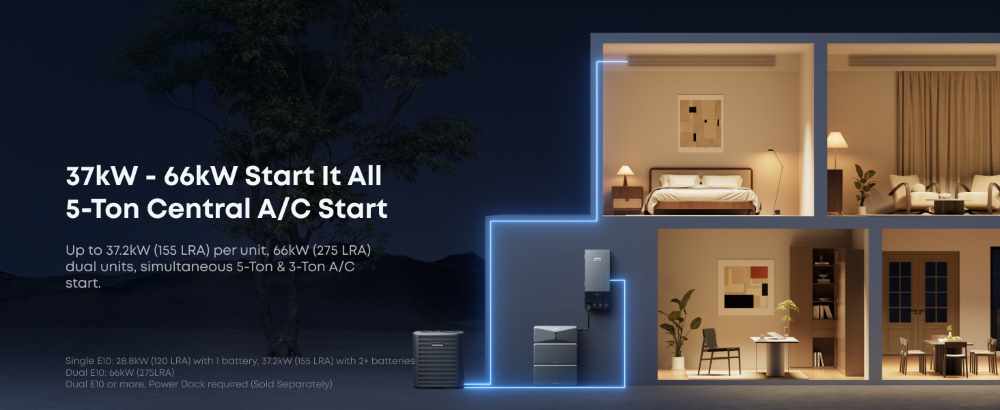
Even more impressive? If you combine two E10 units, the surge capacity hits 66 kW — enough grunt to start almost any residential appliance you can throw at it, including a 5-ton AC unit with a high starting wattage.
2. Near-Instant Transfer Speed
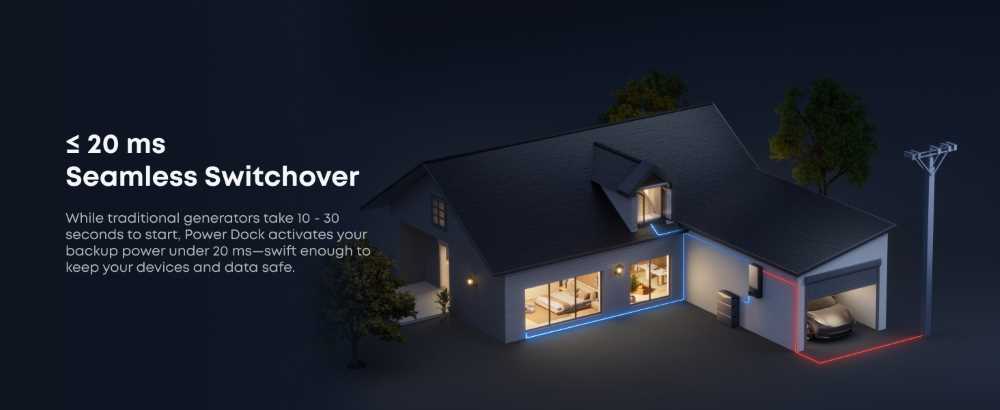
Ever noticed how even a split-second power interruption is enough to reboot your router, reset your microwave clock, and crash your work computer? With the Anker SOLIX E10 and the Power Dock, the transfer switch happens in under 20 milliseconds. That’s faster than your eye can blink. Your home literally won’t feel the outage happen.
3. Battery Longevity — Built for the Long Game
The E10 uses durable components and retains 80% of its capacity after 4,000 charge cycles. If you’re charging and discharging the system daily, that’s over 10 years of useful battery life. That kind of longevity dramatically improves the return on your investment when you calculate the Anker SOLIX E10 cost over time.
4. NEMA 4 Weather Protection
The Anker SOLIX E10 features an all-metal NEMA 4 enclosure with UV protection, rated to operate in temperatures ranging from -4°F all the way up to 131°F. Whether you mount it in the garage or on an outdoor concrete pad, this thing is genuinely built to survive the elements.
The Smart Generator: Why It Changes the Price-Value Equation
One of the most underrated aspects of the Anker SOLIX E10 whole-home backup price discussion is the Smart Generator 5500 integration. Here’s why it matters.
The Smart Generator is a tri-fuel generator supporting gas, propane, and natural gas as fuels, and Anker calls this “infinite backup power” due to the multi-fuel range extension. When paired with the E10, it doesn’t just sit there as a clunky backup — it actually communicates with the battery system intelligently.
When the battery hits a certain low point, the generator automatically kicks on to recharge it, and once the battery is full, it shuts off. You don’t have to go outside in the cold to pull a cord. That level of automation turns the E10 + generator combo into something that practically runs itself.
Even more compelling: when powering the same energy demand, the E10’s DC range-extended technology generates five times more usable energy than a traditional standby generator using the same amount of fuel. So not only are you getting “infinite” backup, you’re getting it more efficiently than old-school generator setups.
Solar Integration: The Long-Term Cost Saver
If you’ve got solar panels or are planning to add them, the Anker SOLIX E10 battery system cost starts looking like an investment rather than an expense.
When paired with Power Dock or Smart Inlet Box, the E10 uses AC coupling, self-consumption, and Time-of-Use (TOU) modes, combined with solar energy, to reduce electricity bills by up to 80%. Over the lifetime of the system, that kind of savings has the potential to pay off a substantial portion of your initial investment.
On the solar input side, the system can handle up to 9 kW per unit, and with dual MPPT inputs, it supports both new and existing solar installations. That’s a big deal if you’ve already spent money on solar panels — you don’t have to start from scratch.
Installation Considerations: The Hidden Costs
We’ve touched on this, but it bears repeating: the final Anker SOLIX E10 price will include installation fees if you opt for the automatic backup kits.
The Power Dock is a 200-amp smart panel that sits between your utility meter and your main breaker panel. Installing this is a job for a licensed electrician and requires pulling permits with your local municipality. It’s not a quick DIY afternoon project. The Smart Inlet Box is simpler but still requires a connection to your home’s wiring.
When you’re budgeting, always, always add a 20-30% buffer to the hardware cost to account for the soft costs: labor, permits, and shipping. If the hardware is $5,799, plan for a total spend closer to $7,500.
Real-World Performance: What Reviewers Are Saying
Numbers on a spec sheet are one thing. Real-world performance is another. Let’s look at what independent testers found.
Reviewers found that the system easily handled its rated output without any issues, and what was particularly impressive was how the unit handled surge testing — achieving surges of nearly 30kW for short bursts. For a home backup system, that surge headroom is remarkable.
When overloaded, the E10 didn’t just shut down and stay off, which is often the case with smaller power stations; instead, it recovered gracefully, which speaks to the quality of its engineering.
One real user shared: “A car accident took out a utility pole near my subdivision, and we lost power for a little over 18 hours. The E10 kept our entire house running the whole time without missing a beat.”
Who Should Actually Buy the Anker SOLIX E10?
Now for the million-dollar (or $4,299) question: Is this thing for you? The Anker SOLIX E10 price is a barrier, yes, but it’s a barrier to a specific club.
You should buy it if:
- You live in an area with frequent power outages or severe weather events (hurricanes, ice storms, wildfires).
- You are a homeowner who wants to start reducing reliance on the grid and wants a safety net.
- You appreciate a modular, tech-forward approach to home improvement.
- You want the ability to integrate solar power without being locked into a single installer or brand.
You should probably skip it if:
- You rent your home or plan to move soon (the installation is semi-permanent).
- You rarely lose power and are happy with a small, portable power station for your phone and laptop.
- You are looking for the absolute cheapest backup option (a gas generator is still cheaper upfront).
The Verdict on Value: Is It Worth It?
We’ve looked at the numbers, the features, and the fine print. So, where does that leave us with the Anker SOLIX E10 price?
This isn’t an impulse buy. It’s a considered purchase, similar to upgrading your HVAC system or installing solar panels. But in a world where the climate is getting weirder, and the grid feels increasingly fragile, the value of energy security is skyrocketing.
The E10 offers a unique path to that security. It doesn’t force you to choose between clean solar power and reliable generator power. It gives you both, wrapped in a user-friendly package. The base Anker SOLIX E10 price of $4,299 is the cost of entry to a world where you stop worrying about the weather forecast. And for a growing number of homeowners, that’s a price worth paying.
Conclusion
The Anker SOLIX E10 price is a multifaceted topic, ranging from an accessible $4,299 entry point to a substantial five-figure investment for a full-scale, generator-backed, 90kWh fortress. It’s a system designed for the long haul, offering not just emergency backup but a legitimate strategy for reducing daily energy costs through smart time-of-use management.
While the hardware costs are clear, remember that installation, particularly for the Power Dock, will inflate your final bill. However, when compared to the competition from Tesla and traditional generator manufacturers, the E10 carves out a compelling niche.
It’s the hybrid solution for the hybrid world—blending the silence of solar with the roar of a generator, all under the umbrella of a trusted name in electronics. If you have the means and the need for unshakeable power, the E10 delivers a level of versatility and peace of mind that is hard to find anywhere else in 2026.
FAQs About Anker SOLIX E10 Price
No, the Anker SOLIX E10 price listed on the website is for the hardware only. The base system can be used as a portable unit (similar to a giant power station), but if you want the automatic whole-home backup capabilities via the Power Dock or Smart Inlet Box, you will need to hire a certified electrician, which is an additional cost.
Absolutely! This is one of the best ways to offset the Anker SOLIX E10 price. The system supports up to 9kW of solar input per unit. By storing excess solar energy during the day and using it during peak rate periods in the evening, you can significantly reduce your utility bill. Anker estimates savings of up to 80% on energy costs, helping the system pay for itself over a few years.
Yes, the entry-level Anker SOLIX E10 price of $4,299 is significantly lower than the typical cost of a Tesla Powerwall, which often starts around $9,000-$10,000 before installation. However, the base E10 system provides less capacity (6kWh vs 13.5kWh) and requires an additional component (the Power Dock) for fully automatic backup, which narrows the price gap.
Yes, history suggests the Anker SOLIX E10 price is subject to promotions. We've seen discounts ranging from $500 coupons during pre-order to $1,600 off during Earth Day events. It's highly likely that the system will see discounts during major sales events like Black Friday, Prime Day, and Cyber Monday.
The Anker SOLIX E10 starts at $4,299 for the base configuration, which includes one Power Module and one B6000 Battery Module. Bundle packages with the Smart Inlet Box or Power Dock range from $4,599 to $5,799.
Each additional B6000 Battery Module costs $2,499 and adds 3.84kWh of capacity. The maximum configuration supports up to 14 battery modules across three Power Modules, reaching 53.76kWh of total storage.
Yes, significantly so. The Anker SOLIX E10 base price is $4,299, while the Tesla Powerwall 3 costs approximately $11,500 fully installed. The E10 also doesn't require a Tesla-authorized installer, giving you more flexibility in who sets it up.
When paired with the Smart Generator 5500, the system offers what Anker calls "infinite backup power." As long as you have fuel available — whether gasoline, propane, or natural gas — the generator can recharge the battery indefinitely, covering even the longest outages.
Home battery storage systems certified to UL9540A standards are generally eligible for the federal Investment Tax Credit (ITC) in the United States, which can cover up to 30% of the system cost. However, tax eligibility depends on your individual situation, so it's always advisable to consult a tax professional for personalized guidance.
You Might Also Like