

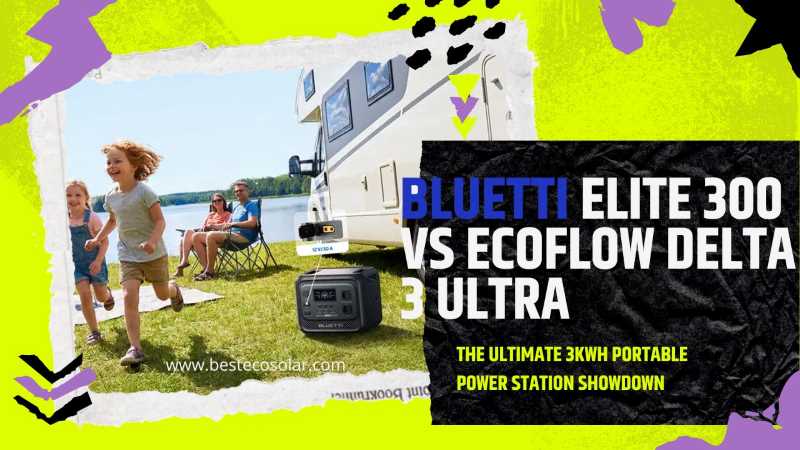
BLUETTI Elite 300 VS EcoFlow DELTA 3 Ultra: The Ultimate 3kWh Portable Power Station Showdown
Two names keep popping up in every conversation about serious backup power: the BLUETTI Elite 300 and the EcoFlow DELTA 3 Ultra. Both of these beasts promise roughly 3,000 watt-hours of juice. Both use rock-solid LiFePO4 battery chemistry. And both claim to be the answer to your power outage nightmares.
BLUETTI Elite 300 VS EcoFlow DELTA 3 Ultra – They’re built for very different people. One is a featherweight champion that you can actually lift without calling your gym buddy. The other is a silent powerhouse that could run your entire kitchen without breaking a sweat.
So, which one deserves a spot in your garage, your RV, or your bug-out bag? I’ve dug into the latest hands-on reviews, official specs, and real-world torture tests to give you the no-BS breakdown. Let’s get into it.
What’s the Big Deal About 3kWh Power Stations Anyway?
Before we pit these two against each other, let’s talk about why 3kWh (that’s 3,000 watt-hours) is such a sweet spot. Think of it like this: a 1kWh power station is like a large water bottle—great for a short hike, but you’ll be thirsty again soon. A 5kWh unit is like hauling a 50-gallon drum—overkill for most people and a pain to move around.
A 3kWh portable power station? That’s your trusty 5-gallon camping jug. It’s enough to keep your essentials humming for a full day (or longer if you’re careful), but it’s still portable enough to toss in your trunk.
In practical terms, 3kWh means you can run a full-size refrigerator for about 20-25 hours, charge your laptop 50+ times, or keep your Wi-Fi router and lights on for well over a day.
For anyone living in hurricane country, dealing with rolling blackouts, or dreaming of off-grid van life, this capacity is the Goldilocks zone. And that’s exactly why the BLUETTI Elite 300 VS EcoFlow DELTA 3 Ultra debate is so heated right now.
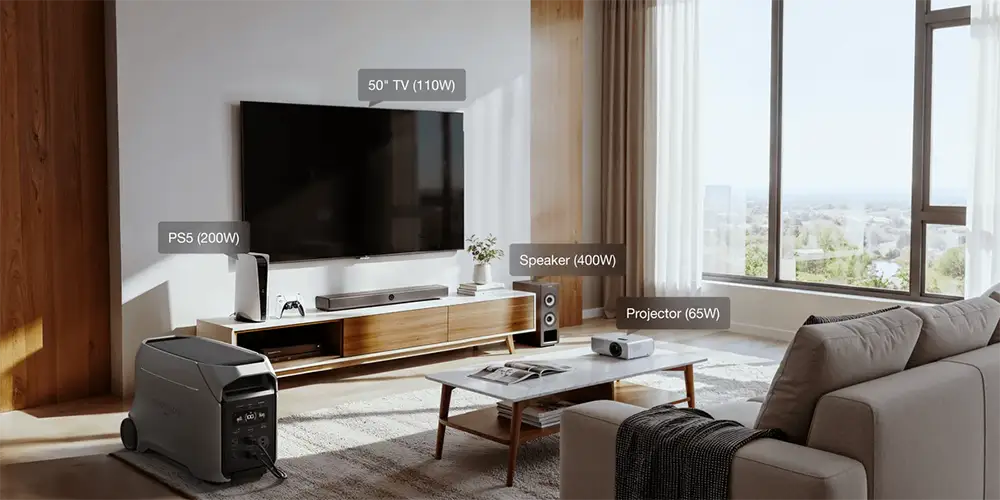
Battery Capacity and Chemistry
1. BLUETTI Elite 300: Compact but Non-Expandable
The BLUETTI Elite 300 packs a 3,014.4Wh LiFePO4 battery. That’s a mouthful, but all you need to know is this: LiFePO4 cells are the gold standard for safety and longevity. BLUETTI claims 6,000 charge cycles before the battery hits 80% capacity, and they back it with a 5-year warranty. That’s roughly a decade of regular use.
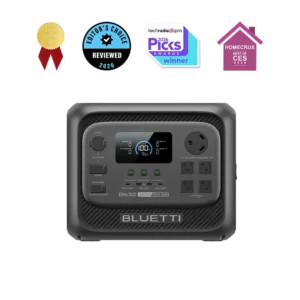
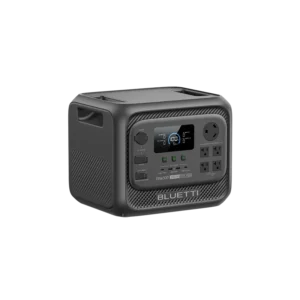
Here’s the catch, though. The Elite 300 is not expandable. What you see is what you get. There’s no slot to slap on an extra battery pack if you decide you need more juice later. For some people, that’s a dealbreaker. For others, it’s liberating—no temptation to keep spending, no bulky add-ons to store. It’s a self-contained unit, plain and simple.
2. EcoFlow DELTA 3 Ultra: Slightly More Juice, But Also Fixed
The EcoFlow DELTA 3 Ultra edges ahead with 3,072Wh of LFP capacity. EcoFlow uses what they call “automotive-grade full-tab cells,” which basically means lower internal resistance and better heat management under heavy loads. They also rate the battery for a 10-year lifespan, though the warranty is technically 3 years plus 2 years extended if you register through the app.
Output Power – Can It Actually Run Your Stuff?
1. BLUETTI Elite 300: Modest but Efficient
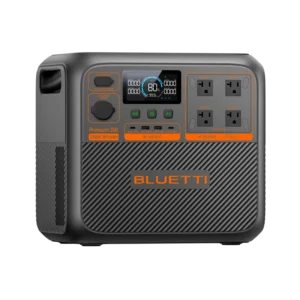
Here’s where the BLUETTI Elite 300 starts to show its compromises. It delivers 2,400W of continuous AC output with a 4,800W surge in Power Lifting Mode. That’s enough for a hair dryer, a microwave, or most power tools—but only one at a time if they’re power-hungry. Why? Because the Elite 300 only has two AC outlets (on the EU/global version; the US version gets four).
Real-world testing showed the Elite 300 handles surge loads surprisingly well, peaking around 3,900W in practice. But if you try to run a space heater and a coffee maker simultaneously, you’ll trip the overload protection. It’s like asking a compact sedan to tow a boat—it’ll try, but it’s not pretty.
2. EcoFlow DELTA 3 Ultra: The Heavyweight Champion
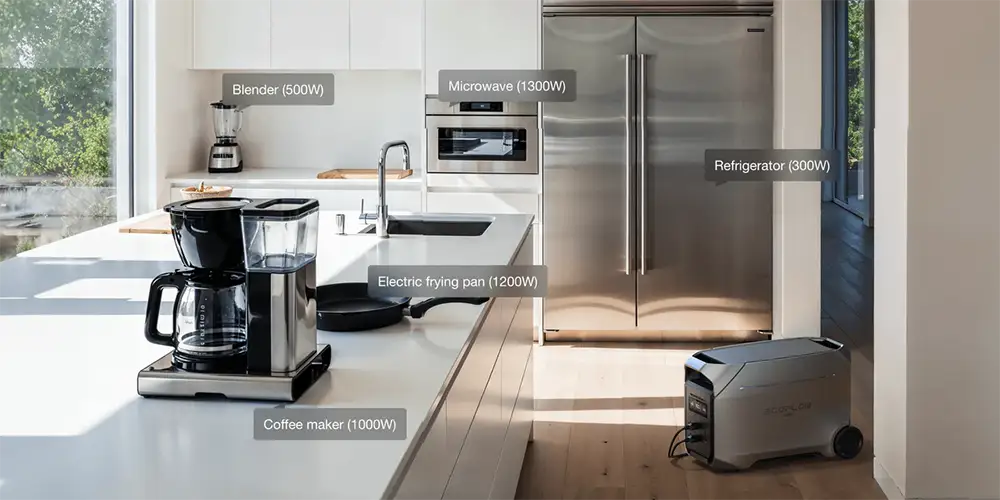
The EcoFlow DELTA 3 Ultra is an entirely different animal. We’re talking 3,600W continuous output and a 7,200W surge. That’s 50% more raw power than the Elite 300. Plus, EcoFlow’s X-Boost technology can push resistive loads (like space heaters or hair dryers) up to 4,600W.
What does that mean in English? You can run a full-size microwave, a clothes dryer on low heat, a table saw, or even a small window AC unit without blinking. And with four AC outlets on the US model, you’re not playing musical chairs with your plugs. This is the unit you buy when you want to pretend the grid never went down.
Portability – Can You Actually Lift It?
1. BLUETTI Elite 300: The Featherweight Surprise
This is where BLUETTI absolutely crushes it. The Elite 300 weighs just 26.3 kg (58 lbs) and measures roughly 36.6 × 30.5 × 29.8 cm. BLUETTI claims it’s the world’s smallest 3kWh power station, and independent reviewers agree—it’s genuinely compact for this capacity class. One reviewer described it as “a 3kWh power station in the size of a 2kWh system.”
You can actually lift this thing into your car without herniating a disc. For campers, RV owners, and anyone who needs to move their power around, this is a massive advantage. It’s the difference between a power station you use and one that becomes a permanent fixture in your garage because it’s too heavy to bother with.
2. EcoFlow DELTA 3 Ultra: The Gym Membership Test
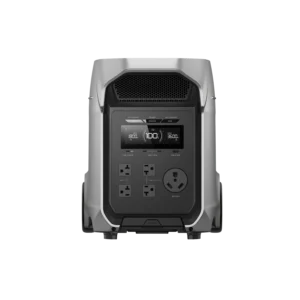
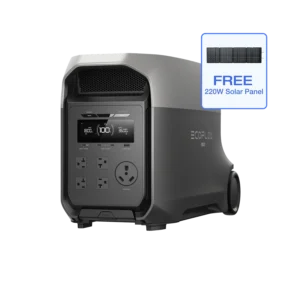
The DELTA 3 Ultra weighs about 32.7 kg (72 lbs). That’s roughly 14 pounds heavier than the Elite 300. It’s also physically larger. Now, 72 lbs isn’t impossible to move—many people can handle it with two hands—but it’s definitely not something you’ll casually toss into a kayak.
EcoFlow’s design is built around an EV-grade CTC (Cell-to-Chassis) structure, which is rigid and durable but adds bulk. If your plan is to park this in your basement for home backup and wheel it out once a year, the weight is irrelevant. But if you’re a digital nomad living in a van? That extra heft matters every single day.
Bluetti Stores
| USA | Australia | Europe | United Kingdom |
|---|---|---|---|
 |
 |
 |
 |
| Visit Store | Visit Store | Visit Store | Visit Store |
| Italy | Germany | France | Canada |
 |
 |
 |
 |
| Visit Store | Visit Store | Visit Store | Visit Store |
Charging Speed – How Fast Until You’re Back in Business?
1. BLUETTI Elite 300: Respectable, Not Record-Breaking
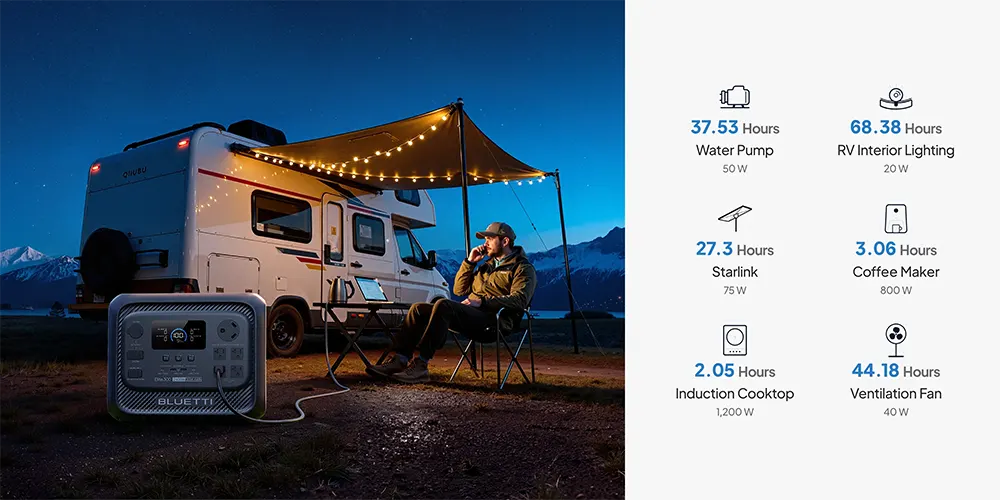
The Elite 300 charges via AC at up to 1,800W (US version) or 2,300W (EU version). In practice, that means 0-80% in about 78 minutes and a full charge in roughly 1.6 hours at max speed. Solar input maxes out at 1,200W, and you can combine AC + solar for a total of 2,400W input.
One reviewer noted that at standard 1,200W charging, the Elite 300 took about 2 hours and 44 minutes to go from empty to full. That’s not lightning-fast, but for a 3kWh unit, it’s perfectly respectable. The EU version’s faster 2,300W input is a nice bonus if you’re on 230V power.
2. EcoFlow DELTA 3 Ultra: X-Stream Charging Dominance
EcoFlow’s X-Stream technology is legendary for a reason. The DELTA 3 Ultra charges from 0-80% in just 89 minutes via AC wall charging. That’s nearly twice as fast as many competitors. The unit accepts 1,800W AC input, plus up to 800W solar input (or 1,600W on the Ultra Plus model).
Here’s where EcoFlow’s ecosystem shines: if you pair it with their Smart Generator or use dual charging methods, you can hit even faster speeds. The Ultra Plus, for example, can hit 0-80% in 48 minutes with solar + generator dual charging. For emergency scenarios where you need to “charge before the storm hits,” this speed is a genuine lifesaver.
Noise Levels – Will It Wake the Baby?
1. BLUETTI Elite 300: Loud Under Load
This is one of the Elite 300’s biggest weaknesses. Under heavy loads, the fan noise pushes over 50 dB (measured from 1 meter away). That’s roughly equivalent to a quiet office or a refrigerator humming. Not terrible, but if you’re camping in a quiet forest or trying to sleep in the same room during a blackout, you’ll definitely notice it.
2. EcoFlow DELTA 3 Ultra: Whisper-Quiet Operation
EcoFlow has pulled off something genuinely impressive here. At 600W output, the DELTA 3 Ultra operates at just 25 dB. That’s quieter than a whisper. Even under heavier loads, the EV-grade cooling and full-tab cell design keep noise to a minimum. For home backup—especially if the unit lives in your living room or bedroom—this is a game-changer.
It’s the difference between forgetting it’s there and constantly being reminded that your power is running on borrowed time.
Ports, Outlets, and Practical Connectivity
1. BLUETTI Elite 300: Thoughtful but Limited
The Elite 300 keeps things simple. On the US model, you get:
- 4x AC outlets (120V)
- 1x NEMA TT-30 RV port (30A)
- 2x USB-C (100W and 140W)
- 2x USB-A (15W)
- 1x 12V car socket (120W)
- 1x 12V/30A DC output (XT90)
That 30A RV port is a standout feature—perfectly positioned and sideways-mounted so it doesn’t block your other outlets. The high-output USB-C ports are also a welcome touch for laptop users. But the tight spacing between AC outlets is a common complaint; bulky power bricks will block neighboring plugs.
2. EcoFlow DELTA 3 Ultra: The Kitchen Sink Approach
The DELTA 3 Ultra is loaded:
- 4x AC outlets (US model)
- 1x TT-30 RV port
- 1x USB-C (140W)
- 2x USB-C (45W)
- 1x USB-A (18W)
- 1x 12V car socket
- 1x Anderson port (for RVs and solar)
The Anderson port is a nice addition for RV owners, and the overall layout is spacious. You won’t be fighting with oversized plugs here. Plus, the Smart Output Priority feature on the Ultra Plus lets you choose which circuits stay powered via the app—something BLUETTI simply doesn’t offer.
Smart Features and App Control
1. BLUETTI Elite 300: Functional but Basic
The BLUETTI app connects via Wi-Fi and Bluetooth and lets you monitor power flows, toggle AC/DC ports, check remaining runtime, and install firmware updates. It’s functional, but reviewers describe it as “a bit laggy than the EcoFlow app.” You can set charging modes (Silent, Normal, Turbo), enable a child lock, and schedule basic tasks. However, features like off-peak charging scheduling are missing.
2. EcoFlow DELTA 3 Ultra: OASIS 3.0 is in Another League
EcoFlow’s OASIS 3.0 app is widely considered one of the best in the business. Beyond basic monitoring, you get:
- Storm Guard Mode: Auto-charges to 100% when severe weather is detected
- Self-Powered Mode: Optimizes charging around Time-of-Use electricity rates
- Scheduled Tasks: Automate charge/discharge cycles
- Smart Output Priority (Ultra Plus): Manage which devices get power first
- Generator Auto Start/Stop (Ultra Plus): Pairs with EcoFlow Smart Generators
The app is snappy, intuitive, and genuinely useful—not just a gimmick to check a box on the spec sheet.
BLUETTI Elite 300 VS EcoFlow DELTA 3 Ultra Comparison Table
| Feature | BLUETTI Elite 300 | EcoFlow DELTA 3 Ultra |
|---|---|---|
| Battery Capacity | 3,014.4Wh | 3,072Wh |
| Battery Chemistry | LiFePO4 | LiFePO4 (automotive-grade full-tab) |
| AC Output (Continuous) | 2,400W | 3,600W |
| AC Output (Surge) | 4,800W | 7,200W |
| X-Boost / Power Lifting | Up to ~3,900W tested | Up to 4,600W |
| AC Outlets | 2 (EU) / 4 (US) | 4 (US) |
| USB-C Ports | 2 (100W + 140W) | 3 (140W + 2×45W) |
| RV Port | TT-30 (30A) | TT-30 (30A) |
| 12V DC Output | 12V/30A (XT90) | Anderson port |
| Weight | 26.3 kg (58 lbs) | 32.7 kg (72 lbs) |
| Dimensions | 36.6 × 30.5 × 29.8 cm | Larger (CTC structure) |
| AC Charging (0-80%) | ~78-89 min | 89 min |
| Solar Input | 1,200W | 800W |
| Noise (under load) | >50 dB | ≤25 dB at 600W |
| Expandability | No | No (Ultra Plus: up to 11kWh) |
| UPS Switchover | <10ms | <10ms |
| App Control | Wi-Fi + Bluetooth | Wi-Fi + Bluetooth (OASIS 3.0) |
| Warranty | 5 years | 3+2 years (with app registration) |
| Price (MSRP) | ~$1,099-$2,299 | ~$1,499-$2,499 |
| Best For | Portability, camping, RV travel | Home backup, heavy loads, quiet operation |
Real-World Scenarios: Who Should Buy Which?
1. Choose the BLUETTI Elite 300 If…
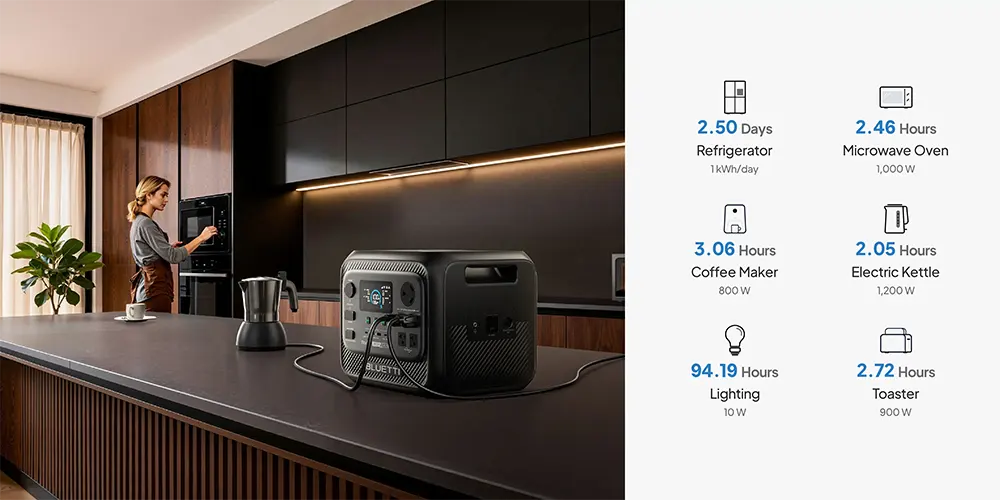
You’re the kind of person who values portability above all else. You want a 3kWh power station that you can actually lift into your camper van without calling for backup. You’re a weekend warrior who needs reliable power for boondocking, and you don’t plan on running a table saw and a microwave simultaneously.
The Elite 300 is your travel buddy—compact, efficient, and surprisingly lightweight. It’s the Swiss Army knife you can carry with one hand.
2. Choose the EcoFlow DELTA 3 Ultra If…
You’re building a serious home backup system, and you want to pretend power outages don’t exist. You need to run heavy appliances—window AC units, power tools, dryers—and you want to do it without the roar of a generator waking up the neighborhood. The DELTA 3 Ultra is your home’s silent guardian.
It’s also the better choice if you think you might expand to the Ultra Plus later for whole-home coverage.
EcoFlow Stores
| United Kingdom | Italy | France | Spain | Germany | Canada | Australia | USA |
|---|---|---|---|---|---|---|---|
 |
 |
 |
 |
 |
 |
 |
 |
| Visit Here | Visit Here | Visit Here | Visit Here | Visit Here | Visit Here | Visit Here | Visit Here |
BLUETTI Elite 300 VS EcoFlow DELTA 3 Ultra – The Price Question: Which One Gives You More Bang for Your Buck?
Both units currently hover around $1,099 at promotional pricing (though MSRPs are significantly higher). At that price, the EcoFlow DELTA 3 Ultra arguably offers better raw value—you’re getting 50% more output power, quieter operation, and a more advanced app ecosystem for the same money.
However, if you factor in weight and portability, the BLUETTI Elite 300 justifies its price tag for a specific audience. You’re paying for the engineering miracle of stuffing 3kWh into a 26 kg package. That’s not trivial. If you’re constantly on the move, that weight savings is worth every penny.
The Verdict: And the Winner Is…
Look, I’m not going to sit here and declare a universal winner. That would be lazy. The BLUETTI Elite 300 VS EcoFlow DELTA 3 Ultra battle isn’t about which one is “better”—it’s about which one is better for you.
If you ripped my arm off and forced me to choose? For home backup and heavy-duty use, the EcoFlow DELTA 3 Ultra takes the crown. The 3,600W output, 25 dB whisper mode, and X-Stream charging are simply unmatched at this price point. It’s the power station that makes you feel like the grid is just a suggestion.
But for portability, travel, and RV life? The BLUETTI Elite 300 is the champion. It’s the only 3kWh unit on the market that won’t throw out your back, and that matters more than most people realize until they’re staring at a 72-pound box they need to load into a trunk.
Conclusion
At the end of the day, both the BLUETTI Elite 300 and the EcoFlow DELTA 3 Ultra are exceptional pieces of technology. They represent the cutting edge of what portable power can do in 2026. Your choice boils down to a simple question: Do you need to move your power, or do you need your power to move mountains?
If you’re a camper, a road-tripper, or an RV enthusiast who needs the most compact 3kWh power station on the planet, the Elite 300 is calling your name. If you’re a homeowner prepping for the next big storm, a remote worker who can’t afford downtime, or a contractor who needs serious juice on the job site, the DELTA 3 Ultra is your new best friend.
Either way, you’re investing in peace of mind. And in a world where the grid feels less reliable every year, that’s money well spent.
FAQs About Power Stations
Yes, absolutely. With its 3,014Wh capacity and 2,400W output, the Elite 300 can run a standard full-size refrigerator (drawing roughly 100-150W) for approximately 20-25 hours. Just keep in mind that startup surges from the compressor can briefly spike demand, so avoid plugging in other high-wattage devices simultaneously.
Yes, it’s genuinely impressive. At 600W output, the DELTA 3 Ultra operates at just 25 dB, which is quieter than a whispered conversation. Even under heavier loads, the EV-grade cooling system and full-tab LFP cells keep noise far lower than competitors like the Elite 300, which can exceed 50 dB under stress.
The standard BLUETTI Elite 300 and EcoFlow DELTA 3 Ultra are not expandable. However, EcoFlow offers the DELTA 3 Ultra Plus (for roughly $350 more), which can scale from 3kWh up to 11kWh with additional battery packs. If future expandability matters to you, EcoFlow is the only brand here that provides that path.
The BLUETTI Elite 300 accepts up to 1,200W of solar input, while the standard EcoFlow DELTA 3 Ultra maxes out at 800W (though the Ultra Plus bumps this to 1,600W). In theory, the Elite 300 can charge faster from solar under ideal conditions. However, EcoFlow’s dual-charging capabilities and more efficient MPPT controllers often deliver better real-world performance.
Yes, both the BLUETTI Elite 300 and EcoFlow DELTA 3 Ultra use LiFePO4 batteries, which are inherently safer than older lithium-ion chemistries. They produce no emissions, no fumes, and no noise (or very little, in EcoFlow’s case). This makes them ideal for indoor use during blackouts, unlike gas generators which require ventilation and produce deadly carbon monoxide.
You Might Also Like