


EcoFlow Delta Pro 3 Solar Generator: The Whole-Home Backup Beast Worth Your Attention?
I’ve spent a good chunk of time digging into what makes the EcoFlow Delta Pro 3 solar generator tick, comparing it against its siblings and rivals, and honestly? It’s not just another portable power station with a bigger battery slapped on. It’s EcoFlow’s flagship attempt at replacing your noisy gas generator entirely. Let’s break down whether it lives up to that promise.
What Is the EcoFlow Delta Pro 3 Solar Generator, Really?
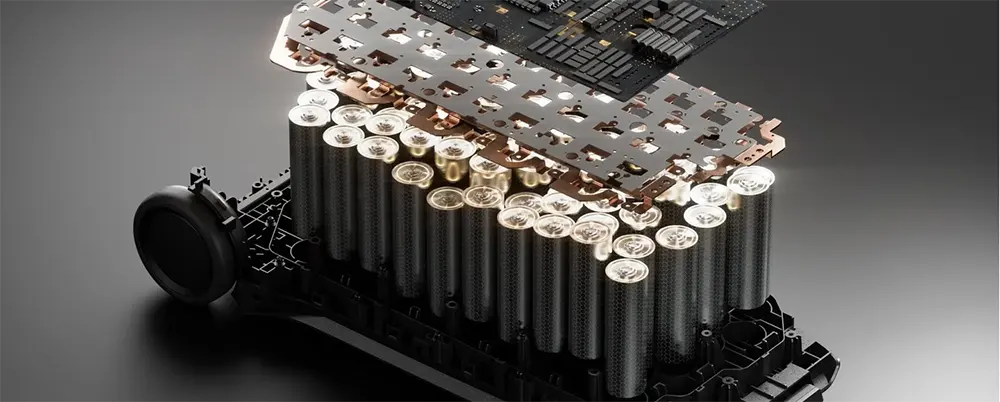
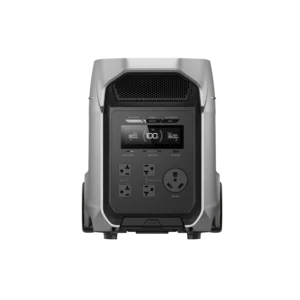
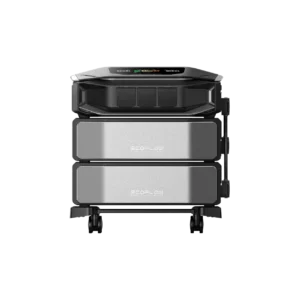
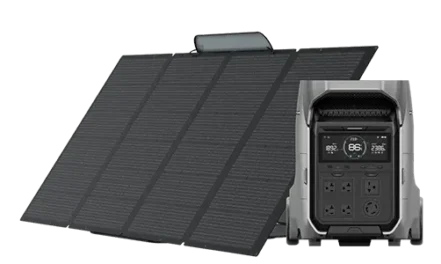 Think of the EcoFlow Delta Pro 3 solar generator as a giant rechargeable battery with a brain. At its core, you’ve got a 4,096Wh LiFePO₄ (LFP) battery pack paired with a 4,000W pure sine wave inverter that pushes out both 120V and 240V from a single unit.
That last part matters more than it sounds — most portable power stations in this price range make you buy a separate stacking kit just to run a 240V appliance like central AC or an electric dryer. The Delta Pro 3 skips that hassle entirely.
It’s not a toy for keeping your phone charged during a picnic (though it can absolutely do that). This is EcoFlow positioning the Delta Pro 3 as an appliance, something you plug into your home’s electrical ecosystem the same way you’d install a dishwasher.
Key Specs at a Glance
Before we go further, here’s the skeleton of what you’re working with:
- Battery capacity: 4,096 Wh (expandable up to 48 kWh with extra batteries and generators)
- AC output: 4,000W continuous, 8,000W surge, boosted to 6,000W effective with X-Boost
- Solar input: Up to 2,600W via dual-PV charging
- AC charging: 0-80% in about 50 minutes, full charge in roughly 1.5-2 hours
- UPS switchover: 10 milliseconds
- Noise level: Around 30 dB at lower output, whisper-quiet under X-Quiet tech
- Weight: Roughly 113-114 lbs
Those numbers alone tell you this isn’t a casual purchase. It’s a serious energy investment, and the specs back up why reviewers keep ranking it near the top of every “best solar generator” list on Google.
Battery Capacity and Expandability Explained
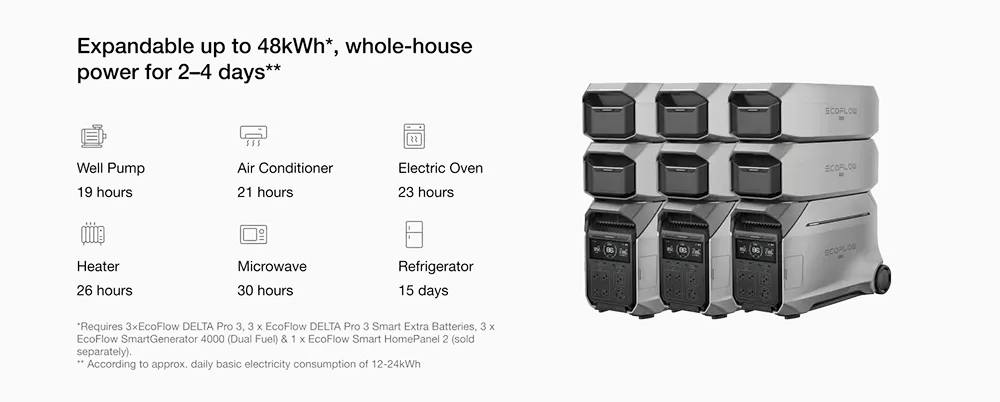
Here’s where the EcoFlow Delta Pro 3 solar generator separates itself from the pack. That 4,096 Wh base capacity isn’t the ceiling — it’s the starting line. Add Smart Extra Batteries, and you can stretch storage to 12 kWh, 24 kWh, or even a jaw-dropping 48 kWh when you throw in the Smart Generator 4000 dual-fuel unit and multiple Delta Pro 3 units wired together through a Smart Home Panel 2.
Why does that matter to you? Because your power needs today probably won’t match your power needs in three years. Maybe right now you just want backup for the fridge and some lights. But if you eventually add an EV charger or a heat pump, or decide to go fully off-grid, the Delta Pro 3 solar generator grows with you instead of becoming outdated dead weight in your garage.
Power Output: Can It Really Run Your Whole House?
Let’s be real for a second — “whole home backup” gets thrown around loosely in this industry. Can the EcoFlow Delta Pro 3 solar generator actually run your whole house? Mostly, yes, if we’re talking about the essential circuits.
With 4,000W continuous output and 8,000W surge capacity, this unit can comfortably run a refrigerator, sump pump, microwave, several lights, a laptop, and a window AC unit all at once. Pair it with the Smart Home Panel 2, and you can prioritise up to 12 circuits, meaning your fridge and medical equipment stay powered even if you’re rationing energy elsewhere. X-Boost technology also lets it start high-surge appliances that would otherwise trip a lesser unit’s inverter.
Is it going to run a fully loaded suburban house with central air, an electric range, and a hot tub simultaneously? Not on a single unit — that’s what the parallel expansion up to 12,000W across three units is for. But for the “keep the essentials running during a blackout” use case, this thing punches way above its weight class.
X-Stream Fast Charging: 0 to 80% in 50 Minutes
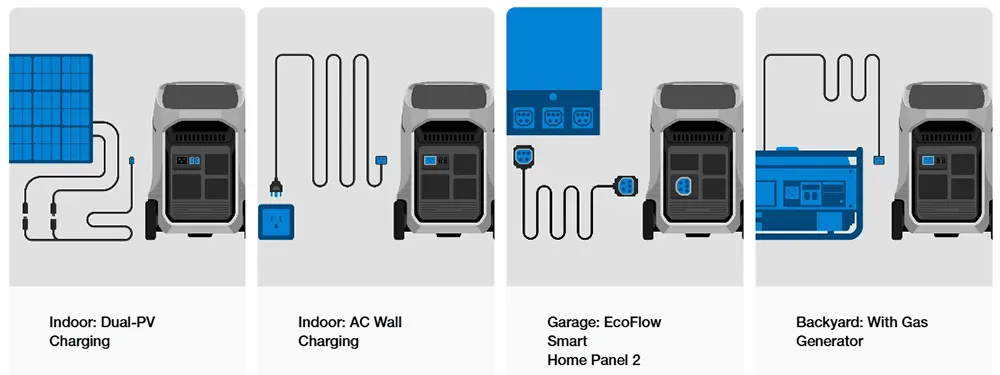
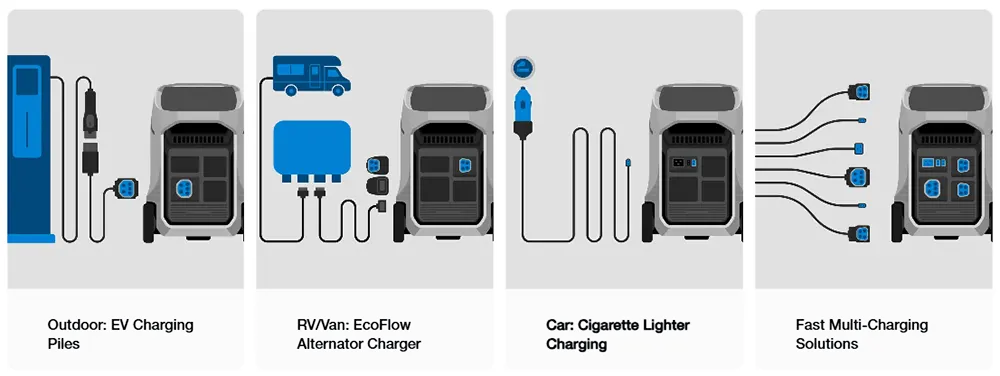
Charging speed is honestly one of the most underrated features of the EcoFlow Delta Pro 3 solar generator, and it’s a big reason reviewers keep ranking it so highly. EcoFlow’s proprietary X-Stream technology gets you from empty to 80% in around 50 minutes using a standard wall outlet, with a full charge landing somewhere between 1.5 and 2 hours.
Compare that to competing power stations in the same capacity range, which often take 4 to 6 hours for a full charge. If a storm warning gives you a two-hour heads-up, most competitors leave you scrambling. The Delta Pro 3 can be topped off and ready before the wind even picks up. That’s not a small thing — it’s the difference between being prepared and being caught flat-footed.
Solar Charging Performance
1. Dual PV Input Explained
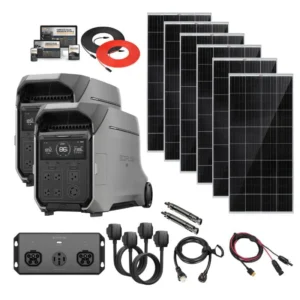
The EcoFlow Delta Pro 3 solar generator supports dual-PV charging, meaning you can connect two separate solar arrays simultaneously for a combined input of up to 2,600W. That’s a meaningful jump over older Delta models, and it means faster recharge times when you’re relying purely on sunlight, like during an extended off-grid camping trip or a multi-day outage.
2. How Many Solar Panels Do You Need?
If you’re pairing this with EcoFlow’s 400W rigid or portable panels, you’d need roughly six to seven panels running simultaneously to hit that 2,600W ceiling. Realistically, most homeowners run two to four panels for supplemental daytime charging, which is plenty to keep a moderately used system topped up. Cloudy day? No panic — you’ve still got AC charging as backup.
UPS Function and Home Backup Reliability
One feature that doesn’t get talked about enough: the EcoFlow Delta Pro 3 solar generator doubles as a legitimate UPS (uninterruptible power supply) with a 10-millisecond switchover time. For context, that’s fast enough that sensitive electronics like your home server, gaming PC, or medical devices won’t even blink when the grid drops out.
This isn’t just a “nice to have”. A lot of budget power stations advertise UPS functionality but switch over slowly enough to reset your router or crash unsaved work on your computer. The Delta Pro 3 genuinely closes that gap.
Noise Levels and Portability
Gas generators are loud, smelly, and require you to store fuel somewhere safe. The EcoFlow Delta Pro 3 solar generator sidesteps all three problems. With X-Quiet technology, it runs at around 30 dB at lower loads — quieter than a normal conversation — climbing to roughly 40 dB under heavier draw. You could genuinely keep this thing in your bedroom overnight and barely register that it’s running.
Portability, though, is where you need to manage expectations. At around 113-114 lbs, this isn’t something you’re tossing in the trunk solo. It’s built on wheels for a reason — think “roll it into position” rather than “carry it up two flights of stairs”.
EcoFlow Delta Pro 3 vs Delta Pro 3 Ultra Plus vs Delta 3: Comparison Table
Confused about which EcoFlow model actually fits your needs? Here’s how the Delta Pro 3 solar generator stacks up against its closest siblings.
| Feature | EcoFlow Delta Pro 3 | Delta 3 Ultra Plus | EcoFlow Delta 3 |
|---|---|---|---|
| Battery Capacity | 4,096 kWh (up to 48 kWh expanded) | 3,072 kWh (up to 11 kWh expanded) | 1,024 kWh (up to 5 kWh expanded) |
| AC Output | 4,000W (8,000W surge) | 3,600W | 1,800W (3,600W surge) |
| Solar Input | Up to 2,600W Dual-PV | Solar-ready, lower ceiling | Up to 500W |
| Full Charge Time | ~1.5-2 hours (X-Stream) | ~48 minutes (Dual Charging) | Varies by input |
| Voltage Output | 120V/240V split phase | 120V/240V | 120V only |
| Best For | Whole-home backup, off-grid systems | Mid-size home backup | Camping, apartments, small backup |
| Weight | ~113-114 lbs | Lighter, more portable | ~27.6 lbs |
| Learn More | Learn More | Learn More | |
The takeaway? If you’re serious about whole-home resilience or off-grid independence, the Delta Pro 3 solar generator is the heavyweight champion. If you want something more portable for apartment living or lighter camping setups, the Delta 3 is the better fit.
Smart Home Panel 2 Integration
Pairing the EcoFlow Delta Pro 3 solar generator with the Smart Home Panel 2 turns it from a “big battery” into an “actual home backup system”. The panel acts as an automatic transfer switch, seamlessly flipping your house over to backup power the instant the grid fails — no manual extension cords, no running outside in a storm to flip a switch.
It also lets you connect up to three Delta Pro 3 units for a combined 12,000W output, controlling up to 12 individual circuits from the EcoFlow app. You decide what gets power first: fridge and well pump before the hot tub, obviously.
Price and Value: Is It Worth $1,999-$3,699?
Pricing on the EcoFlow Delta Pro 3 solar generator has moved around quite a bit since launch. The original list price sat at $3,699, but ongoing promotions and bundle deals have pushed the effective price down significantly, with many retailers listing it closer to $1,999-$3,199 depending on the bundle and time of year.
Is it worth it? For what you’re getting—a UPS-grade, expandable, whole-home-capable, solar-chargeable power station with industry-leading charge speeds—the value proposition holds up well against competitors like the Anker Solix F3800 or Bluetti’s flagship units, both of which sit in a similar price bracket without necessarily matching the charging speed or expansion ceiling.

Who Should Buy the EcoFlow Delta Pro 3 Solar Generator?
- RV Owners and Campers
If you’re living the van-life or RV dream, the Delta Pro 3 solar generator gives you genuine off-grid autonomy. Run your AC, fridge, and electronics without hunting for a hookup, and recharge via solar panels while you drive to your next spot. - Homeowners Preparing for Outages
For anyone who’s sat through a multi-day blackout wondering why they didn’t invest in backup power sooner, this is basically insurance you can touch. Pair it with the Smart Home Panel 2, and you’ve got an automatic, silent alternative to a gas generator. - Off-Grid Living Enthusiasts
Cabin in the woods? Tiny home with no grid connection? The expandability up to 48 kWh makes the Delta Pro 3 solar generator a legitimate foundation for a full off-grid energy system, not just a stopgap.
Pros and Cons
Pros:
- Massive expandability (up to 48kWh)
- Industry-leading charge speed via X-Stream
- Genuine 120V/240V dual output from one unit
- Whisper-quiet operation
- Strong UPS performance for sensitive electronics
Cons:
- Heavy at over 110 lbs, not easily carried solo
- Premium price point even with discounts
- Full whole-home coverage requires additional hardware and units
How to Maximise Your EcoFlow Delta Pro 3 Solar Generator Setup
Getting the most out of your EcoFlow Delta Pro 3 solar generator isn’t just about plugging it in and hoping for the best. Start by mapping out your essential circuits before you ever connect the Smart Home Panel 2 — know exactly what needs power first during an outage.
Second, invest in at least two solar panels if you plan on relying on solar charging regularly; a single panel will trickle-charge rather than truly recharge. Finally, keep the EcoFlow app updated and check your battery health periodically. Like any lithium battery system, a little proactive maintenance goes a long way toward hitting that rated 4,000+ cycle lifespan.
Final Verdict
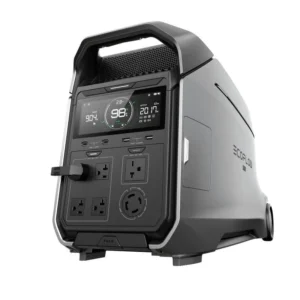
The EcoFlow Delta Pro 3 solar generator isn’t cheap, and it isn’t light, but it earns its flagship status. Between the fast charging, dual-voltage output, near-silent operation, and almost absurd expandability ceiling, it’s hard to find a genuine weakness that isn’t tied directly to its size and price. If you need serious backup power and don’t want to deal with gasoline, fumes, or generator noise ever again, this is about as close to “set it and forget it” as portable power gets right now.
Conclusion
At the end of the day, the EcoFlow Delta Pro 3 solar generator earns its reputation as one of the most capable home backup and off-grid power systems on the market today. It’s not the cheapest option out there, and it’s definitely not the lightest, but for anyone serious about energy independence — whether that’s surviving the next grid outage or living comfortably off-grid — it delivers where it counts.
If you’ve been on the fence, the combination of fast charging, real expandability, and dual-voltage output makes a pretty compelling case to finally pull the trigger.
EcoFlow Stores
| United Kingdom | Italy | France | Spain | Germany | Canada | Australia | USA |
|---|---|---|---|---|---|---|---|
 |
 |
 |
 |
 |
 |
 |
 |
| Visit Here | Visit Here | Visit Here | Visit Here | Visit Here | Visit Here | Visit Here | Visit Here |

FAQs About EcoFlow Delta Pro 3 Solar Generator
A standard refrigerator draws roughly 100-200W on average. On a fully charged 4,096Wh Delta Pro 3, you're looking at somewhere between 20-40 hours of runtime just for the fridge alone, longer if you're supplementing with solar during the day.
Yes. The unit supports Dual-PV solar input up to 2,600W, and you can add compatible EcoFlow solar panels at any point — you're not locked into a bundle at purchase.
Not really. At lower output levels it runs around 30dB, which is quieter than typical background noise in a bedroom. It gets louder under heavy load, but most users report it's still far quieter than a traditional gas generator.
The Delta Pro 3 offers faster charging via X-Stream technology, higher expandability (up to 48kWh vs. the original's lower ceiling), and improved dual-voltage output, making it a meaningful generational upgrade rather than a cosmetic refresh.
For basic portable use, no installation is needed — just plug and play. But if you want to integrate it with your home's electrical panel via the Smart Home Panel 2 or a transfer switch, hiring a licensed electrician is strongly recommended for safety and code compliance.
Yes, EcoFlow DELTA Pro 3 can be connected to EcoFlow Smart Home Panel 2 through the power input/output port.
Yes, EcoFlow DELTA Pro 3 can be connected to the EcoFlow 50 Amp Hub dedicated for EcoFlow DELTA Pro Ultra via the AC Power IN/OUT port, supporting the parallel connection of up to 2 sets of EcoFlow DELTA Pro 3.
EcoFlow DELTA Pro 3 has two PV input ports, which are for high-voltage PV port and low-voltage PV, respectively.High-voltage PV: 30-150V, 15A Max, 1600W Max. Low-voltage PV: 11-60V, 20A Max, 1000W Max.The maximum solar input for the EcoFlow DELTA Pro 3 is 2600W. Please note that this value is based on experimental results under optimal conditions. Achieving this maximum input may require the use of higher-power solar panels that are within the product’s voltage tolerance but exceed the PV port’s power limit. Actual solar input performance can vary depending on the solar panels used, environmental factors, and system configuration. For more information on designing your own solar setup, please contact EcoFlow Customer Service. Before performing any installation, please ensure that it is carried out by a qualified and certified professional.
When the device is powered off, press and hold the power button for more than 5 seconds. The device's LCD screen will light up, and then the screen will blink once (it must blink once), indicating that the Bluetooth connection has been successfully reset.
Yes, it supports Level 1/2 EV chargers. You will need to purchase a dedicated EcoFlow adapter, the EV X-Stream Adapter (DELTA Pro Ultra). Typyically, the grid charging port on the US model only supports AC 120V 2000W charging (Level 1). However, by using the AC POWER IN/OUT port along with the EV X-Stream Adapter (DELTA Pro Ultra), you can connect a 240V EV charger, increasing the charging rate to 4000W (Level 2).
No, but it can perform split-phase output as a standalone unit.There are two buttons for AC output: 120V AC ON/OFF and 240V AC ON/OFF.1. When the 120V AC button is pressed, four 120V 20A outlets and one 30A RV outlet will supply power, and the 240V outlet will be turned off.2. When the 240V AC button is pressed, one L14-30 split-phase outlet and one 6-20R 240V outlet output power, and the 120V outlet will be turned off.
You Might Also Like