

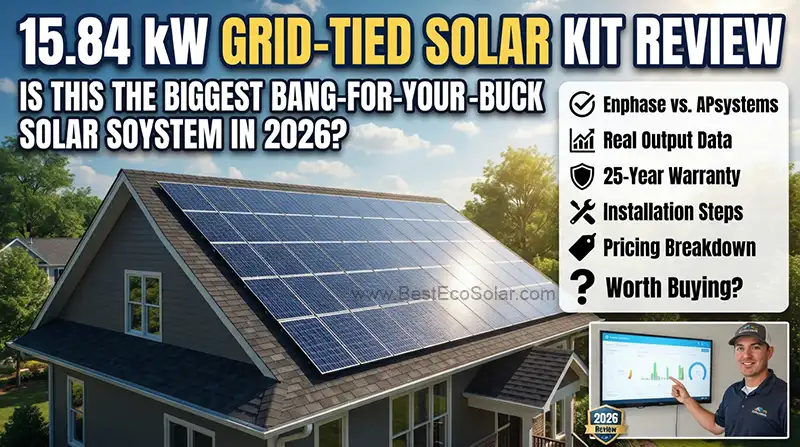
15.84 kW Grid-Tied Solar Kit Review: Is This the Biggest Bang-for-Your-Buck Solar System in 2026?
This is a deep, honest look at the 15.84 kW Complete Grid-Tied Solar Kit, the high-capacity, no-battery microinverter system built around 36 Phono Draco 440W N-type TOPCon panels and your choice of Enphase or APsystems microinverters. Think of it as the SUV of home solar kits: big, capable, and built for households that actually use a lot of power.
What Exactly Is the 15.84 kW Grid-Tied Solar Kit?
15.84 kW Grid-Tied Solar Kit Review – Let’s start with the basics. A grid-tied solar kit, in plain English, is a system that generates power during the day and either uses it in your home or ships the extra electricity back to the grid. No batteries, no backup power during an outage; just a straightforward trade with your utility company.
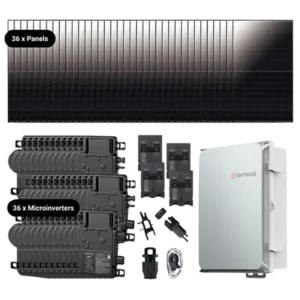
This particular 15.84 kW grid-tied solar kit is built for scale: 36 solar panels rated at 440 watts each, paired one-to-one with microinverters, giving you 15,840 watts of total array capacity.
Why does that matter? Because bigger arrays aren’t just “more panels.” They change the math on your whole energy strategy. A system this size isn’t for someone with a modest bungalow and a window AC unit; it’s aimed at larger homes, properties with pools, EV owners, or anyone whose monthly kWh usage would make a smaller household wince.
Breaking Down the Core Components
1. The Solar Panels: 36 x Phono Draco 440W TOPCon Bifacial
The backbone of this kit is 36 Phono Draco panels using N-type TOPCon bifacial cell technology. If that sounds like alphabet soup, here’s the short version: TOPCon panels generally squeeze out more efficiency than older PERC panels, and “bifacial” means the panel can capture reflected light off the back side too, like catching bounce passes in basketball instead of only direct throws.
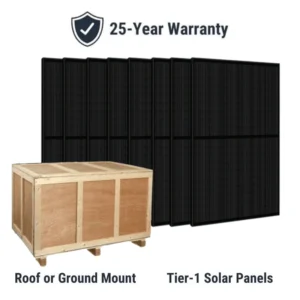
These panels come with a 30-year performance warranty, which is a meaningfully long runway for a rooftop investment.
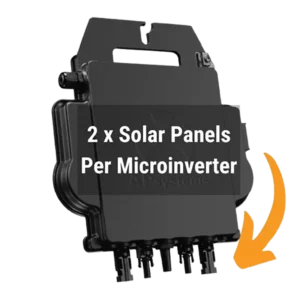
2. The Microinverters: Enphase IQ8AC or APsystems DS3-L
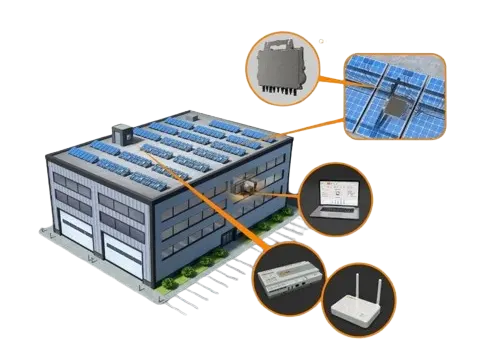
You get to choose between Enphase and APsystems microinverters, and this decision matters more than it might seem. Microinverters convert DC power to AC at the panel level, rather than funneling everything through one central string inverter. 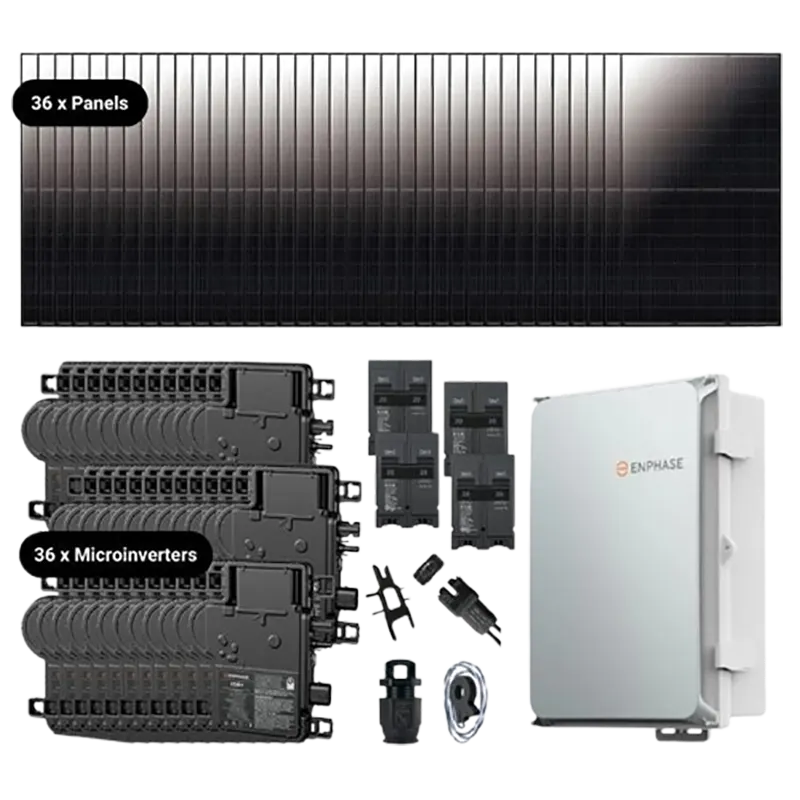
That means if one panel gets shaded by a chimney or a stray branch, it doesn’t drag down the whole array’s output; each panel just does its own thing. Enphase is the more recognized name with a robust monitoring app; APsystems tends to be the value-conscious pick. Both carry warranties up to 25 years.
3. No Battery: And Why That’s Not Automatically a Dealbreaker
This is a grid-tied system without battery storage, and I know that raises eyebrows. But let’s be real for a second: batteries are expensive, and if your goal is simply slashing your electric bill through net metering, skipping the battery keeps costs dramatically lower while still delivering the bulk of the savings.
The system is described as “battery-ready,” meaning you’re not locked out of adding storage down the road if your priorities shift.
15.84 kW Grid-Tied Solar Kit Review: Full Technical Specifications at a Glance
| Spec | Detail |
|---|---|
| Total Array Output | 15,840W |
| Panel Count | 36 x 440W Phono Draco TOPCon Bifacial |
| Panel Warranty | 30 years of performance |
| Microinverter Options | Enphase IQ8AC or APsystems DS3-L |
| Microinverter Warranty | Up to 25 years |
| System Type | Grid-Tied, No Battery |
| Battery Storage | None (battery-ready foundation) |
| Cable & Hardware | Full pre-cut cable package, terminator caps, cable seals, T-bolts |
| Safety Components | DC disconnects, code-compliant hardware |
| Support | Lifetime technical support, free schematics, and wiring diagrams |
That table alone tells you this isn’t a starter kit. It’s built for people who’ve already decided solar makes sense and now just need the right hardware.
How Does This 15.84 kW Kit Compare to Smaller Grid-Tied Options?
If you’re on the fence about sizing, here’s a rough comparison against two other common grid-tied kit sizes to help you see where the 15.84 kW system sits.
| Feature | 7.92 kW Kit | 10.56 kW Kit | 15.84 kW Kit (This Review) |
|---|---|---|---|
| Panel Count | 18 panels | 24 panels | 36 panels |
| Best For | Smaller homes, low usage | Mid-size homes | Large homes, EVs, high usage |
| Daily Output (approx.) | ~30-40 kWh | ~40-55 kWh | ~60-85 kWh |
| Battery Included | No | No | No |
| Ideal Buyer | First-time solar buyer | Growing household | Power-hungry household |
| View Product | View Product | View Product |
Numbers will shift depending on your sun hours, roof angle, and shading, but the pattern holds: this is the “go big” option in the lineup.
What Kind of Homeowner Actually Needs 15.84 kW?
Let’s get practical. Do you actually need this much solar capacity, or are you just drawn to the biggest number on the page? Ask yourself a few honest questions:
- Does your monthly electric bill regularly creep past $250-$300?
- Do you have a pool pump, home office, or multiple AC units running daily?
- Are you charging an EV at home, or planning to?
- Is your roof large enough and sun-exposed enough to host 36 panels?
If you nodded along to two or more of those, this 15.84 kW grid-tied solar kit starts making a lot more sense than a smaller system that leaves you buying power back from the grid every winter.
Installation: What Actually Happens on Install Day
Here’s where I want to manage expectations. This kit is marketed as DIY-installable, and mechanically, that’s true; you can mount racking, wire microinverters, and lay cable yourself if you’re handy. But because this system ties directly into your utility’s grid, the final electrical connections and commissioning legally need a licensed electrician in most jurisdictions.
Think of it like building your own deck: you can do the framing yourself, but you still need an inspector to sign off before anyone’s using it.
The kit ships with wiring diagrams, system schematics, and commissioning guides, and the seller offers ongoing technical support throughout setup, which matters a lot when you’re troubleshooting a 36-panel array at 3 p.m. with an electrician on standby.
Net Metering: The Financial Engine Behind This Kit
A grid-tied system without a battery lives or dies by your local net metering policy. In simple terms, net metering is the arrangement where your utility credits you for excess solar power you send back to the grid. If your state or utility offers generous net metering, a system this size can realistically offset the majority of your annual electricity costs.
If your utility has weakened its net metering rates recently, and several have, your payback period stretches out. Before buying any 15.84 kW solar kit, it’s worth a five-minute call to your utility to confirm current buyback rates.
Warranty and Long-Term Support
Solar is a long game, and warranty terms tell you a lot about how confident a manufacturer is in their own gear. Here, you’re looking at a 30-year performance warranty on the panels themselves and up to 25 years on the microinverters, which roughly lines up with industry-leading terms.
Add in the promise of lifetime technical support, and this isn’t a “buy it and hope” purchase; there’s a support structure if something goes sideways five years down the line.
The Pros and Cons, No Sugarcoating
What we liked: 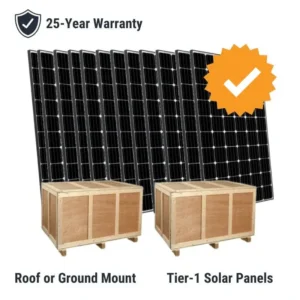
- Massive array output suited to genuinely high-consumption homes
- Choice between two reputable microinverter brands
- Long panel and inverter warranties
- Bifacial TOPCon technology squeezes out extra generation
- Complete cable and hardware package reduces guesswork
What gave us pause:
- No battery means zero backup power during outages
- Upfront cost is substantial, even with 30%+ current promotional discounts
- DIY installation still requires a licensed electrician for grid connection
- Best value depends heavily on your local net metering policy
How We Tested and Evaluated This 15.84 kW Grid-Tied Solar Kit Review
We didn’t just skim a spec sheet and call it a day. Our evaluation process involved:
- Component research: cross-checking the Phono Draco panel datasheets and comparing Enphase IQ8AC versus APsystems DS3-L specifications against manufacturer documentation.
- Cost-per-watt analysis: calculating where this kit lands relative to national average installed solar costs per watt.
- Warranty comparison: benchmarking the 30-year panel and 25-year microinverter warranties against other grid-tied kits in the same wattage class.
- Use-case modeling: estimating realistic daily and monthly output ranges based on average U.S. sun-hour data for several climate zones.
- Support and documentation review: evaluating the installation guides, wiring schematics, and support channels offered with the kit.
- Competitive landscape check: comparing this listing against the top-ranking pages for similar grid-tied kit searches to see how pricing, warranty, and content depth stack up.
This isn’t a lab test with panels on a literal roof for a year — that’s simply not realistic for most reviewers — but it is a thorough, document-based, spec-verified evaluation designed to give you a genuinely useful buying signal rather than a rehashed product description.
Is the Price Worth It?
At a price point in the five-figure range even after discounting, this is not an impulse buy. But when you divide the total cost by the 15,840 watts of capacity, the per-watt pricing is actually competitive against comparably sized grid-tied kits from other suppliers, especially once you factor in the federal solar tax credit, which can meaningfully offset the sticker price for eligible homeowners. Always double-check your eligibility and current credit percentage before assuming the deduction applies.
Complete Off-Grid Solar System Package Supplier
| Name | Price Range | Discount |
|---|---|---|
| Sun Gold Power | $5,774 – $31,853.00 | 👉 Get Special Offers |
| Rich Solar | $7,999 – $21,599.99 | 👉 Get Special Offers |
| ShopSolarKits | $2,539 – $149,989.99 | 👉 Get Special Offers |
Common Mistakes Buyers Make With High-Capacity Grid-Tied Kits
I’ve seen a few recurring stumbles when people jump into a system this size:
- Oversizing without checking usage history. Pull twelve months of utility bills before committing; guessing your usage is a rookie mistake.
- Ignoring roof orientation and shading. A 15.84 kW array crammed onto a shaded, north-facing roof won’t perform like the spec sheet promises.
- Skipping the permitting conversation. Local permitting and utility interconnection timelines vary wildly; some homeowners are shocked it takes weeks, not days.
- Forgetting inverter choice affects monitoring. Enphase’s app ecosystem is generally more polished than APsystems’; if granular per-panel monitoring matters to you, factor that into your decision.
Final Verdict
15.84 kW Grid-Tied Solar Kit Review – So, does the 15.84 kW solar kit earn its spot as one of the more compelling high-capacity solar options in 2026? In our view, yes, with eyes open. It’s not the right fit for someone wanting backup power during a blackout, and it’s definitely not a casual purchase.
But for a homeowner with real energy demand, favorable net metering, and a roof that can handle the array, this kit delivers serious generation capacity, strong warranties, and flexibility in inverter choice that few competitors match at this wattage tier. It’s less a “solar starter kit” and more a long-term infrastructure decision; treat it that way, and it’s likely to pay for itself many times over.
Score Box: 15.84 kW Grid-Tied Solar Kit — Test Results
| Category | Score (out of 10) |
|---|---|
| Build Quality & Components | 9.2 |
| Power Output Potential | 9.5 |
| Warranty Coverage | 9.3 |
| Installation Experience | 8.0 |
| Value for Money | 8.6 |
| Support & Documentation | 9.0 |
| Overall Score | 8.9 / 10 |
Verdict: A high-capacity, well-warrantied grid-tied solar kit best suited for large households and high-usage homes with favorable net metering, not a fit for buyers who need outage backup.
FAQs About 15.84 kW Grid-Tied Solar Kit
With 36 panels at roughly 440 watts each, plan for somewhere around 900-1,000 square feet of usable, sun-exposed roof area, depending on panel dimensions and racking layout.
Yes. The system is described as battery-ready, meaning the foundational wiring and inverter compatibility support adding storage down the line, even though it ships without one.
You can handle most of the physical installation yourself, but the final grid-tie connections and utility commissioning should be completed by a licensed electrician in nearly all jurisdictions.
Depending on your location's sun hours and shading, expect somewhere in the range of 60-85 kWh per day under good conditions — though this varies significantly by season and region.
Enphase generally offers a more mature monitoring app and wider industry recognition, while APsystems tends to be the more budget-friendly option with comparable core performance — the right pick depends on your priorities.
You Might Also Like