




DELTA 3800 Gen4 vs. DELTA 3000 Gen4: Which EcoFlow Power Station Should You Buy in 2026?
That’s the whole puzzle with the DELTA 3800 Gen4 vs DELTA 3000 Gen4 decision, and it’s a more interesting one than the model numbers suggest. These two siblings share a lot of DNA, but they’re built for different kinds of people.
Quick Verdict: DELTA 3800 Gen4 vs DELTA 3000 Gen4 at a Glance
DELTA 3800 Gen4 vs DELTA 3000 Gen4 – If you want the short version, here it is. Pick the DELTA 3000 Gen4 if your outages are short, your solar plans are modest, and you’d like to move it around without calling a neighbor. Pick the DELTA 3800 Gen4 if you’ve ever sat through a multi-day blackout, you want to add batteries later, or you plan to run more than 1,000W of solar panels.
The 3800 Gen4 isn’t “better” in every way. It’s bigger in the ways that matter for resilience. Whether those ways matter to you is the entire question.

DELTA 3800 Gen4 vs DELTA 3000 Gen4: Specs Side by Side
Numbers first, opinions after. Figures below come from EcoFlow’s launch materials and the independent coverage listed in the section after the table. US and Japan units differ slightly in rated output, so check your region.
| Feature | DELTA 3000 Gen4 | DELTA 3800 Gen4 |
|---|---|---|
| Battery capacity | 3,072 Wh | 3,763 Wh |
| Rated AC output (US) | 3,600W | 3,600W |
| Surge output | 7,200W | 7,200W |
| Max solar input | 1,000W (one port) | 2,000W (two ports) |
| Expansion battery support | No | Yes, up to two extra batteries |
| Max system capacity | 3,072 Wh | About 11,955 Wh |
| Weight | About 26 kg / 57.3 lb | About 30.6 kg / 67.5 lb |
| Wall recharge (US, 1,800W) | About 118 min | About 146 min |
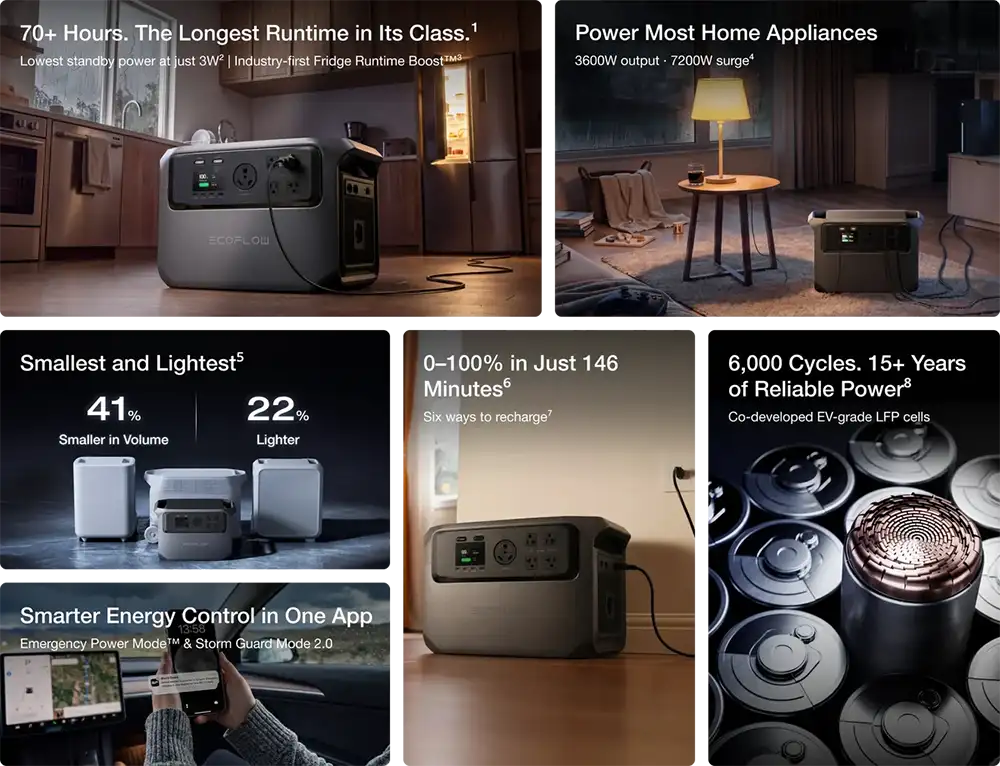
| Fridge Runtime Boost claim | Up to 58 hrs | 70+ hrs |
| US launch price | $1,299 | $1,699 |
| US list price | $1,699 | $2,199 |
| View Product | View Product |
The two models share a 3.6kW rated AC output and a 7.2kW surge rating, so neither one will choke on a space heater plus a fridge. Everything else in that table is where the real story lives.
How We Tested (and What That Means for Brand-New Gear)
Here’s the honest version, because you deserve one. At the time of writing, these units were in a pre-order and early-shipping window, and we did not run lab discharge tests on retail units. So instead of pretending otherwise, we built our evaluation like this:
- Cross-checked specs across regions. We compared EcoFlow’s US, Japan, and European launch information to catch inconsistencies in capacity, weight, and charging figures.
- Compared independent runtime modeling. We leaned on third-party runtime estimates for a typical 140W “essentials” load (fridge, router, lights, phone charging) rather than relying only on marketing claims.
- Did our own math. We calculated cost per watt-hour, solar recharge windows, and capacity-per-pound ourselves.
- Read the fine print on claims. The Fridge Runtime Boost numbers, for example, come from tests on a 654-litre fridge with an empty interior, so your kitchen will behave differently.
- Scored by use case, not by raw specs alone.
Think of it like judging a car from the spec sheet and the engineering notes before you’ve driven it. You can learn a lot. You can’t learn everything. When hands-on testing lands, we’ll update the scores.
Battery Capacity: 3,763 Wh vs. 3,072 Wh
The 3800 Gen4 carries 3,763 Wh against 3,072Wh in the 3000 Gen4. That’s a gap of 691Wh, or roughly 22.5% more energy in the bigger unit. Is 691 Wh a lot? Picture a laptop battery charged about ten times over. In a blackout, that’s a few extra hours of a fridge, a router, and some lights. Handy, but not life-changing on its own.
What You Actually Get: Usable Capacity
No power station hands you every watt-hour on the label. Conversion losses eat a slice. One independent estimate puts the 3800 Gen4’s usable energy at around 3,199 Wh. That’s a sensible ballpark to plan around rather than the headline number.
Essentials Runtime in Real Life
On a lean essentials plan, one independent runtime chart shows the DELTA 3000 Gen4 lasting about 19 hours and the 3800 Gen4 alone about 23 hours. Add extra batteries and the 3800 Gen4 climbs to around 73 hours in the biggest configuration shown there.
So for a one-night outage, either unit does the job. For a long weekend without grid power, they stop being equals.
Fridge Runtime Boost: Clever, but Read the Footnote
EcoFlow’s headline trick this generation is Fridge Runtime Boost. The company claims up to 70 hours of fridge operation on the DELTA 3800 Gen4 and 58 hours on the DELTA 3000 Gen4. In Japan, EcoFlow framed it as stretching runtime about 20% on the 3000 Gen4 and about 42% on the 3800 Gen4 versus the industry average for that capacity class, partly by cutting the unit’s own standby draw to roughly 3W.
It’s a neat idea, like a driver who coasts downhill instead of braking. But “empty fridge, lab conditions” rarely matches a family fridge that gets opened forty times a day. Treat the numbers as directional.
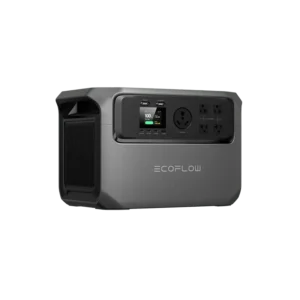
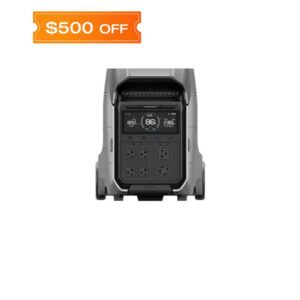
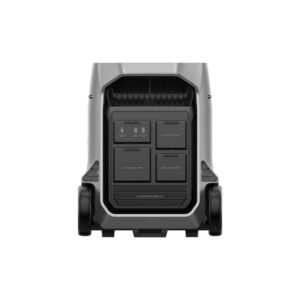
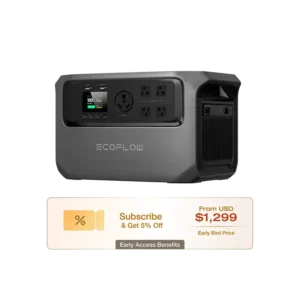
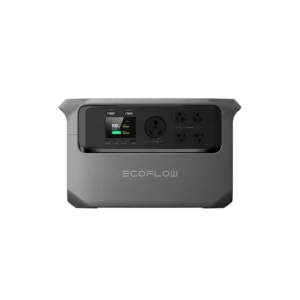


Expandability: The Feature That Really Separates the DELTA 3800 Gen4 from the DELTA 3000 Gen4
If the capacity gap is a nudge, expandability is a shove. This is the biggest practical difference between the two.
Extra Batteries and Up to 12 kWh
The 3000 Gen4 is what it is. As one outlet put it, its spec sheet lists a single 1,000W solar input and no battery port. The 3800 Gen4 has that port. Connect two optional extra batteries, and the system can reach 11,955 Wh, which is close to 12 kWh. That’s the difference between buying a finished room and buying a room with a door to the next one. You may never open that door. But if your needs grow, you can keep the investment instead of replacing it.
Generator Pairing and Auto-Start
There’s a quieter benefit, too. The battery port on the 3800 Gen4 also lets it pair with EcoFlow’s Smart Generator 4000, with an independent source describing 3,200W generator charging with auto-start. The 3000 Gen4 can accept a generator through its AC input, but you’d start that generator yourself.
For anyone in storm country or a rural area with long outages, that’s a real edge. The system can quietly refuel itself while you sleep.
Solar Input: 1,000W vs. 2,000W
This is where the DELTA 3800 Gen4 vs DELTA 3000 Gen4 debate gets practical for solar fans. The 3000 Gen4 accepts up to 1,000 W of solar, and the 3800 Gen4 up to 2,000 W.
Quick back-of-the-envelope math, which is ours and assumes perfect sun: 1,000W would refill the 3000 Gen4’s 3,072Wh in a bit over three hours. Two thousand watts would refill the 3800 Gen4’s 3,763 Wh in roughly two hours. Real skies are messier, so expect longer.
Why does it matter? Because on a cloudy day, panel wattage is your safety net. More input means you can still claw back meaningful energy when the sun is half-hearted. If you’re already planning a bigger array for off-grid cabin life or an RV, the 3800 Gen4 is the natural fit. If you’re adding two or three panels as an emergency top-up, 1,000W is plenty.
Charging Speed: Wall, Car, and Generator
Both units charge from a wall outlet, solar, and a vehicle. The 3800 Gen4 reportedly supports six charging methods, including generator and combined solar plus generator charging.
On wall speed, the smaller battery wins. One US-focused comparison lists about 118 minutes for the 3000 Gen4 and 146 minutes for the 3800 Gen4 at 1,800W. In Japan, where the wall input tops out at 1,500W, EcoFlow quotes around 2.3 hours versus 2.8 hours, and the app lets you dial AC input anywhere from 400W to 1,500W.
That app control is underrated. Charging slower at night when your breaker is busy, or faster when a storm is rolling in, is exactly the kind of flexibility that separates a gadget from a tool. There’s even a time-of-use mode that charges when electricity is cheapest.
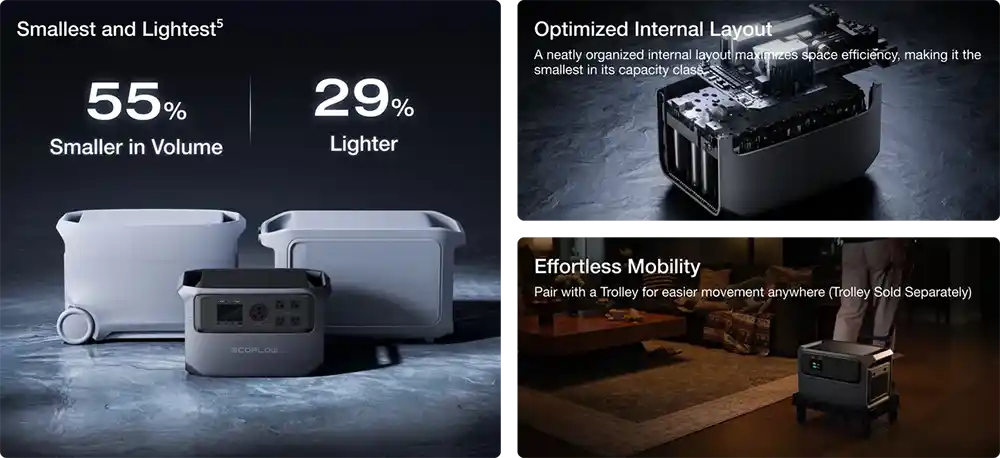
Size and Weight: Which One Is Easier to Live With?
Neither of these is a lunchbox. The 3000 Gen4 weighs about 26 kg (57.3 lb), and the 3800 Gen4 about 30.6 kg (67.5 lb). That 10-pound difference sounds small until you’re carrying it up porch steps.
On the plus side, both are impressively compact for their capacity. EcoFlow says the 3000 Gen4 is roughly 52% smaller and the 3800 Gen4 roughly 44% smaller than the models they’re compared against, with dimensions of about 47.7 × 28.9 × 28.2 cm and 47.7 × 28.9 × 30.7 cm. Both have handles but no wheels, so a cart is worth considering.
If one person will be moving it regularly, the 3000 Gen4 is kinder to your back. If it’s going to sit in a utility room and rarely budge, the weight difference barely matters.
Power Output: Can the DELTA 3000 Gen4 Handle Everything the 3800 Can?
Short answer: yes, at least on paper. Both share 3,600W rated and 7,200W peak output, enough to run a 1,500W heater and a fridge together. So your microwave, well pump, or window AC isn’t a reason to upgrade. What you’re really buying with the 3800 is time and growth, not extra muscle. That’s a distinction a lot of shoppers miss. A bigger fuel tank doesn’t make an engine more powerful.
Price and Value: What You Pay Per Watt-Hour
At launch pricing, the 3000 Gen4 is $1,299 (regular $1,699), and the 3800 Gen4 is $1,699 (regular $2,199). Early-bird pricing, according to one report, runs through December 7, so watch the clock.
Our math at launch prices:
- DELTA 3000 Gen4: about $0.42 per Wh
- DELTA 3800 Gen4: about $0.45 per Wh
- The extra 691Wh costs you about $0.58 each
At list prices, the gap narrows slightly, roughly $0.55 versus $0.58 per Wh. So the 3000 Gen4 is the better pure-capacity bargain. The 3800 Gen4 earns its premium through solar headroom, expansion, and generator integration, not through cheaper energy. If you’ll never use those, you’re paying for a door you won’t open.


Who Should Buy the DELTA 3000 Gen4?
This is your unit if:
- Outages in your area usually end within a day.
- You plan on 1,000W of solar or less.
- You want to carry it, store it in a closet, or take it to a campsite.
- You care about value per watt-hour more than future-proofing.
It’s aimed squarely at small households of two to four people for everyday use and blackout protection. Think of it as a very good fire extinguisher: you may rarely need it, but you’ll be glad it’s there.
Who Should Buy the DELTA 3800 Gen4?
Go bigger if:
- You’ve lived through a multi-day outage and never want to repeat it.
- You want a system that grows, either with extra batteries or a generator.
- Your solar plan passes 1,000W.
- You run a small business, market stall, or job site where uptime pays the bills.
EcoFlow positions it for exactly that, mentioning shops, offices, mobile vending, and outdoor work beyond home use. Is it overkill for a one-person apartment? Probably. Is it comforting for a family in hurricane country? Absolutely.
How They Compare to Rivals
This 3kWh, 3,600W class is crowded. The competition includes Anker’s SOLIX F3000 and Jackery’s Explorer 3000 v2 at similar capacity and output. So why choose EcoFlow? Mostly the combination of compact size, the fridge-focused efficiency mode, and, on the 3800, that expansion path. If another brand already powers your home ecosystem, price-check it before you commit.
EcoFlow Stores
| United Kingdom | Italy | France | Spain | Germany | Canada | Australia | Europe |
 |
 |
 |
 |
 |
 |
 |
 |
| Visit Here | Visit Here | Visit Here | Visit Here | Visit Here | Visit Here | Visit Here | Visit Here |
Conclusion
So, which wins the DELTA 3800 Gen4 vs DELTA 3000 Gen4 showdown? It depends on how you’d answer one question: How long do you need to keep the lights on?
If the answer is “overnight, maybe a day,” the DELTA 3000 Gen4 delivers the same 3.6kW output, a lighter body, and a lower price per watt-hour. If the answer is “as long as it takes,” the DELTA 3800 Gen4 gives you more capacity today, 2,000W of solar input, and a growth path toward roughly 12kWh. Neither choice is wrong. One is simply built for the short sprint, and the other for the marathon.
Pre-order pricing and shipping dates have been shifting, so confirm the current offer on EcoFlow’s site before you buy.
Score Box
| Category | DELTA 3000 Gen4 | DELTA 3800 Gen4 |
|---|---|---|
| Battery capacity | 8.0 | 9.0 |
| Expandability | 3.0 | 9.5 |
| Solar flexibility | 6.5 | 9.0 |
| Portability | 8.5 | 7.5 |
| Charging speed | 9.0 | 8.5 |
| Value for money | 9.0 | 8.0 |
| Overall | 7.3 / 10 | 8.6 / 10 |
FAQs
Only if you’ll use what the extra money buys: expansion batteries, 2,000W solar input, generator auto-start, or longer outages. For short blackouts and modest solar, the 3000 Gen4 is the better value.
No. Its specs show no expansion battery port, so 3,072Wh is its ceiling. Only the 3800 Gen4 supports extra batteries, up to roughly 11,955Wh in total.
The 3800 Gen4, by a clear margin. EcoFlow claims 70+ hours versus 58 hours with Fridge Runtime Boost. Real-world numbers will vary with your fridge, door openings, and room temperature.
In the US, yes. Both are rated at 3,600W continuous with 7,200W surge. The difference is how long and how flexibly they can supply that power, not how much they can deliver at once.
Independent US figures list about 118 minutes for the DELTA 3000 Gen4 and 146 minutes for the DELTA 3800 Gen4 at 1,800W. Speeds can be adjusted in the EcoFlow app, and Japan-market units charge more slowly because of lower AC input limits.
You Might Also Like