



EcoFlow Delta Pro 3 Generator Review: Is This 4,096 Wh Power Station Worth $2,599 in 2026?
I’ve spent weeks digging into real-world tests, spec sheets, and user experiences to bring you the full picture. Whether you’re prepping for hurricanes, planning off-grid cabin life, or just tired of your power bill spiking during peak hours, this review will help you decide if the Delta Pro 3 deserves a spot in your home.
What Is the EcoFlow Delta Pro 3 Generator, Really?
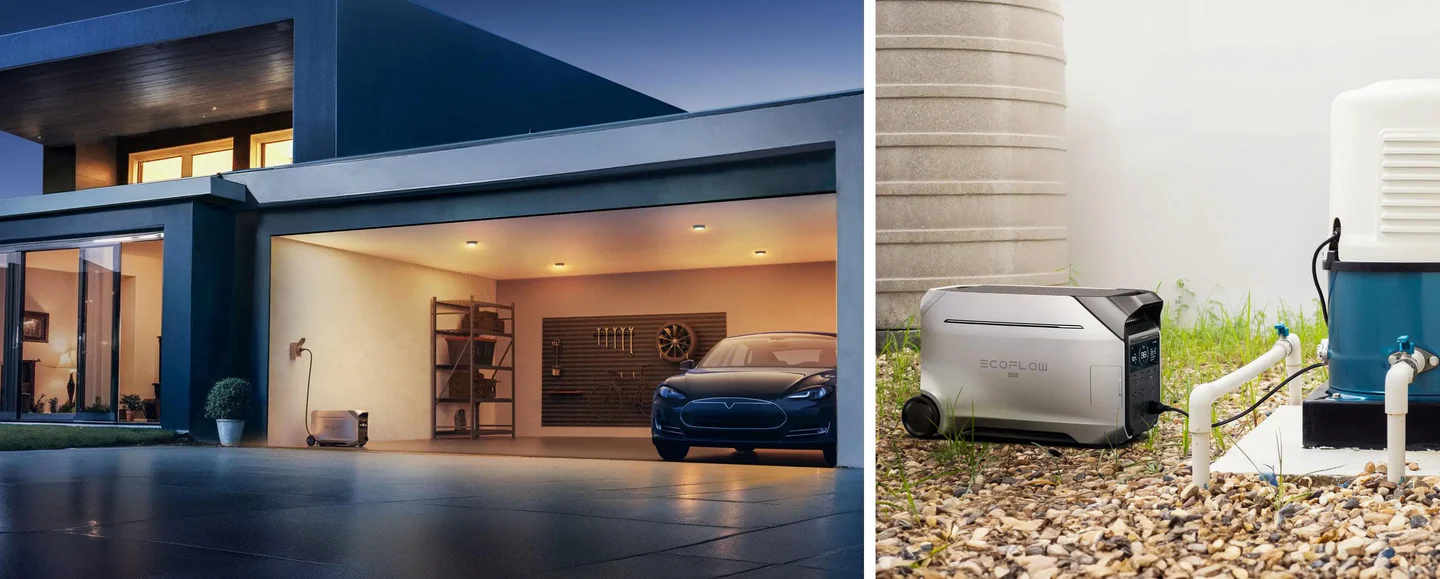
Let’s cut through the marketing fluff. The EcoFlow Delta Pro 3 portable power station is a 4,096 watt-hour (Wh) lithium iron phosphate (LFP) battery system wrapped in a portable shell. Think of it as a Tesla Powerwall you can actually wheel around your house.
It launched in mid-2024 and has since become EcoFlow’s flagship consumer power station, sitting right between the original Delta Pro and the industrial-grade Delta Pro Ultra.
Here’s the kicker: this isn’t just a “camping battery” that can charge your phone. We’re talking about a unit that can run a 3-ton central air conditioner, power your fridge for over 27 hours, or keep your Wi-Fi router alive for nearly two weeks straight. It outputs 4,000 watts continuously with an 8,000-watt surge capacity, and it supports split-phase 120V/240V output—something most portable power stations simply can’t do.
EcoFlow built this thing on their new X-Core 3.0 architecture, which integrates commercial-grade and EV-level battery tech into a consumer product. Translation? Better safety, faster charging, quieter operation, and a battery that won’t degrade after a few hundred cycles. With over 1,000 patents backing this system, EcoFlow isn’t playing around.
Unboxing the Beast: Design, Build, and Portability
At 113.5 pounds and measuring 16.1 x 27.3 x 13.4 inches, the Delta Pro 3 battery generator is no lightweight. But here’s the thing—EcoFlow knows this. They’ve equipped it with built-in 5-inch wheels and a telescoping handle, so moving it feels more like rolling a checked bag through an airport than lugging a car battery.
Is it portable? Yes. Is “throw it in your backpack” portable? Absolutely not. This is a “move it from the garage to the patio” kind of portable.
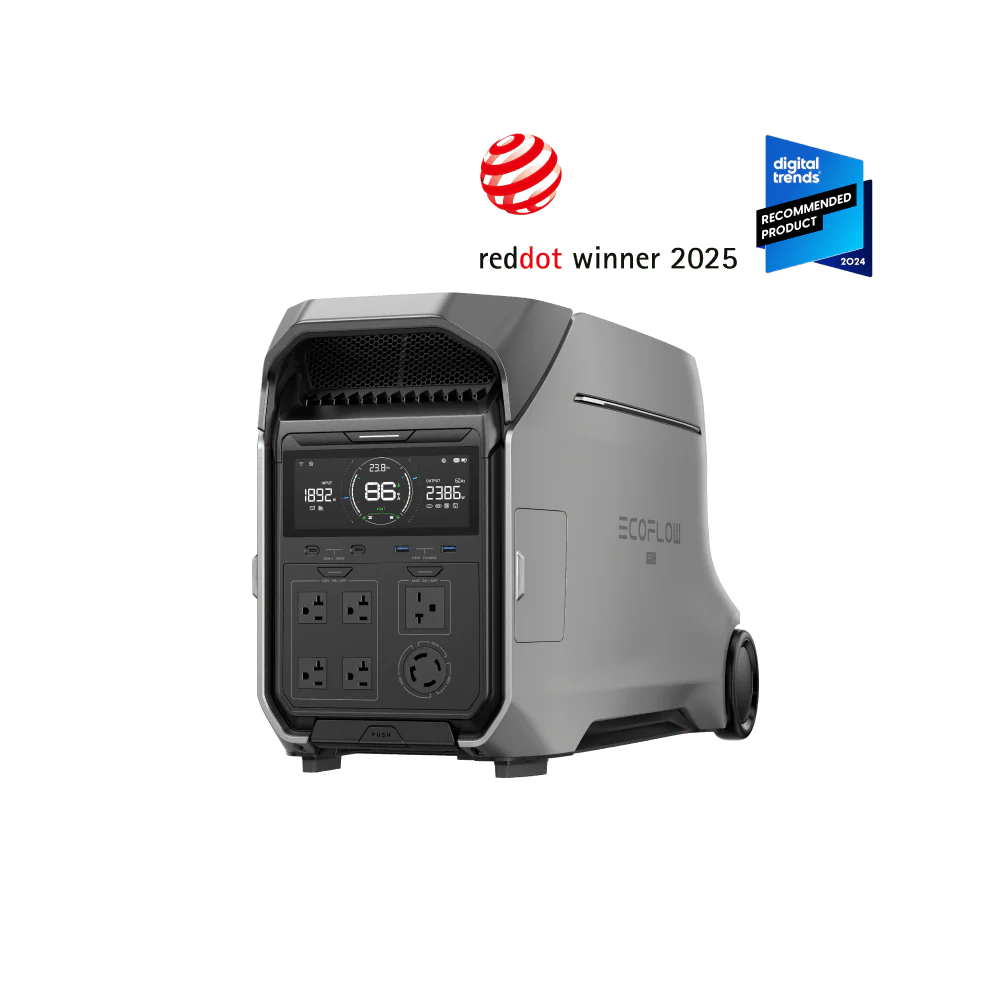
The design language is sharp and modern. The silver-and-black finish looks more like a premium appliance than a utilitarian gadget. On the front, you get a bright 6-inch display that shows everything from real-time wattage to battery health, temperature warnings, and estimated time until empty.
It’s the kind of screen that makes you feel like you’re piloting a spaceship rather than managing a battery.
Flip up the protective covers on the back, and you’ll find the input ports: AC charging, two solar inputs (high and low voltage), two expansion battery ports, and a proprietary AC in/out port for 240V connections or EV charging with a $99 adapter. The sliding side panels reveal a 30A RV outlet (NEMA TT-30) and 12V DC ports for things like automotive fridges or security cameras.
One small gripe? The 12V car socket is gone. If you were planning to plug in a standard car charger, you’ll need an adapter. It’s a weird omission, but not a dealbreaker for most users.
Power Output That Punches Above Its Weight
Let’s talk numbers, because when you’re spending $3,699 on a Delta Pro 3 home backup generator, you need to know exactly what it can handle.
The 4,000W pure sine wave inverter is the heart of this machine. In real-world testing, reviewers pushed it to a sustained 3,650W load for a full hour with about 89% efficiency. That’s impressive. It also handled a 5,100W surge for nearly a minute before the protective shutdown kicked in. So yes, it can start your refrigerator compressor or your microwave without breaking a sweat.
Here’s what that translates to in plain English:
| Appliance | Runtime on Single Charge |
|---|---|
| Standard 120W refrigerator | 27+ hours |
| 50-inch TV | 29.8 hours |
| Wi-Fi router | 13.5 days |
| 1,500W space heater | 2 hours 45 minutes |
| Midea Cube dehumidifier | 9 hours 50 minutes |
| 40W lamp + air circulator | 37+ hours |
But here’s where it gets wild: you can expand this thing. Add two EcoFlow Delta Pro 3 Smart Extra Batteries (4,096 Wh each, priced at $2,599), and you hit 12 kWh. Daisy-chain two full Delta Pro 3 units with two extra batteries each, and you’re staring at 36kWh. That’s enough to run an average American home for a day or two during an outage.
Seven Ways to Charge: Never Run Dry
If variety is the spice of life, the EcoFlow Delta Pro 3 solar generator is a five-star meal. EcoFlow claims seven unique charging methods and 18 combo methods. Let’s break down the main ones:
- AC Wall Outlet (Fastest)
Using EcoFlow’s X-Stream technology, you can hit 80% charge in about 50 minutes and a full charge in roughly 2 hours and 35 minutes. That’s faster than most power stations half its size. You can even dial the charging speed down to 500W via the app if you want to be gentle on your home’s electrical system. - Solar Panels
The Delta Pro 3 accepts up to 2,600W of solar input across two ports (high voltage 30V-150V and low voltage 11V-60V). With a full 12-panel array (three sets of four in series), you can charge from 0-100% in just 3.4 hours. Even a four-panel 500W kit takes about 7 hours in decent sunlight. EcoFlow’s bifacial panels (which generate power from both sides) have an IP68 weatherproof rating, so rain and dust won’t stop them. - EV Charging Stations
This is where the Delta Pro 3 really stands out from the crowd. With a $99 EV X-Stream Adapter, you can plug directly into public EV charging stations. Road-tripping in your RV and need a top-off? Pull into any EV charger and juice up. No other consumer power station offers this level of flexibility. - Car Charger
The 800W alternator charger option lets you recharge from your vehicle’s power system. Great for overlanders and van-lifers. - Dual Fuel Smart Generator 4000
For the truly paranoid (or the truly off-grid), pair the Delta Pro 3 with EcoFlow’s dual-fuel smart generator. It auto-starts when battery levels drop, giving you a hybrid gas-battery backup system. - & 7. Multi-Charging Combos
Combine AC + solar, solar + car, or all three for even faster charging. The unit intelligently manages inputs so you don’t overload anything.
The EcoFlow App: Your Power Station’s Brain
Gone are the days of squinting at a tiny LCD screen. The EcoFlow app (iOS and Android) turns your phone into a command centre. You get two homepage views—Energy Flow and Standard—both showing real-time input/output wattage, per-port usage, battery percentage, and solar generation.
Dig into the settings, and you’ll find granular controls: set auto-timeout for ports, configure charging speeds, enable X-Boost for temporary overloads, schedule charging during off-peak hours for bill savings, and even set up backup reserve modes. One reviewer noted the app instantly recognised the generator on first launch—no Bluetooth pairing headaches, no manual IP addresses.
The peak-shaving feature deserves special mention. With electricity rates climbing nationwide, you can programme the Delta Pro 3 to charge itself at 2 AM when rates are dirt cheap, then power your home during expensive peak afternoon hours. Over a year, that could shave serious money off your utility bill.
Real-World Performance: What Owners Are Saying
Numbers on a spec sheet are one thing. Living with the EcoFlow Delta Pro 3 portable generator is another. One long-term reviewer from CleanTechnica took the unit on a five-week camping trip across the American Southwest.
Paired with a second battery (8 kWh total) and 1,800 W of rooftop solar, they ran an older, inefficient RV air conditioner for about 9 hours per night. Total generator runtime over the entire month? About 20 hours. The rest came from the sun. “It hasn’t left me unable to power the things I wanted to power,” they reported.
Another test by PCMag involved plugging in a 1,500W space heater. The Delta Pro 3 lasted 2 hours and 45 minutes—exactly what you’d expect from a 4,096 Wh battery at that load. Recharging took 2 hours and 35 minutes.
They also ran a dehumidifier for nearly 10 hours and a lamp-plus-fan combo for over 37 hours. In every test, it outperformed competitors like the Ugreen PowerRoam 2200 by significant margins.
However, it’s not all sunshine. Some users report an occasional need to reset the unit, and one long-term tester advised against using it for critical unattended backup (like powering a pet’s AC unit while you’re away) due to rare shutdown events. It’s reliable, but not quite “set it and forget it” for life-or-death applications.
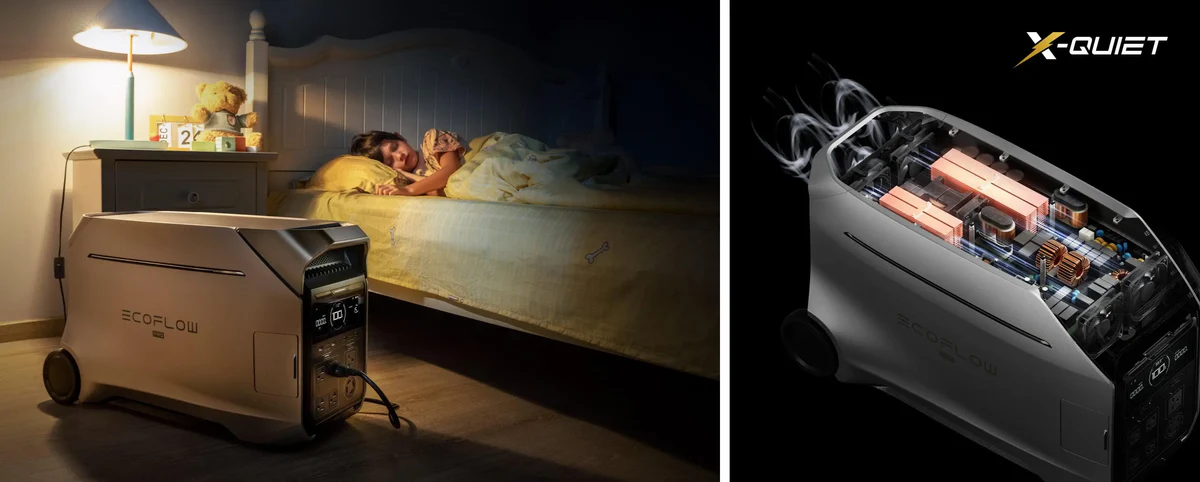
Noise Levels: How Quiet Is the Delta Pro 3, Really?
EcoFlow markets the Delta Pro 3 as “silent as a whisper” at 30 dB under a 2,000W load. In practice, reviewers found it lives up to the hype at lower loads—you really can sleep next to it. At higher loads (3,000W+), the fans spin up, and it becomes audible, though still far quieter than any gas generator.
One reviewer described the AC charging port as making a faint “cricket-like” chirp, which could annoy light sleepers in a small RV.
Compared to the original Delta Pro, it’s noticeably quieter. Compared to the Delta Pro Ultra? Not quite as silent, but the Ultra is a different beast entirely. For 99% of users, the noise level is a non-issue.
Safety Features: Because 4,096 Wh is a Lot of Energy
Let’s be real—this is a massive battery. You want to know it’s not going to turn into a fireball. EcoFlow’s X-Core 3.0 system includes explosion-proof battery packs, advanced thermal management, and a battery management system (BMS) that monitors temperature, voltage, and current in real-time. The IP65-rated battery enclosure protects against dust and water jets.
The LFP chemistry itself is inherently safer than traditional lithium-ion. It won’t go into thermal runaway like the batteries in some cheaper power stations. With a 4,000+ cycle lifespan (that’s over 10 years of daily use), you’re not just buying power—you’re buying peace of mind.
Expandability: Building Your Personal Power Grid
The EcoFlow Delta Pro 3 power station isn’t a dead-end purchase. It’s an ecosystem starter kit.
- Smart Extra Batteries: Stack up to two 4,096 Wh units for 12kWh total.
- Smart Home Panel 2: Wire the Delta Pro 3 directly into your home’s electrical panel for automatic backup during outages.
- Dual Fuel Smart Generator 4000: Hybrid gas-battery backup for extended blackouts.
- Solar Arrays: Scale from a single 125W panel to a 2,600W rooftop array.
- Legacy Compatibility: Works with original Delta Pro smart batteries, so existing EcoFlow users can upgrade without starting from scratch.
This backward compatibility is huge. When EcoFlow released the Delta Pro Ultra, it broke compatibility with older batteries, frustrating loyal customers. The Delta Pro 3 fixes that mistake.
Price and Value: Is the Delta Pro 3 Worth $3,699?
Here’s the sticker shock: the base EcoFlow Delta Pro 3 generator price is $3,699. As of early 2026, street prices have settled around $3,199 during sales. Bundles include:
| Bundle | Regular Price | Sale Price |
|---|---|---|
| Delta Pro 3 + Smart Extra Battery | $6,298 | $5,498 |
| Delta Pro 3 + Alternator Charger | $4,298 | $3,799 |
| Delta Pro 3 + Smart Home Panel 2 | $5,598 | $4,798 |
| Delta Pro 3 + Dual Fuel Smart Generator 4000 | $5,498 | $4,698 |

Is it expensive? Absolutely. But compare it to a whole-home natural gas generator (easily $10,000+ installed) or even a Tesla Powerwall ($11,500+), and the Delta Pro 3 starts looking like a bargain—especially since you can take it with you when you move or go camping.
If you need a high-capacity portable power station with multiple charging options, split-phase output, and smart home integration, PCMag awarded it an Editors’ Choice. That says something.
Who Should Buy the EcoFlow Delta Pro 3?
Let me be blunt: this isn’t for everyone. If you just need to charge a laptop on a weekend camping trip, buy a $300 power bank and call it a day. But if you fall into any of these categories, the Delta Pro 3 is worth serious consideration:
- Homeowners in storm-prone areas: Hurricanes, ice storms, and wildfire-season blackouts are becoming the norm. The Delta Pro 3 can keep your essentials running for days.
- RV and van-life enthusiasts: With 30A RV outlet support, EV charging compatibility, and silent operation, it’s the ultimate road-trip companion.
- Off-grid cabin owners: Pair it with solar panels, and you’ve got a renewable power system that rivals permanent installations.
- Remote workers: Keep your internet, computers, and monitors alive during outages. That 10ms switchover time means you won’t even lose your Zoom call.
- Peak-rate shavers: If your utility charges time-of-use rates, the Delta Pro 3 can pay for itself over time by storing cheap power and displacing expensive peak usage.
Who Should Skip It?
- Budget buyers: At $3,199-$3,699, this is a serious investment. The EcoFlow Delta 3 (1,800W, 56-minute charge) costs a fraction and handles most basic needs.
- Ultra-lightweight campers: 113.5 pounds is not “backpackable”. Look at the EcoFlow River series instead.
- Users needing simultaneous 120V/240V: The Delta Pro 3 can’t run both voltages at once. For that, you’ll need the Delta Pro Ultra or a hardwired solution.
EcoFlow Delta Pro 3 vs. Competitors: A Quick Comparison
| Feature | EcoFlow Delta Pro 3 | Ugreen PowerRoam 2200 | Anker Solix F3800 |
|---|---|---|---|
| Battery Capacity | 4,096 Wh | 2,048 Wh | 3,840 Wh |
| Continuous Output | 4,000W | 2,200W | 3,800W |
| Surge Output | 8,000W | 4,400W | 7,600W |
| AC Charge Time (0-100%) | ~2.5 hours | ~1.5 hours | ~2.5 hours |
| Solar Input | 2,600W | 1,200W | 2,400W |
| EV Charging | Yes (with adapter) | No | No |
| Weight | 113.5 lbs | 56.2 lbs | ~100 lbs |
| Price | ~$3,199 | $1,599 | ~$3,499 |
| Expandable to | 36 kWh | 12 kWh | 26.9 kWh |
| View Details | View Details | View Details |
The Delta Pro 3 sits in a sweet spot: more powerful than mid-range options like the Ugreen, more portable and affordable than the Anker Solix F3800, and uniquely capable with its EV charging feature.
Conclusion: Should You Pull the Trigger?
After weeks of research and reading countless real-world tests, here’s my honest take: the EcoFlow Delta Pro 3 generator is the best all-around portable power station for serious users in 2026. It doesn’t revolutionise the category—it’s more like a perfected version of what EcoFlow has been building since 2021. But perfecting something this complex is no small feat.
The combination of 4,096Wh base capacity, 4,000W output, seven charging methods, EV station compatibility, smart home integration, and genuine expandability makes it a Swiss Army knife of energy. Yes, it’s heavy. Yes, it’s pricey. But when the lights go out, and your house stays warm, your food stays cold, and your Wi-Fi stays on, you’ll forget all about the cost.
If you’re already an EcoFlow Delta Pro owner and it’s meeting your needs, this isn’t a must-upgrade. It’s like going from an iPhone 14 to an iPhone 15—nice improvements, but not earth-shattering. But if you’re new to the portable power world or your current setup is leaving you in the dark, the Delta Pro 3 is absolutely worth the investment.

You Might Also Like