

Delta Pro 3 vs Bluetti Apex 300: Which Power Station Actually Deserves Your Money?
So you’re staring at two spec sheets, two price tags, and one big question: Delta Pro 3 vs Bluetti Apex 300 — which one should actually end up in your garage? I get it. Picking a home backup power station feels a little like buying a used car with the hood welded shut.
Quick Take: Delta Pro 3 vs Bluetti Apex 300 in a Nutshell
Here’s the short version if you’re in a hurry. The EcoFlow Delta Pro 3 is the more polished, refined performer with a slightly higher base price and a battery-tested track record. The Bluetti Apex 300 is the scrappy challenger — cheaper out of the gate, wildly scalable, and backed by a battery rated for nearly 50% more charge cycles. Neither is “bad.” They’re just built for slightly different kinds of buyers, and that distinction matters more than most review sites let on.
What Is the EcoFlow Delta Pro 3, Really?
The Delta Pro 3 is EcoFlow’s current flagship portable power station, and it doesn’t try to hide its ambitions. This is a home-backup machine wearing a camping-friendly disguise. It ships with 4,096Wh of LFP (lithium iron phosphate) battery capacity in a single unit, and it can push a continuous 4,000W of AC output — enough to run a central air conditioner, a sump pump, and your kitchen appliances without anyone in the house noticing there’s a blackout happening outside.
What makes it interesting isn’t just raw numbers, though. It’s how those numbers scale. Add one extra battery, and you’re at 8kWh. Add two, and you’re sitting on 12kWh from a single unit. Chain three Delta Pro 3 units together and you’re talking about 36kWh of storage and 12kW of output — genuinely whole-house territory.
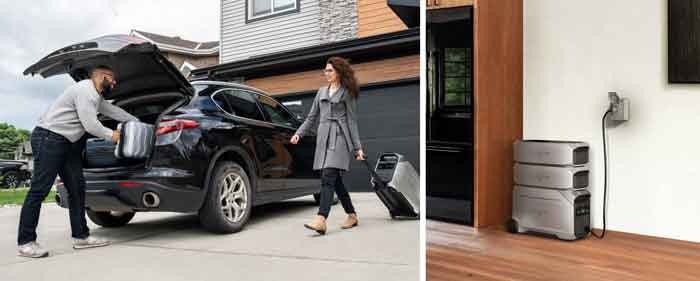
Delta Pro 3 Battery and Expansion Capabilities
Here’s where the Delta Pro 3 quietly earns its “flagship” title. EcoFlow rates the battery at 4,000 cycles to roughly 80% capacity, which translates to somewhere around 11 years of typical use. That’s a solid number, and it means you’re not gambling on a battery that degrades noticeably by year three.
The dual-PV solar input tops out around 2,600W (or up to 5,200W when paired with a second unit), so if you’re pairing this with rooftop or ground-mount solar, recharging isn’t painfully slow.
Delta Pro 3 Charging Speed and Real-World Runtime
Thanks to EcoFlow’s X-Stream fast-charging tech, the Delta Pro 3 can hit 80% capacity in about 50 minutes from a wall outlet. That’s genuinely fast for a battery this size. In practical terms, if a storm knocks your power out at dinner time, you could theoretically top this thing back up to nearly full before bed, assuming you had grid power at some point during the day.
Runtime-wise, expect this unit to comfortably carry a fridge, a few lights, a modem, and a laptop for well over 24 hours on a single 4,096Wh charge — longer if you’re not running anything power-hungry like an AC compressor.

What Is the Bluetti Apex 300?
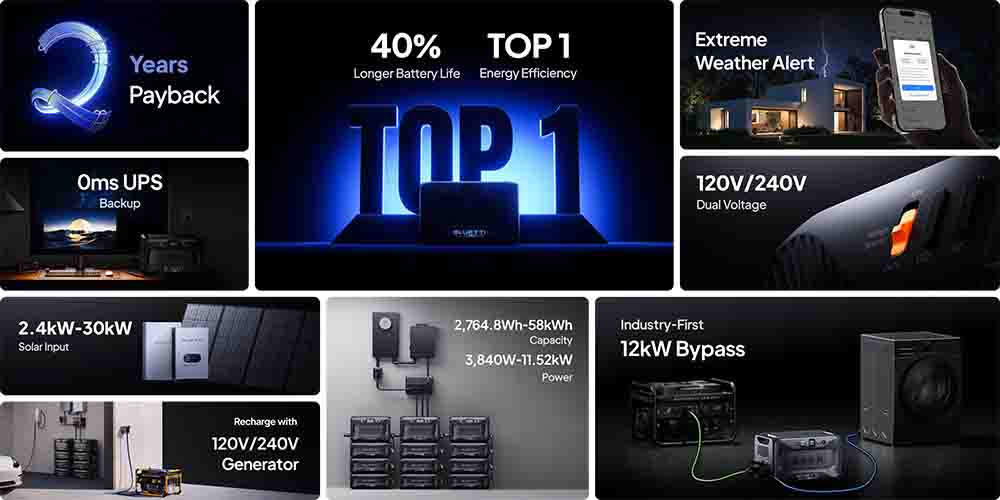
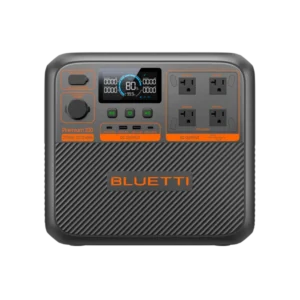
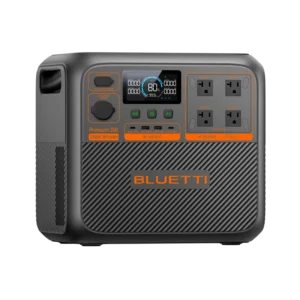
Now let’s talk about the challenger. The Bluetti Apex 300 launched with a clear mission: undercut the big flagship units on price while still delivering legitimate whole-home performance. It packs 2,764.8Wh of second-generation LFP battery capacity per unit and delivers 3,840W of continuous AC output, with short bursts up to 7,680W for appliances with a hungry startup draw (looking at you, air conditioners and well pumps).
Where the Apex 300 gets genuinely exciting is scalability. Chain up to three units together and you’re looking at 11.52kW of output and up to 58kWh of total storage once you factor in the B300K expansion batteries. That’s not a typo — 58kWh is enormous, easily rivaling small home solar-battery installations.
Bluetti Apex 300 Battery Longevity: The Sleeper Spec
This is the number that tends to get buried in marketing copy, and it shouldn’t be. Bluetti rates the Apex 300’s battery for 6,000 charge-discharge cycles, which the company estimates at around 17 years of realistic use. Compare that to the Delta Pro 3’s 4,000-cycle rating, and the Apex 300 pulls ahead by a meaningful margin on pure longevity.
If you’re the type who wants to buy something once and forget about it for a couple of decades, this is a genuinely compelling reason to lean Bluetti.
Bluetti Apex 300 Solar Charging and the 12kW Bypass Trick
Solar input on the Apex 300 runs up to 2,400W per unit through dual XT60 ports, and with the optional SolarX 4K controller, that ceiling jumps dramatically higher for larger installations. But the feature that really sets it apart is the 12kW bypass function — this lets the unit pass grid power straight through to power-hungry devices like an EV charger or a central AC unit, even while it’s simultaneously charging its own battery.
It’s a clever bit of engineering that effectively turns the Apex 300 into a mini power-management hub, not just a battery in a box.
Delta Pro 3 vs Bluetti Apex 300: Side-by-Side Comparison Table
Numbers speak louder than adjectives, so here’s the head-to-head breakdown.
| Spec | EcoFlow Delta Pro 3 | Bluetti Apex 300 |
|---|---|---|
| Battery Capacity (base) | 4,096Wh | 2,764.8Wh |
| Continuous AC Output | 4,000W | 3,840W (7,680W surge) |
| Battery Chemistry | LiFePO4 (LFP) | 2nd-Gen LiFePO4 (LFP) |
| Rated Cycle Life | 4,000 cycles (~11 years) | 6,000 cycles (~17 years) |
| Max Expandable Capacity | Up to 48kWh (multi-unit) | Up to 58kWh (multi-unit) |
| Max Solar Input | 2,600W (5,200W paired) | 2,400W (up to 19.2kW with SolarX 4K) |
| AC Recharge Time (0-80%) | ~50 minutes | ~55 minutes (solar), ~75 min full |
| Voltage Output | 120V/240V dual | 120V/240V dual |
| Special Feature | Whole-Home Power Kit integration | 12kW grid-bypass function |
| Approx. Street Price | ~$1,999 | ~$1,400–$1,899 |
| Warranty | 5 years | 5 years |
| Learn More | Learn More |
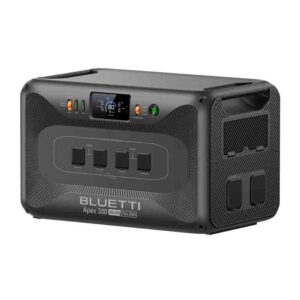
Price and Value: Where Your Dollars Actually Go
Let’s not dance around it — price is usually the deciding factor for most people, and it should be. The Delta Pro 3 typically runs around $1,999, though promotional pricing has pushed it lower at times. The Apex 300, meanwhile, has been spotted for as little as $1,400 during sales, with its regular list price hovering closer to $1,899 or above depending on the retailer and bundle.
On a pure dollars-per-watt-hour basis, the Delta Pro 3 actually wins, since you’re getting nearly 50% more battery capacity for a similar or only slightly higher price. But if your budget is tighter and you’re planning to expand your system gradually over a few years, the Apex 300’s lower entry cost and modular battery packs might fit your cash flow better. Think of it like buying a starter home versus buying land you’ll build on — both get you somewhere, just on different timelines.
Portability and Physical Footprint
Neither of these units is something you’re tossing in a backpack. Both are wheeled, both are heavy, and both are designed to live in a garage, basement, or utility closet rather than a hiking trail. The Apex 300 weighs in at around 38kg (roughly 84 pounds), and while EcoFlow doesn’t always advertise it loudly, the Delta Pro 3 sits in a similar weight class.
If portability within your property (not across a campsite) is your priority, both handle that job fine thanks to built-in wheels and telescoping handles.
Noise Levels: Which One Lets You Sleep?
Nobody talks about this enough, but noise matters when a power station is running in your bedroom closet at 2 a.m. The Delta Pro 3 is rated at around 30dB under typical loads (roughly 2,000W), which is close to a whisper — quieter than a running refrigerator.
Bluetti doesn’t always publish an equivalent decibel figure for the Apex 300 as prominently, but user reports generally describe it as comparably quiet under normal household loads. If ultra-silent operation is non-negotiable for you, the Delta Pro 3’s published numbers give it a slight edge on paper.
App Control and Smart Features
Both units lean heavily on companion apps for monitoring and control, and honestly, this is table stakes at this price point now. The EcoFlow app lets you fine-tune charging speeds, monitor output in real time, and schedule charge/discharge cycles remotely. Bluetti’s app does much of the same, with added alerts for extreme weather conditions — a nice touch if you’re using the Apex 300 as a genuine home-backup safety net rather than just a camping accessory.
Home Backup Integration: Whole-Home Panels Compared
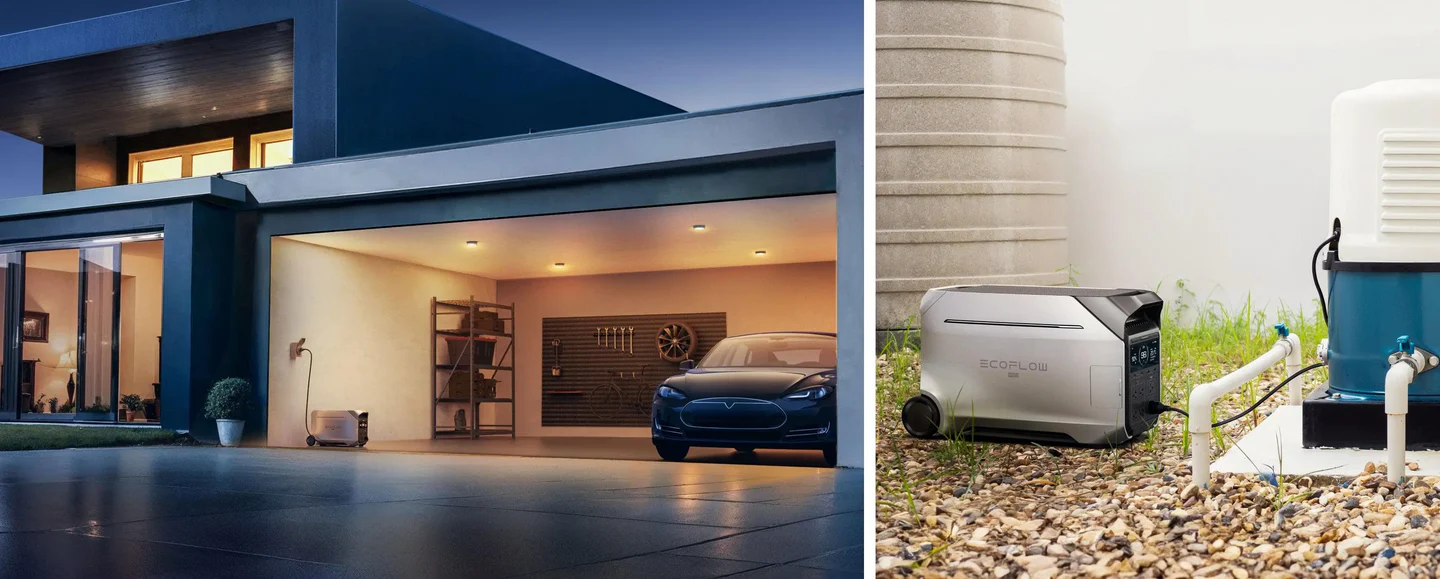
This is where things get serious for anyone thinking beyond “backup for a few appliances.” EcoFlow sells a Smart Home Panel 2 that integrates directly with the Delta Pro 3, letting you automate circuit-level switching during an outage. Bluetti counters with its own modular ecosystem built around the Apex 300, emphasizing that 12kW bypass function I mentioned earlier, which lets the unit essentially sit inline with your home’s power without acting as a bottleneck.
If you’re planning a true whole-home setup rather than a “plug a few things into it” solution, both brands want to sell you an entire ecosystem, not just a single box. Budget accordingly — the base unit price is rarely the final price once you add panels, cables, and expansion batteries.
Efficiency and Real-World Performance
Independent testing on the Apex 300 has clocked its real-world efficiency around 85%, which is a solid, respectable number for an inverter this size.
EcoFlow doesn’t always publish an equivalent third-party efficiency figure for the Delta Pro 3, but its X-Stream charging architecture and CTC (cell-to-chassis) design are engineered specifically to minimize energy loss during both charging and discharging. In plain English: neither unit is going to waste an embarrassing chunk of your solar-generated electricity as heat.
Who Should Buy the EcoFlow Delta Pro 3?
Picture this: you want a single, powerful unit that handles most of your home’s essential circuits without needing to chain together multiple boxes right away. If that’s you, the Delta Pro 3 makes a lot of sense. It’s the better choice if you value a higher base capacity out of the box, faster documented charge times, and EcoFlow’s more mature Whole-Home ecosystem. It’s also a strong pick if quiet operation is a hard requirement, since that 30dB rating is genuinely impressive.

Who Should Buy the Bluetti Apex 300?
Now flip the script. If you’re budget-conscious right now but planning to scale your system over the next few years, the Apex 300’s lower entry price and modular battery expansion (all the way up to 58kWh) make it the more flexible long-game option.
Add in that 6,000-cycle battery rating — nearly 50% longer than the Delta Pro 3’s — and the Apex 300 becomes a genuinely smart pick for anyone thinking in decades, not just storm seasons. The 12kW bypass function is also a killer feature if you’re eyeing an EV charger or a central AC unit down the road.
Delta Pro 3 vs Bluetti Apex 300: The Verdict
So, which one wins? Honestly, that’s like asking whether a sedan or an SUV is “better” — it depends entirely on what you’re hauling. If you want more capacity right now, faster charging, and a quieter unit with a polished ecosystem, go with the Delta Pro 3.
If you want a lower entry cost, superior long-term battery life, and a more scalable expansion path, the Bluetti Apex 300 is hard to beat. Neither choice is a mistake. Both are legitimate, well-engineered home backup power stations that solve the same core problem in slightly different ways.
Conclusion
At the end of the day, comparing the Delta Pro 3 vs Bluetti Apex 300 isn’t about crowning a universal winner — it’s about matching the machine to your actual life. Need raw power and a refined, quiet system right out of the box? EcoFlow’s Delta Pro 3 delivers.
Need a budget-friendly entry point with a battery built to outlast your mortgage and room to scale into a genuinely massive system? Bluetti’s Apex 300 has your back. Either way, you’re walking away with a legitimate home-backup power station, not a glorified phone charger. Take a look at your budget, your power needs, and how far you want this system to grow, and the right answer will pretty much pick itself.
Bluetti Stores
| USA | Australia | Europe | United Kingdom |
|---|---|---|---|
 |
 |
 |
 |
| Visit Store | Visit Store | Visit Store | Visit Store |
| Italy | Germany | France | Canada |
 |
 |
 |
 |
| Visit Store | Visit Store | Visit Store | Visit Store |
FAQs About Delta Pro 3 vs Bluetti Apex 300
Both can support whole-home setups when paired with their respective smart panels, but the Delta Pro 3 offers a higher base capacity per unit, while the Apex 300 offers greater maximum expandability across multiple units.
The Bluetti Apex 300 wins here, with a 6,000-cycle rated battery (about 17 years) compared to the Delta Pro 3's 4,000-cycle rating (about 11 years).
Yes. Both units support the surge wattage needed for central AC startup, though you'll want to size your total system (including any expansion batteries) around your specific AC unit's draw.
The Delta Pro 3 edges out slightly, reaching 80% charge in about 50 minutes via X-Stream fast charging, compared to roughly 55 minutes for the Apex 300 under optimal solar conditions.
You Might Also Like