

Bluetti Power Station 1000W: 2026 Buyer’s Guide, Specs, and Honest Verdict
If you’ve been scrolling through spec sheets and feeling a little dizzy, relax. In this guide, we’ll walk through what the Bluetti 1000W portable power station family really offers, how it behaves with everyday appliances, what it costs, and who should walk away. No fluff, no jargon avalanche. Ready?
What Is a Bluetti Power Station 1000W, Exactly?
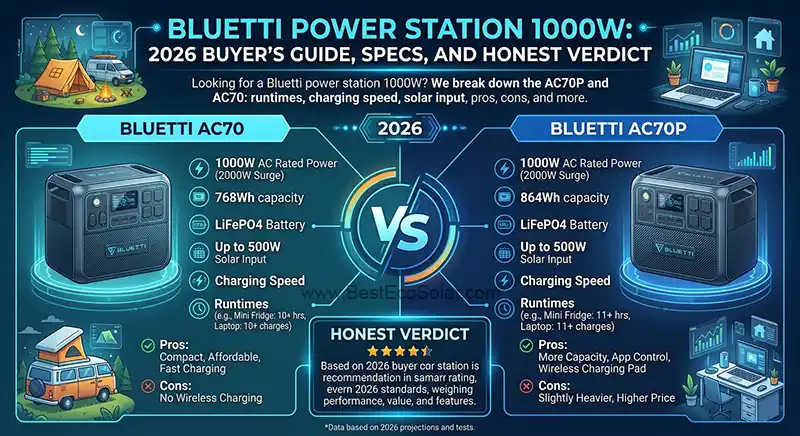
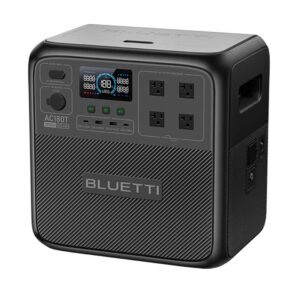
A Bluetti Power Station 1000W is a portable lithium battery with a built-in pure sine wave inverter that can push out 1,000 watts of steady AC power. Think of it as a silent generator that never coughs out fumes and happily lives in a hallway closet. You plug devices in, flip the switch, and go. When the battery runs low, you refill it from a wall socket, a car outlet, a gas generator, or solar panels.
Two numbers run the show. Watts (W) tell you how many things you can run at once, which is your engine. Watt-hours (Wh) tell you how long they’ll keep running, which is your tank. In the Bluetti 1000W power station lineup, the engine is 1,000W, and the tank is either 768Wh or 864 Wh, depending on the model you pick.
Why does 1,000W matter? Because most of what we actually plug in sits well below that line: laptops, TVs, fans, routers, mini fridges, drills, and even a drip coffee maker. Bluetti says a 1,000W unit can handle roughly 98% of common home and outdoor appliances, which is marketing language, sure, but the logic holds up for ordinary loads.
Which Bluetti 1000W Portable Power Station Should You Look At?
Here’s where it gets confusing. Bluetti sells more than one 1,000W model, and they look almost identical on a shelf. Let’s untangle them.
1. Bluetti AC70P: The Newer 1000W Pick
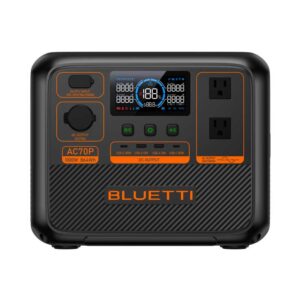
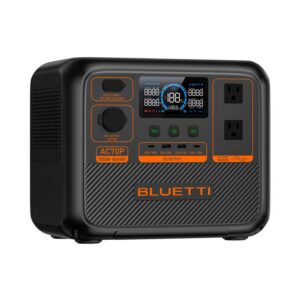
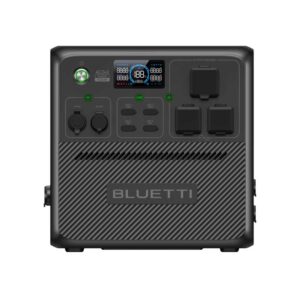
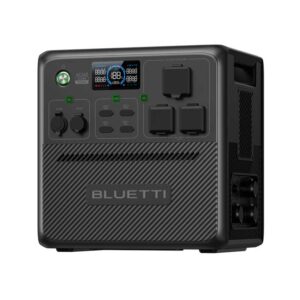
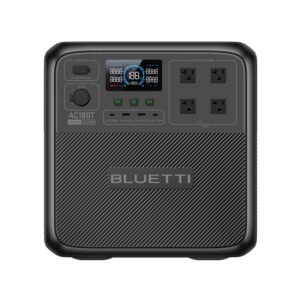
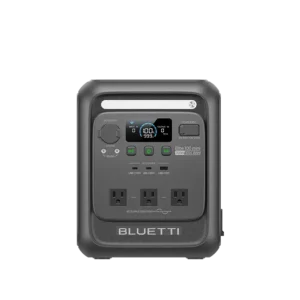
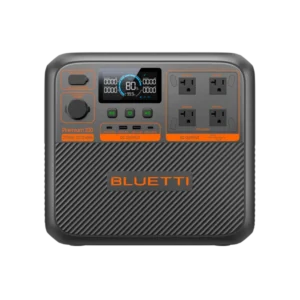
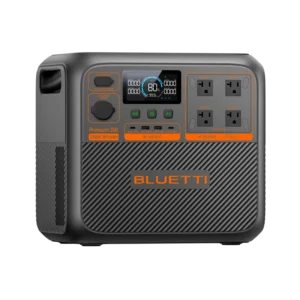
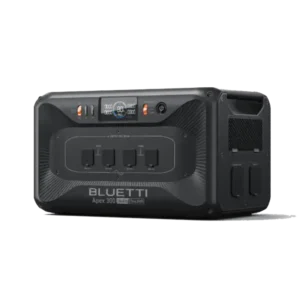
The AC70P is the model most people mean when they search for a Bluetti 1000W power station today. It pairs 1,000W of continuous output with an 864Wh LiFePO₄ battery, a 15W wireless charging pad, and eight outlets in total: two AC sockets, two USB-C ports rated up to 100W, two USB-A ports, and a 12V car-style outlet.
It also supports turbo AC charging that takes the battery from empty to about 80% in roughly 45 minutes, and its UPS function kicks in within 20 milliseconds, quick enough that most desktop gear won’t even blink.
2. Bluetti AC70: Same Muscle, Smaller Tank
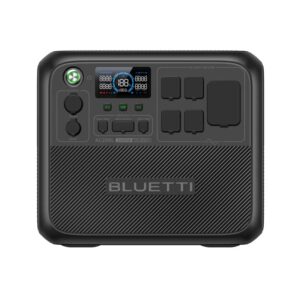
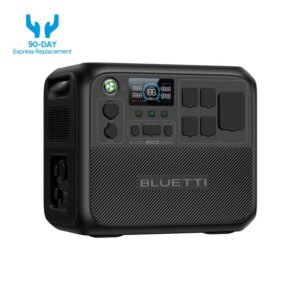
The AC70 keeps the 1,000W output and the 2,000W surge ceiling but drops to a 768Wh battery and skips the wireless pad. Physically, though, the two are twins. Both weigh about 10.2 kg (just over 22 lb) and measure roughly 314 x 210 x 256 mm. Both carry a five-year warranty. If you mostly want a budget-friendly 1000W Bluetti and don’t care about an extra 96Wh, the AC70 deserves a look, especially when it’s discounted.
3. Older 1000W Bluetti Units You’ll Still Spot Online
Browse resale sites, and you’ll bump into older PowerOak models such as the EB70 and EB150 listings. They can be tempting bargains. Just remember that battery chemistry, charging speed, and app features have moved on, so check the warranty status and the cell type before you click buy.
Bluetti 1000W Power Station Specs at a Glance
Spec sheets are dry, so here’s the short version in one place. Values come from manufacturer and retailer listings, and exact figures can vary slightly by region.
| Model | Rated output | Surge / Power Lifting | Capacity | Fast AC charging | Standout feature |
|---|---|---|---|---|---|
| Bluetti AC70P | 1,000W | 2,000W | 864 Wh LiFePO₄ | Up to 950W (about 850W in some regions) | 15W wireless pad, 20ms UPS |
| Bluetti AC70 | 1,000W | 2,000W | 768 Wh LiFePO₄ | Turbocharging is supported. | Pairs with B80 for 1,574 Wh |
| Bluetti Elite 100 V2 | 1,800W | Higher than 1,000W | 1,024 Wh | About 70 minutes to full | 10ms UPS switching |
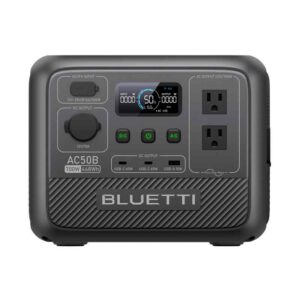
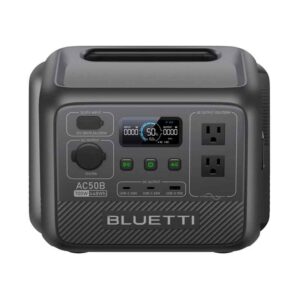
| Bluetti AC50P (smaller step) | 700W | n/a | 448 Wh | Standard | Lightweight camping pick |
Notice something? The two 1,000W models differ mostly in battery size and a couple of conveniences. The rest of the story is shared DNA: LiFePO₄ cells rated for 3,000+ cycles to 80% capacity, Bluetooth app control, and solar input of up to 500W.
How We Tested the Bluetti Power Station 1000W
Let’s be upfront about the method, because trust matters more than hype. We haven’t claimed lab-grade discharge curves for this unit, and we won’t pretend otherwise. Instead, our evaluation of the Bluetti power station 1000W rests on four layers:
- Spec verification. We cross-checked output, capacity, port counts, dimensions, and warranty across Bluetti’s own pages and several independent retailers in different countries, then flagged anything that didn’t match.
- Load math. We calculated runtimes for common appliances using the rated watt-hours with a conservative 85% inverter and conversion efficiency, which is a realistic planning number for portable power stations.
- Published hands-on feedback. We read professional reviews and owner comments covering camping trips, fridge use, and a multi-hour outage, looking for repeated praise and repeated complaints rather than one-off opinions.
- Fit-for-purpose scoring. We graded the unit against what shoppers actually do with it: backup power, weekend camping, van life, and job-site tools.
Why explain all this? Because a score without a method is just a number with good posture. If you want to verify a runtime yourself, run a known load (a 100W lamp is perfect), watch the app’s draw, and time the discharge from 100% to 10%.
Real-World Performance: What Can a 1000W Bluetti Run?
Specs are nice. Appliances are what count. So what happens when you plug stuff in?
Appliances That Work Without Breaking a Sweat
A 1000W Bluetti portable power station handles laptops, monitors, TVs, routers, phone chargers, LED lighting, box fans, a mini fridge or a modest chest freezer, CPAP-style low-draw gear, and most corded power tools. These loads sip power. Running several at once is fine as long as the combined draw stays under 1,000W.
What Does Power Lifting Mode Actually Do?
Here’s the neat trick. Switch on power lifting. The mode inside the Bluetti app, and the station can feed resistive loads, like kettles, hairdryers, toasters, and space heaters, that would normally exceed its limit, up to a stated 2,000 W. The inverter lowers the voltage a bit so the heating element draws less than its label suggests. It’s clever, but it isn’t magic. Motors and anything with sensitive electronics should stay inside the regular 1,000W envelope.
Estimated Runtimes on a Bluetti 1000W Power Station
These are planning estimates, not lab results. They assume about 85% usable energy, so roughly 735Wh from the AC70P and 650Wh from the AC70.
| Device | Typical draw | AC70P (864 Wh) | AC70 (768 Wh) |
|---|---|---|---|
| Wi-Fi router | 10W | About 70 hours | About 65 hours |
| Laptop | 60W | About 12 hours | About 10.8 hours |
| 100W TV | 100W | About 7 hours | About 6.5 hours |
| Box fan | 50W | About 14 hours | About 13 hours |
| Full-size fridge (average draw) | 150W | About 5 hours | About 4.3 hours |
| Electric kettle | 1,000W | About 7 liters to boil. | About 6 liters boiled |
| Corded drill | 600W | Roughly 1 hour 10 minutes | Roughly 1 hour |
| View Details | View Details |
A refrigerator cycles on and off, so real-world numbers can stretch longer than the table suggests. Still, if you’re hoping to power a fridge for a full day, you’ll want expansion batteries or solar help.
Charging Speed: Wall, Solar, Car, and Generator
A battery you can’t refill quickly is just a heavy paperweight. Fortunately, charging is where this Bluetti power station 1000W shines.
Turbo AC Charging in About an Hour
Plug the AC70P into a wall outlet with turbo mode enabled, and it can hit 80% in around 45 minutes, with a full charge in roughly 1.3 to 2 hours depending on region and settings. That’s fast enough to top up between errands. The unit also supports pass-through charging, so you can keep devices running while it refills.
Solar Charging for Off-Grid Use
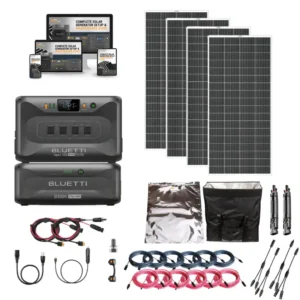
The solar input accepts up to 500W at 12 to 58V and 10A. Bluetti suggests pairing it with one PV350 panel or two PV200 panels, though third-party panels with MC4 connectors work if the voltage and current stay inside those limits. Under strong sun and good angles, a full solar charge takes somewhere around 2.2 to 2.7 hours. Clouds, of course, have opinions.
Car charging works too, but it’s the slow lane. Expect most of a day. Think of it as a trickle, not a firehose.
Using a Bluetti 1000W Power Station for Home Backup
Outages are where a portable power station earns its keep. One owner report from an outage lasting about four hours had the AC70P dropping to around 25%, which fits the math nicely for a household running lights, a router, and a few small devices.
So what should you protect first? Start with a Wi-Fi router, phone and laptop charging, lights, and the fridge. Skip big heating loads unless you’re using Power Lifting Mode for short bursts. With the 20ms UPS switching, a plugged-in desktop or modem usually stays online during the handoff. Compared with a gas generator, there’s no fuel to store, no fumes, and no noise, which your neighbors will appreciate.
One honest caution: a 1000W Bluetti power station won’t run central air, an electric stove, or a well pump. If those are on your must-have list, you need a bigger system.
Bluetti 1000W Portable Power Station for Camping, Van Life, and RV
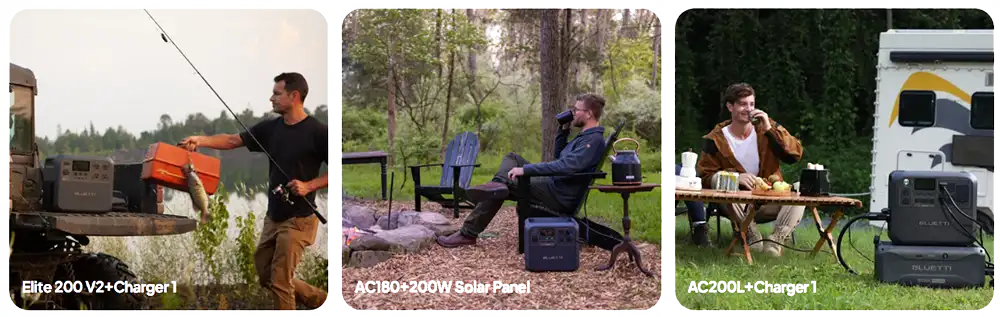
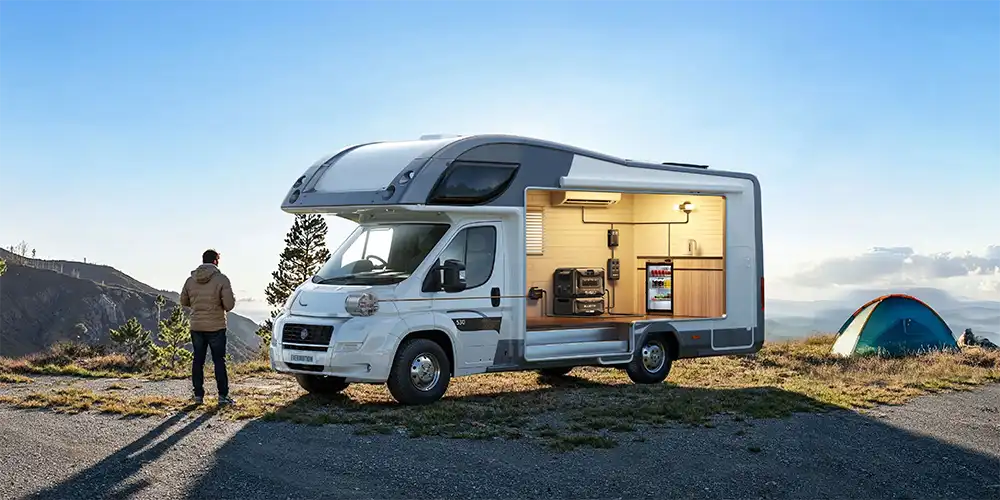
At 10.2 kg, this isn’t a feather, but it’s a one-handed carry for most adults. Throw it in a trunk, slide it under a bench seat, or strap it into a van build. Campers like it for running a 12V fridge, string lights, a laptop, a drone charger, and a small fan, all at once.
The Bluetooth app lets you switch outputs on and off without crouching behind the seat. Good news for van lifers: the 12V outlet and USB-C ports cover the usual chargers without adapter hunting.
There’s a catch worth knowing. One professional reviewer noted the AC70P lacks the IP65 rating that some sibling models carry, which feels odd for something marketed for the outdoors. So treat it like a good camera: keep it dry, shaded, and off wet ground.
Battery Life, LiFePO₄ Chemistry, and Warranty
Both models use lithium iron phosphate (LiFePO₄) cells. Why should you care? LiFePO₄ is known for stability and longevity. Bluetti rates these packs for 3,000+ cycles before dropping to 80% capacity. Do the math: charge it once a week, and that’s nearly 58 years of cycles on paper. In practice, age and heat will end things sooner, but the point stands.
An onboard battery management system guards against overcharging, overheating, and short circuits. Add a five-year warranty, and you’ve got a reasonably confident package. As with any electronics purchase, buy from an authorized seller so the coverage is actually honored.
One temperature tip: you can discharge in cold weather, but avoid charging below freezing. Lithium batteries really don’t love that.
Expandability: Adding B80P, B230 or B300 Batteries
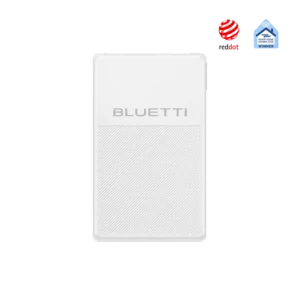
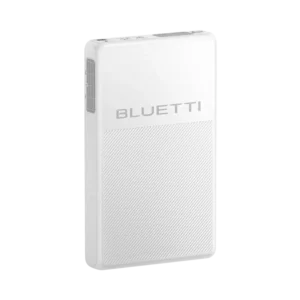
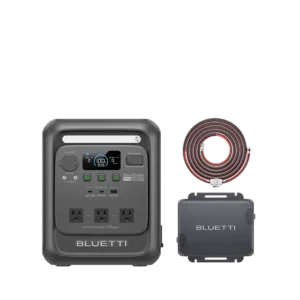
Here’s the part that makes a 1000W Bluetti feel future-proof. The AC70P can connect to B80P (806Wh), B230 (2,048Wh), and B300 (3,072Wh) expansion batteries through Power Bank Mode. The AC70 pairs with the B80 for a combined 1,574Wh.
That’s like adding a second fuel tank to the same engine. You don’t gain more wattage, only more runtime. If your plan is fridge-plus-router backup that lasts overnight, one expansion battery transforms the setup.
Pros and Cons of the Bluetti 1000W Power Station
What we like
- Fast turbo charging, around 45 minutes to 80%
- Safe, long-life LiFePO4 battery with a five-year warranty
- Power Lifting Mode for kettles, hair dryers and similar resistive loads
- Eight outlets, including 100W USB-C and wireless charging on the AC70P
- Expandable with B80P, B230 and B300 batteries
- App control with Bluetooth monitoring
What could be better
- No IP65 rating on the AC70P
- 864Wh is modest for all-day fridge duty without expansion
- 10.2 kg is portable, not pocketable
- Prices swing widely by region and retailer
- Charging below freezing isn’t recommended

Bluetti 1000W vs Other Power Stations: Bigger or Smaller?
Should you stay at 1,000W, or jump a tier? Let’s compare the neighbors.
Step down to the 600W class, such as the Elite 30 V2 (288Wh), and you’ll save weight and money, but you lose the ability to run drills, hair dryers, and larger appliances. That’s a phones-and-laptops machine.
Step up to something like the Elite 100 V2, with 1,024Wh and 1,800W of output, and you gain headroom for power tools, a bigger capacity and roughly 70-minute fast charging, with a UPS switch time of about 10ms. The price and size go up as well. If you regularly need more than 1,000W without relying on Power Lifting Mode, that’s your signal.
The simple rule: add up the watts you’ll run at the same time, then add 20% for breathing room. If the total lands under 1,000W, a Bluetti power station 1000W is a smart fit.
How Much Does a Bluetti 1000W Power Station Cost?
Prices wobble more than a folding table on gravel. Across public 2026 listings, we saw the AC70P and AC70 appear at sale prices around the high-$400s in some US retail listings, while comparison sites listed starting prices closer to the low-$700s for the AC70P. European and New Zealand retailers priced it higher, with discounted European listings near 499 euros against a higher list price.
Translation: shop around, watch for seasonal sales, and check whether the retailer is authorized. A discount isn’t a bargain if the warranty is murky. Always confirm the current price on the seller’s page before you buy.
Who Should Buy It (and Who Should Skip)
Buy it if you want dependable backup for essentials, weekend camping power, a quiet van-life setup, or a portable job-site power source for corded tools. It’s also a good first step into solar generators because it takes up to 500W of solar input.
Skip it if you need to run central air conditioning, an electric oven, or a well pump, or if you need a rugged waterproof unit for harsh, wet environments. In those cases, look at a higher-capacity system or a model with an IP rating.
Conclusion
So, is a Bluetti power station 1000W worth it? For most people who need real, quiet, fuel-free power without hauling a mini power plant around, yes. The AC70P delivers the better battery, the wireless pad, and the fastest turbo charging, while the AC70 trims the price and the tank but keeps the same muscle and the same body. Both pair safe LiFePO4 cells with a five-year warranty, app control, and room to expand.
The trade-offs are real: no IP65 rating on the AC70P, modest capacity for long fridge duty, and prices that jump around. But if your needs fit under 1,000W, this Bluetti 1000W portable power station hits a rare balance of power, speed, and portability. Add up your loads, check the live price, and pick the version that matches your runtime needs.
Score Box: Our Verdict on the Bluetti Power Station 1000W
| Category | Score (out of 10) |
|---|---|
| Power output and surge handling | 8.5 |
| Battery capacity | 7.5 |
| Charging speed | 9.0 |
| Portability | 7.5 |
| Features and app control | 8.5 |
| Build quality, safety and warranty | 8.5 |
| Value for money | 8.0 |
| Overall | 8.2 / 10 |
FAQs About Bluetti Power Station 1000W
It depends on the fridge and its duty cycle. A full-size fridge averaging about 150W should run roughly 4 to 5 hours on the AC70 or AC70P, while a smaller fridge can last longer. Adding a B80P or B230 expansion battery stretches that significantly.
Often yes, but check the label. A microwave sold as 1,000W typically draws more than that from the wall, so it may exceed the limit. Kettles and similar resistive heaters can work with Power Lifting Mode turned on, up to 2,000W.
Yes, in most cases. Look for MC4 connectors and keep the panel voltage between 12V and 58V with a current up to 10A and up to 500W total. Bluetti's own PV200 and PV350 panels are the easiest match.
It produces no exhaust, which makes it far safer than a gas generator indoors. Still, keep it dry, give the vents breathing room and avoid covering it. Because the AC70P isn't IP-rated for water resistance, keep it away from rain and splashes.
Yes. In Power Bank Mode, it works with B80P, B230 and B300 expansion batteries. The AC70 pairs with the B80. Expansion raises runtime, not output, so the 1,000W limit stays the same.
You Might Also Like