



EcoFlow DELTA 3 1000 Air Review: The Compact UPS Power Station That Punches Above Its Weight
Is the EcoFlow DELTA 3 1000 Air actually worth your hard-earned cash, or is it just another overhyped gadget collecting dust in your garage? Stick with me, because I’ve dug deep into the specs, real-world performance, and honest drawbacks of this little beast.
What Is the EcoFlow DELTA 3 1000 Air, Anyway?
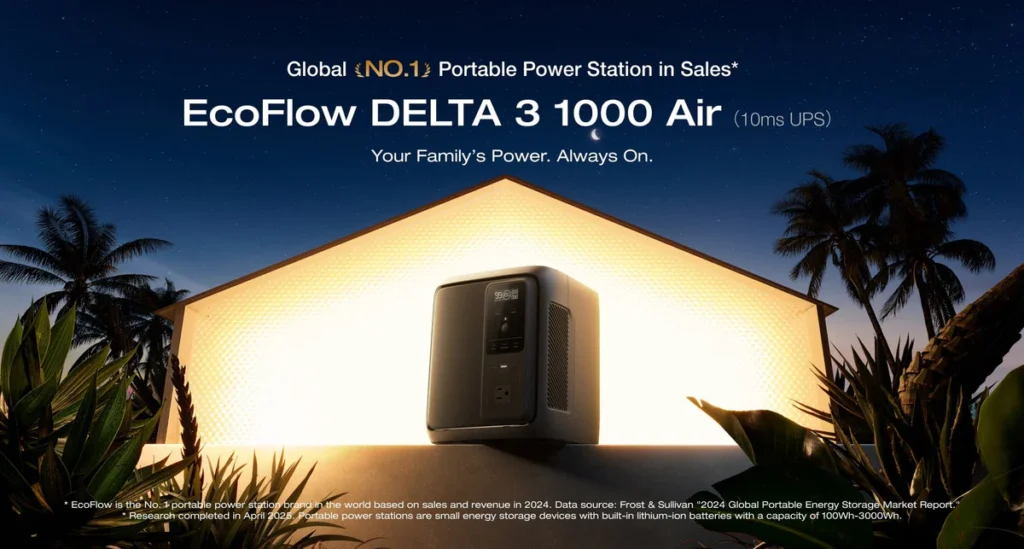
EcoFlow DELTA 3 1000 Air Review – Let’s cut through the marketing fluff. The EcoFlow DELTA 3 1000 Air is a compact, 960Wh lithium iron phosphate (LiFePO₄) portable power station designed primarily as a UPS (Uninterruptible Power Supply) and lightweight backup unit. Unlike its beefier siblings in the DELTA 3 family — like the Classic, Plus, and Max — the EcoFlow DELTA 3 Air takes a “less is more” approach.
Think of it like this: If the DELTA 3 Max is a Swiss Army knife with 47 tools, the EcoFlow DELTA 3 1000 Air is a beautifully crafted chef’s knife. It does one job — keeping your essential devices alive during outages — and it does that job exceptionally well. It strips away the bells and whistles to deliver a focused, efficient, and budget-friendly power solution.
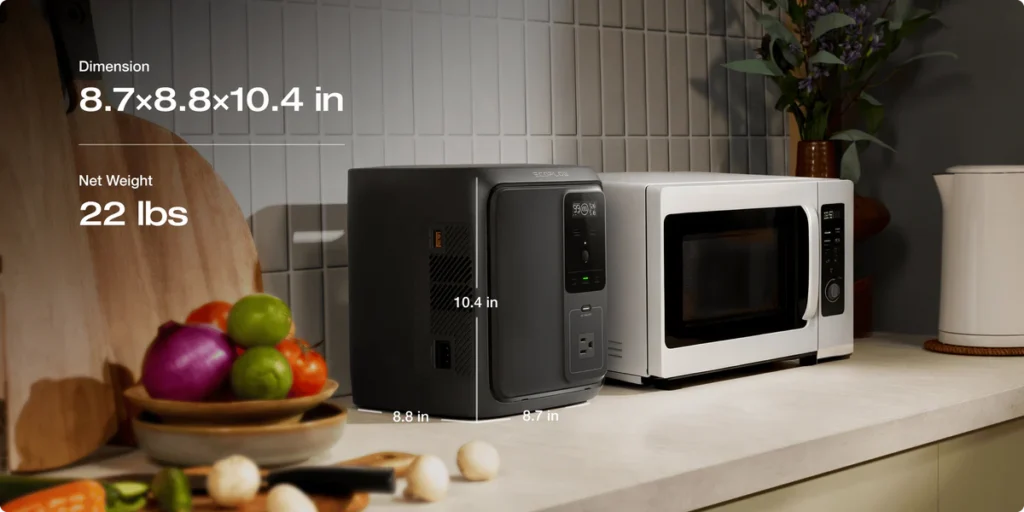
At roughly the size of a rice cooker and weighing just 22 pounds, this EcoFlow DELTA 3 Air is genuinely portable. You can lift it with one hand, tuck it under a desk, or toss it in your trunk without throwing out your back. And honestly? That’s refreshing in a market where “portable” power stations often feel like you’re lugging around a car battery.
EcoFlow DELTA 3 1000 Air Specs: The Numbers That Matter
Before we get into how this thing actually performs, let’s talk specs. Because when you’re shopping for a 960Wh LiFePO₄ battery backup, the devil is absolutely in the details.
The EcoFlow DELTA 3 1000 Air packs a 960Wh LFP battery cell — that’s the good stuff. LiFePO₄ chemistry means better thermal stability, longer cycle life, and zero risk of the scary overheating stories you sometimes hear about older lithium-ion packs. EcoFlow rates this unit for years of reliable use, and the 2-year warranty gives you some peace of mind right out of the box.
On the output side, you’re looking at 500W of continuous AC power with an 800W surge capacity. With EcoFlow’s X-Boost technology engaged, you can push certain resistive loads up to around 1000W.
Now, 500W might sound modest compared to the 1800W or 3000W monsters in EcoFlow’s lineup, but here’s the thing — most of your critical home devices don’t need that much juice. Your Wi-Fi router? Maybe 20W. Your laptop? 60W. A mini-fridge? Around 80W. The DELTA 3 1000 Air can handle all of those simultaneously without breaking a sweat.
The port selection is intentionally minimal: one 120V AC outlet, one 12W USB-A port, and one 18W USB-C port. No 12V car socket, no flood of AC plugs, no expansion battery ports. It’s a minimalist’s dream and a power user’s limitation — and we’ll unpack that tension later in this EcoFlow DELTA 3 1000 Air review.
Who Is the EcoFlow DELTA 3 1000 Air Actually For?
Here’s where we need to get real. Not every power station is for every person. The EcoFlow DELTA 3 Air isn’t trying to power your entire house during a week-long blackout. It’s not going to run your air conditioner, your electric dryer, or your welding equipment.
So who should actually buy this thing?
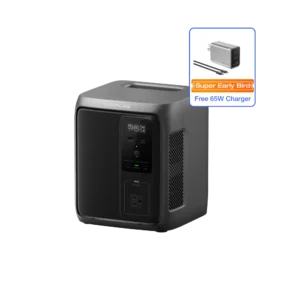
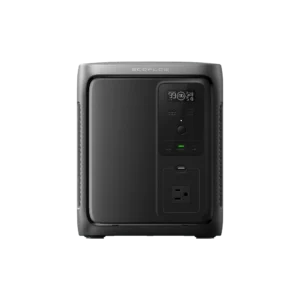
If you work from home and need a rock-solid compact UPS power station to keep your computer, monitor, and router humming through brief outages, the DELTA 3 1000 Air is practically tailor-made for you. The 10ms switchover time means your electronics won’t even hiccup when the grid goes down. That’s faster than most budget UPS units from the office supply store.
If you’re a camper or weekend warrior who wants a lightweight emergency power station that won’t take up half your vehicle, this unit shines. At 22 pounds with a built-in handle, it’s genuinely grab-and-go. You can charge it from solar panels in about two hours, which means free energy from the sun while you’re sipping coffee by the lake.
And if you live in an area with unstable grid power — maybe frequent brownouts or voltage fluctuations — the EcoFlow DELTA 3 1000 Air acts like a voltage stabiliser. It detects instability and switches to its own clean power supply automatically. That’s a feature usually reserved for units twice the price.
Real-World Performance: How Does the EcoFlow DELTA 3 Air Actually Hold Up?
Okay, enough with the brochure talk. Let’s get into the nitty-gritty of how the EcoFlow DELTA 3 1000 Air performs when you actually plug things into it.
First off, the efficiency is genuinely impressive. Independent testing puts the round-trip efficiency at around 88%. In plain English? For every 100 watts you put into this EcoFlow DELTA 3 Air portable power station, you get about 88 watts back out. That’s an A+ grade in the power station world, especially for a unit this compact.
The 10ms UPS feature works exactly as advertised. I can’t tell you how many “budget” UPS devices I’ve tested that take 20-30 ms to switch over — long enough to reboot your computer and ruin your unsaved work. The EcoFlow DELTA 3 1000 Air doesn’t have that problem. When the power cuts, you won’t even notice.
But here’s a genuinely cool trick: Even when you’re pulling the full 500W output, the unit can continue charging from the wall. Most small power stations either stop charging under load or trickle-charge so slowly that you’re just treading water.
Not the EcoFlow DELTA 3 Air. If you’re running a heavy load and plugged into AC, you can see combined input rates that actually recharge the battery while powering your gear. That’s a game-changer for areas with rolling blackouts or unstable grids.
Solar charging is another strong suit. With a 500W maximum solar input, you can fully recharge this 960Wh LiFePO₄ battery backup in roughly two hours with the right panel setup. That’s lunch-break charging territory. For off-grid cabins, van life, or just keeping your carbon footprint low, that’s a huge win.
The Good, The Bad, and The Honest: What I Love and What I Don’t
Let’s not pretend the EcoFlow DELTA 3 1000 Air is perfect. No product is. So let me break down the honest pros and cons from real-world use.
1. What I Absolutely Love
The portability is legit. At 22 pounds, this is a power station you’ll actually move around. I’ve owned “portable” units that stayed in one corner of my garage because they weighed 60+ pounds. The DELTA 3 Air lives in my home office during the week and comes camping on weekends. It actually gets used.
The whisper-quiet operation is another huge plus. At under 39 dB, it’s quieter than a normal conversation. You can run this quiet indoor backup power solution in your bedroom, your nursery, or your home office without wanting to tear your hair out. Compare that to gas generators that sound like lawnmowers and spew fumes — there’s no contest.
The input stability indicator is a small but brilliant feature. If you’re charging from a sketchy generator or travelling internationally with different voltages, the EcoFlow DELTA 3 1000 Air warns you about unstable input. That’s the kind of thoughtful engineering that prevents fried electronics and wasted money.
And let’s talk price. At around $293 (with typical discount codes), this is one of the most affordable entries into the EcoFlow ecosystem. You’re getting genuine EcoFlow build quality, app connectivity, and LiFePO4 safety at a price that undercuts most competitors.
2. What Honestly Frustrates Me
The port selection is… sparse. One AC outlet, one USB-A, one USB-C. That’s it. If you need to run a lamp, charge your phone, and power your laptop simultaneously, you’re already out of ports. The 18W USB-C is particularly underwhelming — it won’t fast-charge a modern laptop, so you’ll end up using the AC outlet with your laptop brick anyway.
The idle consumption is higher than I’d like. When the unit is on, but nothing is plugged in, it burns through about 14 watts just keeping the inverter alive. On a 960Wh battery, that means you’re losing roughly 1.5% of your capacity every hour to… nothing. Leave it on overnight, and you’ve lost a noticeable chunk of your backup power. Competitors like the Bluetti Elite series idle closer to 8 watts, which adds up over time.
And while it’s marketed as whisper-quiet, the fans do kick up when charging and discharging simultaneously. If you’re using it as a bedside UPS during an outage, that hum might bother light sleepers.
EcoFlow DELTA 3 1000 Air vs The Competition: A Head-to-Head Comparison
Let’s be honest — you’re probably comparing the EcoFlow DELTA 3 1000 Air to a few other options. Here’s how it stacks up against some popular alternatives:
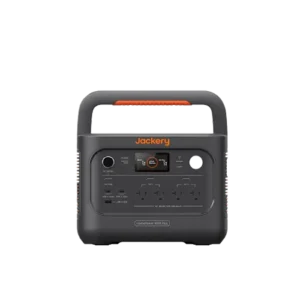
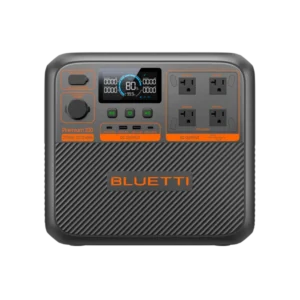
| Feature | EcoFlow DELTA 3 1000 Air | EcoFlow DELTA 3 Classic | Bluetti EB70S | Jackery Explorer 1000 |
|---|---|---|---|---|
| Battery Capacity | 960 Wh LiFePO₄ | 1,024 Wh LiFePO₄ | 716 Wh LiFePO₄ | 1,002 Wh NMC |
| AC Output | 500W (800W surge) | 1,800W (3,600W surge) | 800W (1,400W surge) | 1,000W (2,000W surge) |
| AC Outlets | 1 | 3 | 4 | 3 |
| USB-C Output | 18W | 100W | 100W | None |
| Weight | 22 lbs | 27.6 lbs | 21.4 lbs | 22 lbs |
| UPS Switchover | 10 ms | 10 ms | No | No |
| Solar Input | 500W | 500W | 200W | 200W |
| Expandable | No | No | No | No |
| Noise Level | <39 dB | <30 dB at 600 W | ~45 dB | ~45 dB |
| Typical Price | ~$293 | ~$417 | ~$499 | ~$999 |
| More Details | More Details | More Details | More Details |

So what does this table tell us? The EcoFlow DELTA 3 1000 Air sits in a unique sweet spot. It’s cheaper and lighter than the Classic but trades raw power and ports for UPS functionality and efficiency. Against the Bluetti EB70S, it offers more battery capacity and faster solar charging at a lower price — but fewer AC outlets. And compared to the Jackery Explorer 1000, it’s dramatically cheaper, uses safer LiFePO₄ chemistry, and includes true UPS functionality that Jackery lacks.
If your priority is maximum power and ports, the DELTA 3 Classic or a Jackery might serve you better. But if you want a focused, efficient, UPS-ready compact power station for home backup, the EcoFlow DELTA 3 1000 Air offers unbeatable value.
Setting Up Your EcoFlow DELTA 3 1000 Air: Easier Than Making Coffee
One of my favourite things about the EcoFlow DELTA 3 Air is the zero-hassle setup. There’s no wiring, no installation, no permits, and no contractor visits. You literally unbox it, plug it into the wall to charge, and you’re ready to go.
The EcoFlow app connects via Wi-Fi or Bluetooth and gives you basic controls — turn outputs on and off, check battery percentage, adjust charging settings, and update firmware. It’s not the most feature-rich app in EcoFlow’s lineup, but honestly, for a unit this simple, you don’t need a dashboard that looks like NASA mission control.
For UPS use, just plug the EcoFlow DELTA 3 1000 Air into your wall outlet, then plug your computer or critical device into the unit. That’s it. When the power goes out, the switchover happens in 10 milliseconds — faster than your devices can notice. When power returns, it switches back to grid power and starts recharging. It’s genuinely set-it-and-forget-it.
For the solar setup, just connect compatible solar panels to the XT60 input on the side. With up to 500W of solar input, you can recharge fully in about two hours of good sunlight. That’s fast enough that you can realistically run small devices indefinitely during a sunny day.
EcoFlow DELTA 3 1000 Air Review: As a Home Office Lifesaver
Let me paint you a picture. It’s 2 PM on a Tuesday. You’re on a Zoom call with your biggest client. Your presentation is going flawlessly. Then — click — the power dies. Your screen goes black. Your router reboots. Your client is staring at a frozen image of your nostrils.
With the EcoFlow DELTA 3 1000 Air sitting under your desk, that scenario never happens. Your computer stays on. Your router never blinks. Your client has no idea there was even a hiccup. You finish the call, close the deal, and only afterwards do you check to see that your neighbourhood is dark.
That’s the real value of this best small power station for home office use. It’s not about running your entire house. It’s about protecting the few devices that actually matter to your livelihood. And at 960Wh, it can keep a typical home office setup — laptop, monitor, router, and a desk lamp — running for 6 to 10 hours easily. That’s more than enough to ride out most outages or finish critical work.
Camping and Road Trips: Is the EcoFlow DELTA 3 Air Adventure-Ready?
Here’s where I have to be slightly honest about the limitations. The EcoFlow DELTA 3 1000 Air is compact and portable, but it’s not a hardcore outdoor power station.
The lack of a 12V car outlet means you can’t run a 12V camping fridge directly—you’d need to use the AC outlet with a fridge that has a standard plug. The absence of a built-in LED light means you’ll need a separate lantern for nighttime use. And with only one AC outlet, you’re limited in how many camp devices you can run at once.
That said, for casual camping, weekend van trips, or as a backup in your RV, it still works great. The 22-pound weight means anyone in the family can carry it. The 500W solar input lets you stay off-grid indefinitely for small devices. And the LiFePO₄ battery is safe to use inside your tent or vehicle without ventilation worries.
If you’re a hardcore overlander running multiple 12V accessories, you might want to look at the EcoFlow River 3 Plus or a more feature-rich unit. But for the average camper who just wants to charge phones, run a fan, and keep a portable cooler going? The EcoFlow DELTA 3 Air gets the job done.
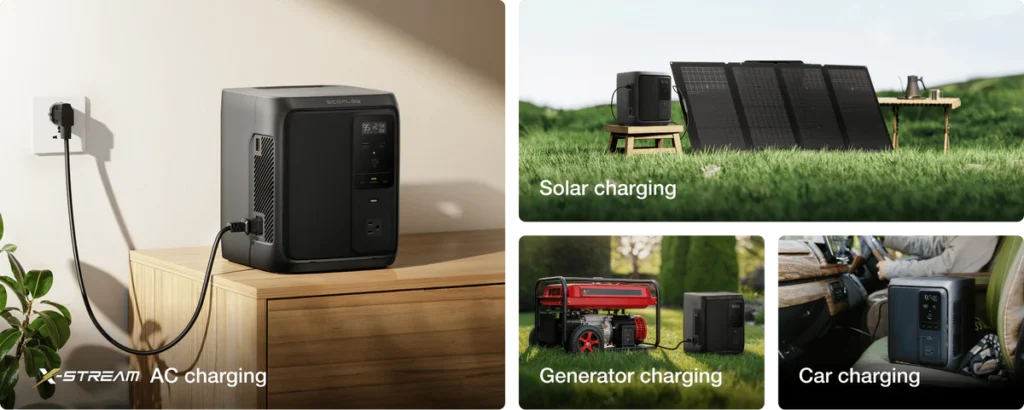
Solar Charging the EcoFlow DELTA 3 1000 Air: Free Energy, Fast
Let’s talk about one of the most exciting features of the EcoFlow DELTA 3 1000 Air — solar charging. With a maximum 500W solar input, this little unit can soak up the sun like a sponge.
In real-world conditions, that means you can fully recharge from 0 to 100% in roughly two hours with a decent solar panel array. That’s genuinely impressive. Many competing 1kWh power stations take 4 to 6 hours to recharge via solar because their input is capped at 200W.
What does this mean practically? If you’re camping, you can set up your panels in the morning, go for a hike, and come back to a fully charged power station. If you’re using it for home backup, a couple of folding solar panels on your porch can keep it topped off indefinitely during extended outages.
And because the EcoFlow DELTA 3 1000 Air uses MPPT charge controllers, it optimises solar input automatically. You don’t need to fiddle with settings or worry about partial shade ruining your charge rate. It just works.
Longevity and Safety: Built to Last a Decade?
EcoFlow claims the LiFePO₄ battery in the EcoFlow DELTA 3 1000 Air is built to last for years of regular use. While the exact cycle count isn’t always prominently advertised for this specific model, LiFePO₄ chemistry generally delivers 3,000 to 4,000 cycles before hitting 80% capacity. For a home backup unit used occasionally during outages, that could easily translate to a decade of service.
Safety-wise, the unit includes comprehensive BMS (Battery Management System) protection against overcurrent, overvoltage, overheating, and short circuits. The LFP chemistry itself is inherently safer than the NMC (nickel manganese cobalt) batteries found in older or cheaper power stations. It won’t undergo thermal runaway, it won’t catch fire if punctured, and it performs better in temperature extremes.
The 2-year warranty is decent, though some competitors now offer 5-year coverage. Still, EcoFlow’s reputation for customer support and firmware updates adds intangible value that budget brands can’t match.
The Price Question: Is the EcoFlow DELTA 3 1000 Air Worth It?
At approximately $293 with typical discount codes, the DELTA 3 1000 Air sits in a fascinating position. It’s cheaper than almost every other 1kWh power station from a major brand. It’s cheaper than the DELTA 3 Classic. It’s cheaper than the Bluetti EB70S. And it’s less than one-third the price of the Jackery Explorer 1000.
But is it worth it?
Suppose you need a true UPS for sensitive electronics, absolutely. You simply cannot find another 960Wh LiFePO₄ battery backup with 10 ms switchover at this price point. The UPS functionality alone justifies the cost for anyone working from home or running critical medical devices.
If you need a general-purpose power station with lots of ports and high output, maybe not. The limited 500W inverter and single AC outlet are real constraints. For $100 more, the DELTA 3 Classic gives you nearly 4x the output and triple the outlets.
My advice? Buy the EcoFlow DELTA 3 1000 Air for what it is — a focused, efficient, UPS-first power station — not for what it isn’t. If you go in with the right expectations, it’s one of the best values in portable power right now.
Conclusion of EcoFlow DELTA 3 1000 Air Review
So, where do we land after all this? The DELTA 3 1000 Air is a purpose-built powerhouse that knows exactly what it wants to be. It doesn’t try to please everyone. Instead, it delivers reliable, efficient, whisper-quiet backup power for your most essential devices at a price that undercuts the competition.
Is it perfect? No. The limited ports, modest USB-C output, and higher idle consumption are genuine drawbacks. But the 10ms UPS, 88% efficiency, lightning-fast solar charging, and sub-$300 price point make it a standout in the crowded portable power market.
If you’re a remote worker, a casual camper, or a homeowner looking for affordable outage protection without the noise and fumes of a gas generator, the EcoFlow DELTA 3 1000 Air deserves a serious look. It’s proof that sometimes, the best tool isn’t the one with the most features — it’s the one that does its one job flawlessly.
EcoFlow Stores
| United Kingdom | Italy | France | Spain | Germany | Canada | Australia | USA |
|---|---|---|---|---|---|---|---|
 |
 |
 |
 |
 |
 |
 |
 |
| Visit Here | Visit Here | Visit Here | Visit Here | Visit Here | Visit Here | Visit Here | Visit Here |
FAQs About EcoFlow DELTA 3 1000 Air
Yes, but with caveats. A standard full-size refrigerator requires 800-1,200W to start up, which exceeds the 500W continuous output. However, a mini-fridge or efficient compressor fridge (under 500W running) will work fine. The X-Boost feature can handle some higher startup surges, but don't expect it to power your side-by-side kitchen fridge.
It depends entirely on what you're running. A typical home office setup (laptop, monitor, router) draws around 100-150W total, giving you 6 to 9 hours of runtime. A single Wi-Fi router at 20W could run for nearly two days. Just remember that the unit consumes about 14W per hour in idle mode, so turn it off when not in use.
No, the EcoFlow DELTA 3 1000 Air is not expandable. The 960Wh capacity is fixed. If you need more storage, you'll want to look at the DELTA 3 Plus or DELTA 3 Max, which support extra battery packs up to 5kWh or more.
Yes, with caution. The AC input supports 100-240V, so it can charge from international outlets. However, the AC output is fixed at 120V/60Hz (US standard). The app allows you to manually set the expected input frequency, and the input stability indicator warns you about unstable power sources — a handy feature for international travel.
The Classic offers 1,024Wh capacity, 1,800W output, three AC outlets, 100W USB-C, and more ports overall. The EcoFlow DELTA 3 1000 Air offers 960Wh, 500W output, one AC outlet, and a focused UPS design. The Air is smaller, lighter, cheaper, and better suited for single-device backup. The Classic is a more general-purpose power station. Choose based on whether you prioritize UPS efficiency or all-around power.
You Might Also Like