


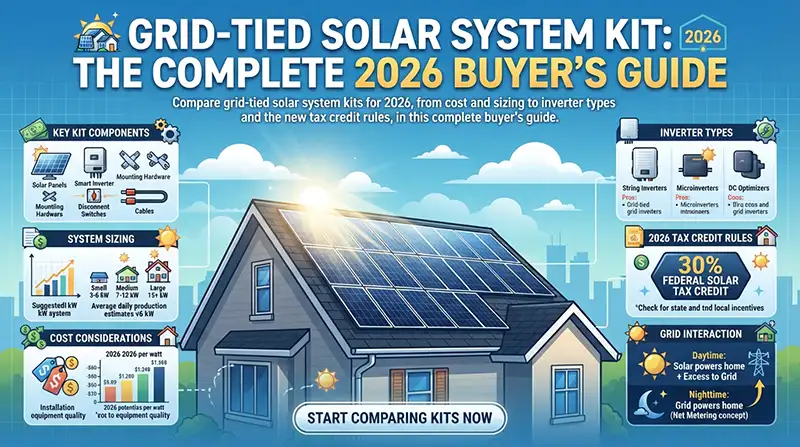
Grid-Tied Solar System Kit: The Complete 2026 Buyer’s Guide
A grid-tied solar system kit is probably the single most cost-effective way to slash your power bill without unplugging from the utility company entirely. No giant battery bank required, no complicated off-grid math, just sunshine converted into savings.
What Is a Grid-Tied Solar System Kit?
A grid-tied solar system kit is a bundled package of solar panels, an inverter, wiring, and mounting hardware designed to connect directly to your home’s existing electrical system and the public utility grid. Instead of storing energy in batteries, the kit sends any extra electricity you generate straight back into the grid, and your utility credits you for it, a setup most people call net metering.
Think of it like a checking account for electricity. You deposit power when your panels are cranking at noon, and you withdraw it at night when the sun’s clocked out. The grid is basically your free storage buddy. That’s the whole appeal of a grid-tie solar kit: simplicity plus savings, without a six-figure battery wall in your garage.
How a Grid-Tied Solar System Kit Actually Works
Picture your roof as a mini power plant. Sunlight hits the panels, gets converted into direct current (DC) electricity, and then travels to an inverter that flips it into the alternating current (AC) your appliances actually use. That AC power feeds your home first: lights, fridge, AC unit, and whatever’s left over gets pushed onto the grid.
The Two-Way Energy Exchange
This is where net metering earns its keep. During the day, your grid-tied solar kit might produce more than your house needs, so the meter literally spins backward (or, with digital meters, logs a credit). At night, when your panels are asleep, you pull power back from the grid using those credits. Some months you might owe nothing at all. It’s a two-way exchange, not a one-way donation.
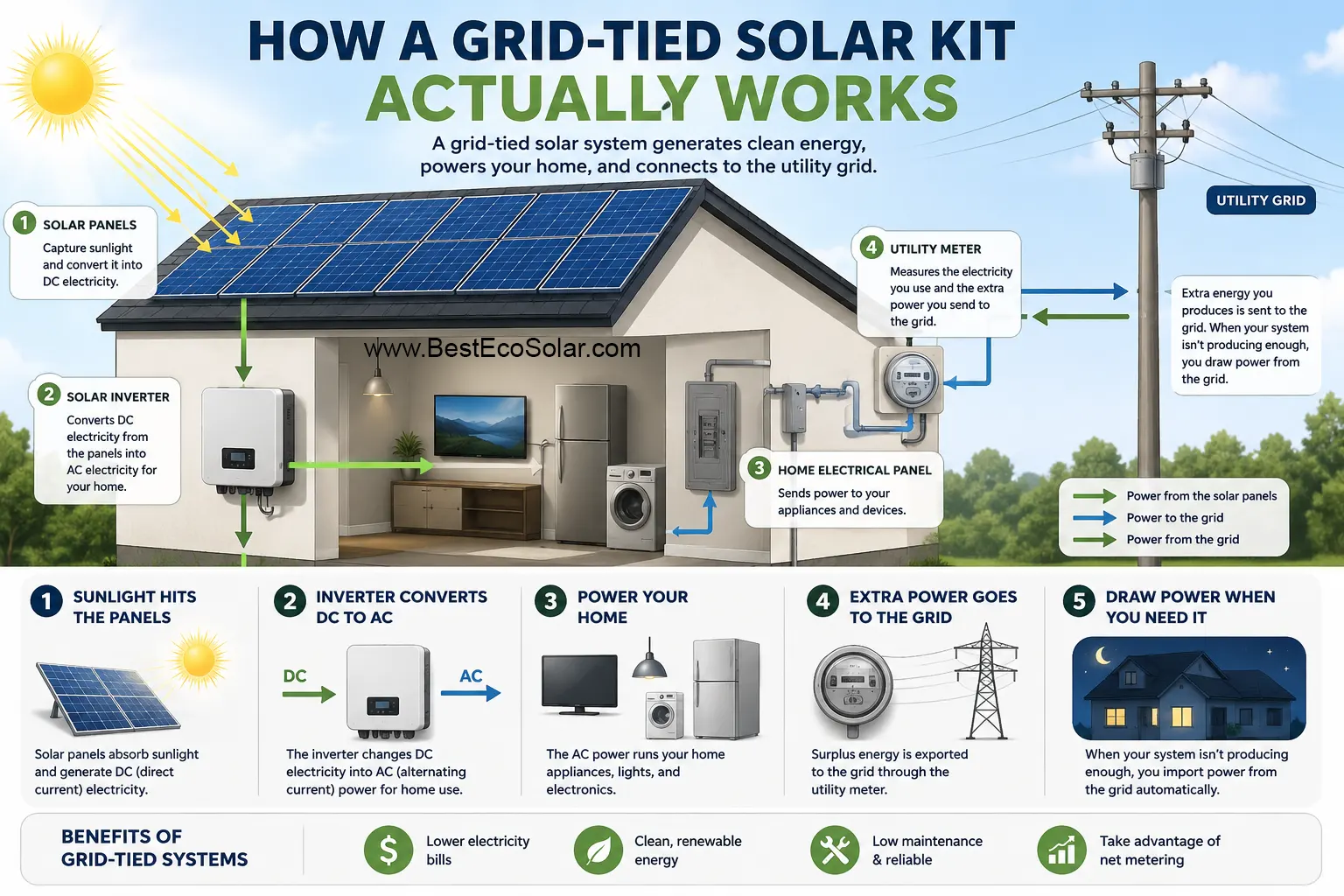
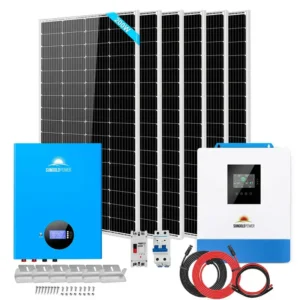
What’s Inside a Typical Grid-Tied Solar System Kit
Not all kits are created equal, but most reputable ones include the same core building blocks.
- Solar Panels
Usually monocrystalline or polycrystalline panels rated between 350W and 450W each. Higher-efficiency bifacial panels are becoming standard in newer grid-tie solar kits because they capture reflected light off rooftops too. - Grid-Tie Inverter
This is the brain of the operation. A grid-tie inverter (string inverter or microinverter) synchronizes your solar output with the grid’s voltage and frequency and automatically shuts off during outages for safety, a feature called anti-islanding. - Racking and Mounting Hardware
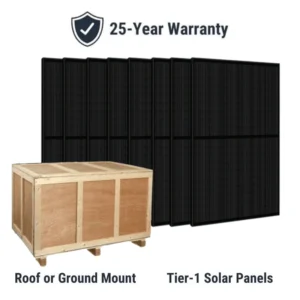
Rails, clamps, flashing, and lag bolts that anchor your grid-tied solar system kit to your roof or ground mount without turning your shingles into a leak factory. - Balance of System Components
Combiner boxes, disconnects, breakers, monitoring hardware, and the cabling that ties it all together. Cheap kits skimp here; good kits don’t.
Grid-Tied vs Off-Grid vs Hybrid Solar Kits
People confuse these three constantly, so let’s clear it up with a quick side-by-side.
| Feature | Grid-Tied Solar Kit | Off-Grid Solar Kit | Hybrid Solar Kit |
|---|---|---|---|
| Connected to the utility grid? | Yes. | No | Yes. |
| Requires battery storage? | No (optional) | Yes (mandatory) | Yes. |
| Works during a blackout? | No, unless battery-backed | Yes, always. | Yes. |
| Net metering eligible? | Yes. | No | Yes. |
| Typical upfront cost | Lowest | Highest | Medium-high |
| Best for | Homeowners on the grid wanting bill savings | Cabins, remote land, no utility access | Homes wanting savings + blackout protection |
A grid-tied solar system kit wins on price and simplicity. An off-grid kit wins on independence. A hybrid solar kit tries to have it both ways and mostly succeeds, at a higher cost.
How Much Does a Grid-Tied Solar System Kit Cost in 2026?
Pricing depends heavily on system size, but here’s a rough 2026 snapshot for a grid-tied solar system kit before labor:
- Small (3-4 kW): roughly $4,000-$6,500
- Mid-size (6-8 kW): roughly $7,500-$12,000
- Large (10 kW+): roughly $13,000-$20,000
DIY installation can shave 30-40% off the total by cutting out installer labor, though you’ll need to handle permitting, inspection, and wiring yourself (or with an electrician’s help on the interconnection).
Complete Off-Grid Solar System Package Supplier
| Name | Price Range | Discount |
|---|---|---|
| Sun Gold Power | $5,774 – $31,853.00 | 👉 Get Special Offers |
| Rich Solar | $7,999 – $21,599.99 | 👉 Get Special Offers |
| ShopSolarKits | $2,539 – $149,989.99 | 👉 Get Special Offers |
The 2026 Federal Tax Credit Reality Check
Here’s something a lot of older articles get wrong, and it matters if you’re budgeting a grid-tied solar system kit right now. The 30% federal residential solar tax credit under Section 25D officially expired on December 31, 2025, after the One Big Beautiful Bill Act moved up its sunset date by nearly a decade. If your system wasn’t placed in service (meaning your utility granted permission to operate) by that date, you no longer qualify for that federal credit in 2026.
That doesn’t mean solar stopped making financial sense; it just means the math leans more heavily on state-level incentives, SREC markets in states like Massachusetts and New Jersey, utility rebates, and straightforward electric bill savings from net metering. Commercial installations can still claim a 30% credit under Section 48E through 2027, so if you’re buying a grid-tied solar system kit for a small business, that’s still worth exploring with a tax professional.
Sizing Your Grid-Tied Solar System Kit
Guessing at system size is how people end up either overspending or under-producing. Don’t guess.
- Calculating Your Daily Usage
Pull your last 12 electric bills and average your monthly kWh usage. Divide by 30 to get your daily average. That number is your baseline target for what your grid-tied solar kit needs to produce. - Matching Panel Count to Your Roof
Once you know your daily kWh need, divide by your region’s average sun hours (typically 4-6 peak sun hours depending on where you live) to estimate the system size in kW. From there, divide by your panel’s wattage to get a rough panel count. A 7kW grid-tied solar system kit, for example, usually needs around 16-18 panels rated at 400-450W.
String Inverters vs. Microinverters for Grid-Tie Kits
This decision shapes performance more than people expect.
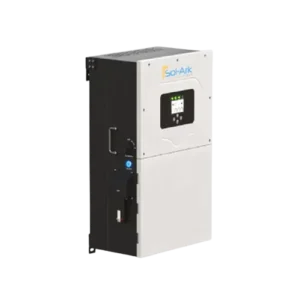
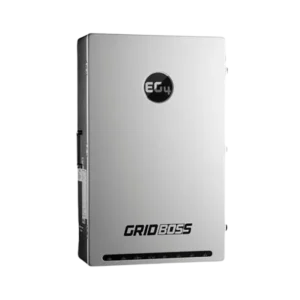
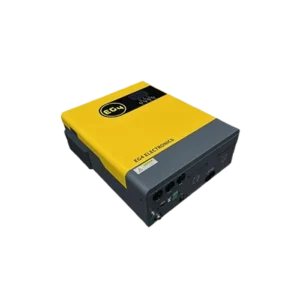
String inverters are cheaper and simpler; one inverter handles a whole “string” of panels. But if one panel gets shaded, the whole string’s output can drop, like a strand of old Christmas lights where one bad bulb dims the rest.
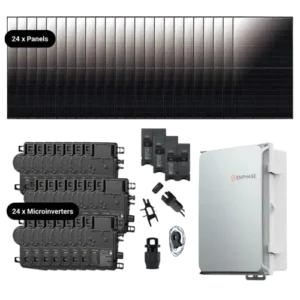
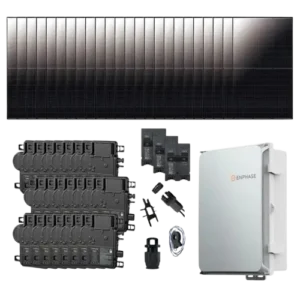
Microinverters sit on each individual panel, so shading or a hiccup on one panel doesn’t drag down the others. They cost more upfront but tend to squeeze out more total energy over the life of your grid-tied solar system kit, especially on roofs with partial shading from trees or chimneys.




DIY Installation vs. Hiring a Contractor
Can you install a grid-tied solar system kit yourself? Technically, yes, especially with permit-ready kits designed for DIY buyers. Should you? That depends on your comfort with electrical work, roof access, and local permitting offices.
DIY saves money but demands time: pulling permits, scheduling inspections, and coordinating the utility interconnection agreement. Hiring a licensed installer costs more but removes nearly all of that friction, and some installers include workmanship warranties that DIY buyers simply don’t get.
Permitting, Net Metering, and Interconnection
Every grid-tied solar system kit needs three approvals before it can legally operate: a building permit from your local jurisdiction, an interconnection agreement with your utility, and, in most states, a net metering agreement that defines how you’re credited for excess production. Skipping any of these steps isn’t just risky; it can void your warranty and delay your “permission to operate” date, which is exactly the date that matters for any remaining incentive eligibility.
Best Use Cases for a Grid-Tied Solar System Kit
A grid-tied solar system kit makes the most sense if you:
- Already have reliable utility service and just want lower bills
- Don’t need power during outages (or you’re planning to add battery backup later)
- Want the fastest payback period among all solar system types
- Live somewhere with a strong net metering policy
It makes less sense if you experience frequent blackouts and have no backup plan, since a standard grid-tie kit shuts off automatically when the grid goes down (a required safety feature, not a flaw).
Common Mistakes to Avoid When Buying a Kit
- Buying based on price alone and skipping UL-listed component certification
- Undersizing the system because you compared “average” household usage instead of your own bills
- Ignoring shading analysis and picking string inverters for a heavily shaded roof
- Forgetting to confirm your state and utility’s current net metering terms before you buy
- Assuming the 30% federal tax credit still applies to a 2026 residential purchase
How We Evaluated Grid-Tied Solar System Kits
For this guide, we compared publicly listed specs and pricing across multiple grid-tied solar system kit retailers, cross-checked component certifications (UL listings, inverter compatibility, and warranty terms), and reviewed the most current 2026 federal and state incentive guidance from tax and energy policy sources. We also weighed real installer commentary on sizing methodology and shading behavior between string and microinverter setups.
Conclusion
A grid-tied solar system kit is still, hands down, the most budget-friendly way to make real progress on your electric bill in 2026, even with the federal tax credit gone for residential buyers. The trick is sizing it correctly, picking the right inverter setup for your roof, and going in with clear eyes about permitting and net metering rules in your state. Do that homework, and a grid-tie solar kit pays for itself faster than most people expect, quietly turning your roof into one of the best investments on your property.
FAQs About Grid-Tied Solar System Kit
Yes, for most homeowners. You lose the 30% federal credit for residential purchases placed in service after 2025, but net metering savings, state incentives, and lower panel prices still make a grid-tie kit financially worthwhile over its 20-25 year lifespan.
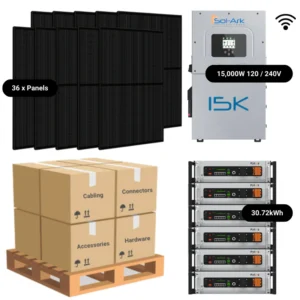
No, not by default. Standard grid-tie kits automatically shut off during outages for utility worker safety (anti-islanding). If you want backup power during a blackout, you'd need to add a hybrid inverter and battery storage.
Many kits are designed to be DIY-friendly and permit-ready, but you'll still need to pull local permits, arrange an inspection, and coordinate an interconnection agreement with your utility. Some homeowners hire a licensed electrician just for the final grid connection.
Typical payback periods range from 6 to 12 years, depending on your local electricity rates, system size, sun exposure, and available state incentives.
Most homes land somewhere between 5kW and 10kW, but the right number depends on your actual monthly kWh usage and your area's average sun hours. Pulling 12 months of utility bills is the most reliable way to size it correctly.
You Might Also Like