



Jackery Explorer 5000 Plus vs BLUETTI AC500: Which Whole-Home Power Station Actually Wins in 2026?
The Jackery Explorer 5000 Plus vs BLUETTI AC500 debate isn’t a simple “pick the bigger number” situation — these two units solve the whole-home backup problem in almost opposite ways, and picking wrong could mean spending thousands on a system that doesn’t actually fit how you live.
Jackery Explorer 5000 Plus vs BLUETTI AC500 – I’ve dug through the specs, the real owner reviews, the pricing history, and the fine print on both systems so you don’t have to. Let’s break this down like we’re chatting over coffee, not reading a spec sheet.
Quick Overview: Jackery Explorer 5000 Plus vs BLUETTI AC500
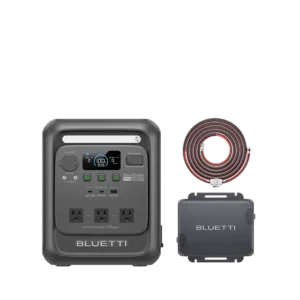
Before we get into the weeds, here’s the elevator pitch. The Jackery Explorer 5000 Plus is an all-in-one unit — battery and inverter live in the same box, and you can bolt on extra battery packs to scale from 5kWh all the way to a jaw-dropping 60kWh. The BLUETTI AC500, on the other hand, is a split system. The inverter is its own separate unit, and you buy battery modules (B300 or B300S) separately to pair with it.
Think of Jackery as a “grab it and go” solution, while Bluetti is more like building your own Lego set of power. Neither approach is wrong — it just depends on whether you want simplicity or flexibility.
What Is the Jackery Explorer 5000 Plus?
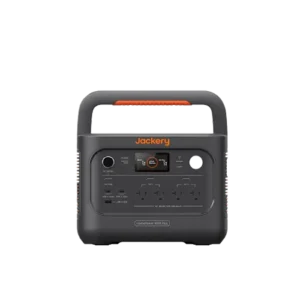
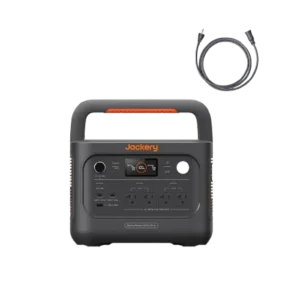
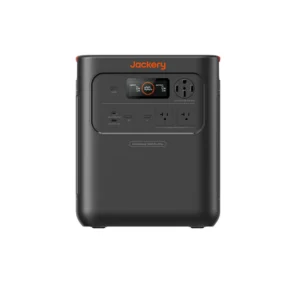
The Jackery Explorer 5000 Plus is Jackery’s flagship whole-home backup power station, and it’s built to feel less like a portable battery and more like a mini electrical panel you can wheel around. It’s designed for homeowners who’ve had enough of losing power during storms and want something that can genuinely keep the fridge, the Wi-Fi router, and a handful of other essentials running for days.
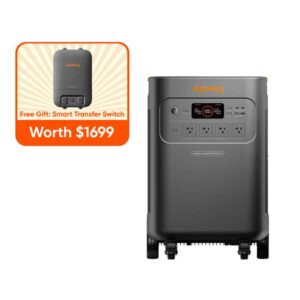
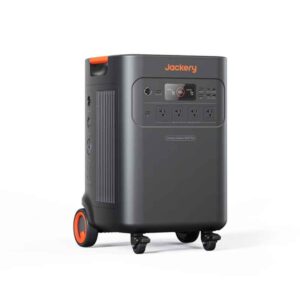
Key Specs of the Jackery Explorer 5000 Plus
Here’s what you’re actually getting in the box:
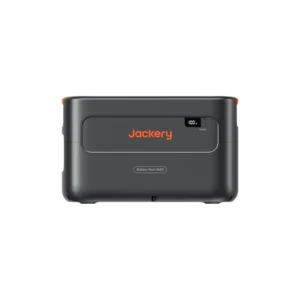
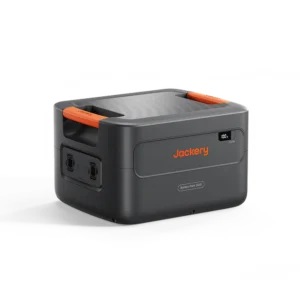
- Battery capacity: 5,040Wh (LiFePO4), expandable up to 60,000Wh with additional Battery Pack 5000 Plus units
- Continuous output: 7,200W, surging to 14,400W when two units are paired
- Solar input: up to 4,000W, which means faster recharge times on sunny days
- UPS switching: 0 milliseconds, so sensitive electronics like routers and NAS drives never even blink
- Voltage support: true dual-voltage 120V/240V operation
- Ports: 12 total, including 4x AC, 2x USB-C, 2x USB-A, 1x DC, and 3x expansion ports
- Battery lifespan: rated for over 4,000 cycles, roughly a 10-year lifespan under normal use
That 0-millisecond UPS switch is honestly one of the sneakiest good features here. Most competitors take 10 to 20 milliseconds to kick in during an outage — enough of a gap to make sensitive gear glitch or reboot. Jackery basically closes that gap entirely.
What Is the BLUETTI AC500?
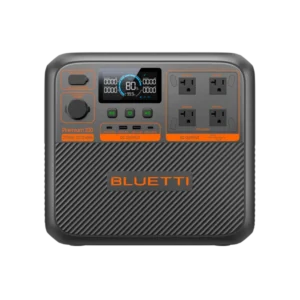
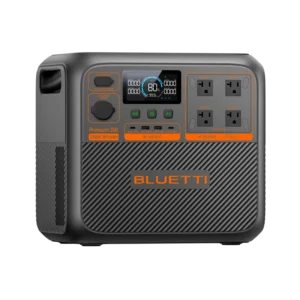
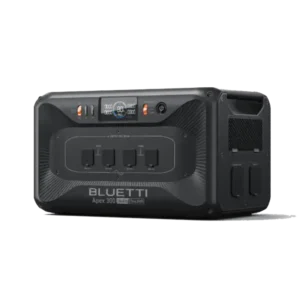
Now let’s flip to the other side of the ring. The BLUETTI AC500 takes a fundamentally different engineering approach. It’s not a battery with an inverter bolted on — it’s an inverter core, full stop. Without a battery module attached, it genuinely does nothing. That might sound like a dealbreaker, but stick with me, because this design choice is exactly what makes the AC500 so appealing to certain buyers.
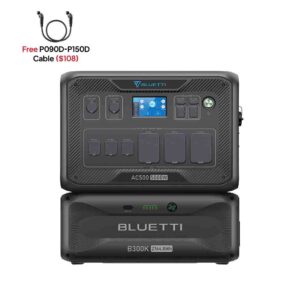
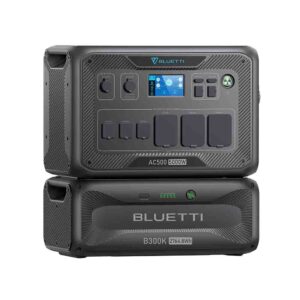
Key Specs of the BLUETTI AC500 + B300S
- Rated power: 5,000W continuous, with a 10,000W surge rating
- Solar input: up to 3,000W
- AC charging: up to 5,000W
- Battery capacity per module: 3,072Wh (B300S), expandable up to 18,432Wh with six modules, or higher with older B300 packs
- Cycle life: 3,500+ cycles to 80% capacity
- Split-phase support: pairing two AC500 units unlocks 240V output, up to 36,864Wh combined capacity
- App control: real-time monitoring, firmware updates, and remote management through the Bluetti app
The AC500’s surge rating of 10,000W actually edges out the standalone Jackery unit, which is worth knowing if you’re planning to run power tools or a well pump with a hefty startup draw.
Jackery Explorer 5000 Plus vs BLUETTI AC500: Battery Capacity Compared
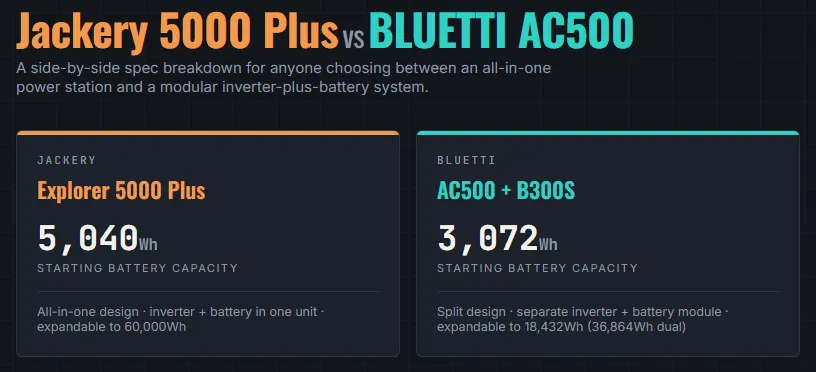
Here’s where things get interesting. Out of the box, the Jackery Explorer 5000 Plus wins with 5,040Wh versus the AC500’s starting 3,072Wh per battery module. But raw starting capacity only tells half the story.
Bluetti’s modular approach means you can mix and match battery packs depending on your budget, adding capacity gradually instead of committing to a giant purchase upfront. Jackery’s expansion units work similarly, but the starting point is already bigger, so you’re paying for more headroom from day one whether you need it yet or not.
If you’re the type who likes to “buy once, cry once,” Jackery’s bigger base capacity might feel more reassuring. If you’d rather ease into a system and expand as your needs (and budget) grow, Bluetti’s piece-by-piece structure gives you more breathing room.
Power Output and Surge Capacity Showdown
Both units are genuinely impressive on paper. The Jackery Explorer 5000 Plus pushes 7,200W continuous and 14,400W surge when two units are linked. The BLUETTI AC500 sits at 5,000W continuous with a 10,000W surge from a single unit.
Numerically, Jackery has the higher continuous ceiling. But here’s the twist: the AC500’s surge rating relative to its continuous output is proportionally stronger, which matters if your home has appliances with big startup spikes — think air conditioners, well pumps, or table saws. A rated power difference of a couple thousand watts sounds abstract until your sump pump kicks on during a flood and you need every bit of surge capacity you can get.
Solar Charging Speed: Which One Refills Faster?
If a hurricane knocks out grid power for a week, your battery is only as useful as how fast you can top it back up. This is where the Jackery Explorer 5000 Plus pulls ahead noticeably, accepting up to 4,000W of solar input compared to the BLUETTI AC500’s 3,000W ceiling.
That 1,000W gap isn’t trivial. On a clear day with a full solar array connected, Jackery could realistically recharge its battery meaningfully faster than the AC500 can. If you live somewhere prone to extended outages — wildfire season in California, hurricane season along the Gulf Coast — that faster solar refill rate could be the difference between staying powered and running dry.
Modularity and Expandability
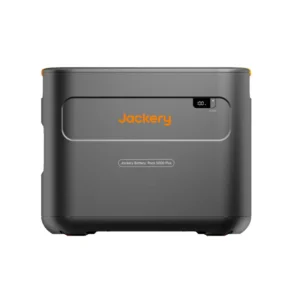
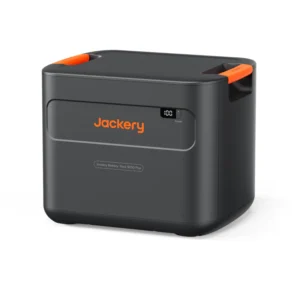
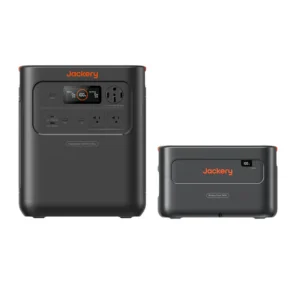
This is genuinely the heart of the Jackery Explorer 5000 Plus vs BLUETTI AC500 comparison. Jackery’s expansion strategy tops out at an eye-watering 60,000Wh, which is honestly overkill for the vast majority of households, but it exists for people who want serious multi-day, whole-property backup.
Bluetti’s AC500 system scales differently. A single inverter maxes out around 18,432Wh with six battery packs, but pairing two AC500 inverters together in a split-phase configuration nearly doubles that to 36,864Wh, while also unlocking full 240V household support.
So which is more flexible? Honestly, it depends on your endgame. Need a truly massive off-grid system with room to keep growing for years? Jackery’s ceiling is higher. Want a more modest, budget-friendly entry point that still leaves room to expand later? Bluetti lets you start smaller and add capacity as your wallet allows.
Design and Portability
Let’s be real for a second — neither of these things is “portable” in the backpacking sense. We’re talking about units designed to live in a garage or utility closet, not something you’re tossing in a hiking pack.
Weight and Footprint Considerations
The Jackery Explorer 5000 Plus is a single, self-contained unit, which actually makes installation and wiring a bit more straightforward since there’s no separate inverter box to mount or connect. The BLUETTI AC500, being a split system, means you’re managing two separate components — the inverter and the battery module — which adds installation complexity but also lets you position them independently if space is tight.
Picture it like the difference between a one-piece appliance and a stackable washer-dryer combo. One’s simpler to set up; the other lets you tuck pieces into odd corners of a room.
Smart App Control and Home Integration
Both brands offer companion apps for real-time monitoring, and both are solid, though neither is flawless. Jackery’s app pairs with its optional Smart Transfer Switch to give you circuit-level control over your home’s power during an outage — meaning you can choose exactly which circuits stay powered and which don’t, right from your phone.
Bluetti’s app similarly offers real-time input/output monitoring and firmware updates over Wi-Fi. Some users have reported occasional connectivity hiccups on both platforms, so neither company has this completely nailed down yet. If rock-solid app reliability is a dealbreaker for you, it’s worth reading recent user reviews before committing, since firmware updates roll out frequently and experiences shift over time.


Price and Value for Money
Pricing on both of these fluctuates constantly with seasonal sales, so treat any number here as a snapshot rather than gospel. As of mid-2026, the Jackery Explorer 5000 Plus standalone unit has been seen anywhere from around $2,799 during flash sales up to its $4,299 MSRP.
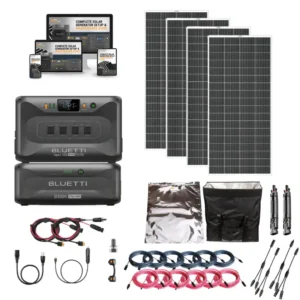
The BLUETTI AC500 inverter alone runs about $1,399, with a single B300S battery adding roughly $899 — meaning a basic bundle lands near $2,299, though promotional pricing has pushed complete AC500-plus-battery bundles as low as around $2,099 during sales events.
On pure sticker price, Bluetti’s entry point is often cheaper. But remember that the entry-level AC500 bundle gives you 3,072Wh of storage, less than Jackery’s out-of-the-box 5,040Wh. So per watt-hour, the value comparison shifts depending on how much capacity you actually need on day one.


Comparison Table: Jackery Explorer 5000 Plus vs BLUETTI AC500
| Feature | Jackery Explorer 5000 Plus | BLUETTI AC500 (+ B300S) |
|---|---|---|
| Starting battery capacity | 5,040Wh | 3,072Wh |
| Max expandable capacity | 60,000Wh | 18,432Wh (single unit) / 36,864Wh (dual, split-phase) |
| Continuous output | 7,200W | 5,000W |
| Surge output | 14,400W (dual unit) | 10,000W |
| Max solar input | 4,000W | 3,000W |
| UPS switch time | 0ms | ~20ms |
| Battery type | LiFePO4 | LiFePO4 |
| Cycle life | 4,000+ cycles | 3,500+ cycles |
| Native 240V support | Yes (single unit) | Requires 2 units |
| Design | All-in-one | Modular/split |
| Approximate starting price | ~$2,799–$4,299 | ~$2,099–$2,299 |
Real-World Use Cases
1. Best For Whole-Home Backup
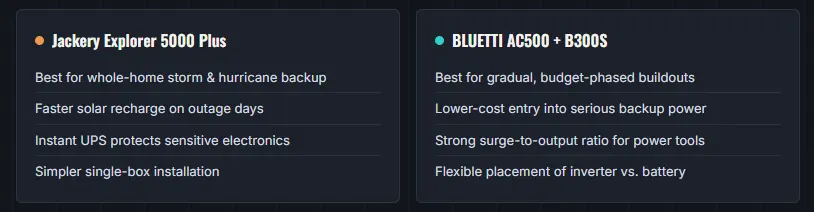
If your main goal is riding out a multi-day grid outage while keeping your fridge, freezer, medical devices, and a few essential circuits alive, the Jackery Explorer 5000 Plus feels purpose-built for that job. The bigger starting capacity, faster solar refill, and instant UPS switching all point toward “set it, forget it, trust it during a crisis.”
2. Best For Off-Grid and RV Living
For off-gridders or full-time RVers who want to build a system piece by piece — maybe starting small this year and adding a battery module next year when funds allow — the BLUETTI AC500’s modular philosophy fits that gradual, budget-conscious lifestyle better. It’s less “buy the whole system now” and more “grow into it.”
Pros and Cons of the Jackery Explorer 5000 Plus
| Pros | Cons |
|---|---|
| Massive expansion ceiling up to 60kWh | Higher upfront cost than Bluetti’s entry bundle |
| Faster 4,000W solar charging | Some users report firmware bugs and Wi-Fi instability |
| True 0-millisecond UPS switching | Large and heavy, not truly portable |
| Native 120V/240V support from a single unit | Smart Transfer Switch sold separately for full home integration |
| Higher continuous and surge output |
Pros and Cons of the BLUETTI AC500
| Pros | Cons |
|---|---|
| Lower entry price point | Inverter is useless without a separately purchased battery |
| Strong 10,000W surge rating relative to its size | Lower solar input ceiling (3,000W vs 4,000W) |
| Modular design lets you scale gradually | Requires two units for full 240V support |
| Solid cycle life rating on B300S batteries | Slower UPS switch time than Jackery |
Which One Should You Buy?
Honestly? There’s no universal winner here, and anyone who tells you otherwise is oversimplifying. If you want maximum capacity, faster solar recovery, and the peace of mind of instant UPS switching, the Jackery Explorer 5000 Plus is the stronger whole-home backup pick. If you’re working with a tighter budget and like the idea of expanding your system module by module over time, the BLUETTI AC500 gives you a more flexible, incremental path to serious backup power.
Ask yourself this: are you the type who wants one big solution installed once and never thought about again, or do you prefer building something up piece by piece as your needs evolve? That single question probably answers this comparison better than any spec sheet could.
Conclusion
Comparing the Jackery Explorer 5000 Plus vs BLUETTI AC500 really comes down to philosophy as much as specs. Jackery bets on an all-in-one design with a bigger starting battery, faster solar charging, and near-instant power switching. Bluetti bets on modularity, letting you build a system that grows alongside your budget and needs.
Both use reliable LiFePO4 battery technology, both offer serious output for whole-home backup, and both have loyal fanbases for good reason. Whichever you choose, you’re getting a genuinely capable power station — just make sure it matches how you actually plan to use it, not just how impressive the spec sheet looks on paper.
FAQs About Jackery Explorer 5000 Plus vs BLUETTI AC500
For most homeowners bracing for extended outages, the Jackery Explorer 5000 Plus tends to be the stronger pick thanks to its bigger starting capacity, faster solar recharge, and instantaneous UPS switching that keeps sensitive electronics running without interruption.
No. The AC500 is purely an inverter core, so it needs at least one B300 or B300S battery module connected to actually store and deliver power.
The Jackery Explorer 5000 Plus supports true 120V/240V output from a single unit. The BLUETTI AC500 requires pairing two units together in a split-phase setup to achieve 240V support.
Jackery's expansion units can scale the system up to 60,000Wh, though costs add up quickly at that scale. Bluetti's modular battery packs let you expand more gradually, with each B300S adding 3,072Wh at a comparatively lower incremental cost.
The Jackery Explorer 5000 Plus accepts up to 4,000W of solar input, compared to the BLUETTI AC500's 3,000W ceiling, giving Jackery a notable edge in recharge speed under full sun.
You Might Also Like